

Spartacus Blog
The JFK Assassination and the link with other political conspiracies: 1963-2026
The assassination of John F. Kennedy in 1963 was organised and carried out by a combination of CIA officers and anti-Castro Cubans. If this had become known at the time that the CIA had removed the elected president of the United States, citizens would rightly have doubted they were living in a democracy. This is the kind of thing that happens in Africa and South America and not in a country that claims the "leadership of the free world".
Since 1963 the Deep State (CIA, FBI, political leaders of the Democrats and Republicans, mainstream media, etc.), has been busy covering up the truth of the assassination. Once you start this process you must continue it, even if it means killing those in a position to reveal the truth. On other occasions they have destroyed the reputation of those politicians who want another investigation into the assassination. Therefore, the JFK assassination has led to a series of other political conspiracies. This continues to the present day. So much so that it has become the political culture of the United States to cover-up crimes carried out by the wealthy elite. That is why the Jeffrey Epstein case is related to the JFK assassination. It is the same Deep State that is protecting these people. It has become more easier in recent years as the wealthy elite who have taken over control of the Democrat and Republican parties.
Why were the CIA and the anti-Castro Cubans so angry with JFK that they felt the need to kill the president? It has been claimed by senior figures in the CIA that they wanted JFK to be elected as president in 1960. They were frustrated that Dwight Eisenhower and Richard Nixon had refused to order an invasion of Cuba. The Kennedy family had a long tradition of being extremely hostile to communism and during the second TV presidential debate on 7 October 1960, JFK attacked Nixon for being a member of an administration that had failed to deal with the threat posed by Fidel Castro. (1)
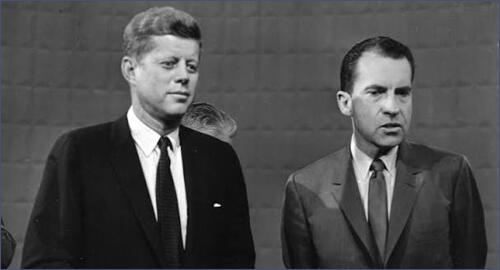
Of course, JFK's relationship with the CIA deteriorated after the Bay of Pigs fiasco. However, it was what was taking place in 1963 that senior figures in the CIA decided that JFK had to die. William Attwood was a long-term friend of JFK. He also held progressive political views. During the 1960 presidential campaign Attwood was employed as a speech writer for JFK. In 1961, Kennedy appointed him as ambassador to Guinea and in 1963 he served with the U.S. delegation to the United Nations. In this post Attwood was the leading advocate inside the Kennedy Administration for talking to Fidel Castro about the potential for improving relations. He was supported by McGeorge Bundy, who suggested to Kennedy and the National Security Council that there should be a "gradual development of some form of accommodation with Castro". (2)
In April 1963 Lisa Howard arrived in Cuba to make a documentary on the country. In an interview with Howard, Castro agreed that a rapprochement with Washington was desirable. On her return Howard met with the Central Intelligence Agency. Deputy Director Richard Helms reported to President John F. Kennedy on Howard's view that "Fidel Castro is looking for a way to reach a rapprochement with the United States." After detailing her observations about Castro's political power, disagreements with his colleagues and Soviet troops in Cuba, the memo concluded that "Howard definitely wants to impress the U.S. Government with two facts: Castro is ready to discuss rapprochement and she herself is ready to discuss it with him if asked to do so by the US Government." (3)
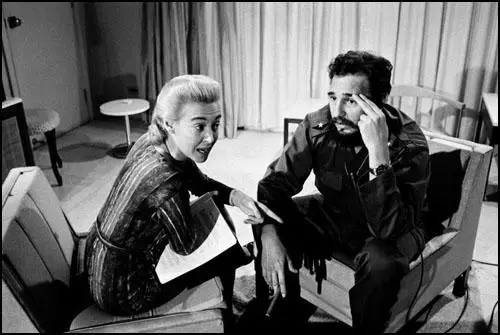
CIA Director John McCone was strongly opposed to Howard being involved with these negotiations with Fidel Castro and the Cuban government. He argued that it might "leak and compromise a number of CIA operations against Castro". According to James W. Douglas, the author of JFK and the Unspeakable: Why He Died and Why It Matters (2008) "the CIA wanted to block the door that could be seen opening through Howard's interview". (4) In a memorandum to McGeorge Bundy, McCone commented that the "Lisa Howard report be handled in the most limited and sensitive manner," and "that no active steps be taken on the rapprochement matter at this time." (5)
Arthur Schlesinger explained to Anthony Summers in 1978 why the CIA did not want President Kennedy to negotiate with Fidel Castro during the summer of 1963. He pointed out that the head of the CIA's Cuba unit, Desmond FitzGerald, masquerading as an American Senator, had told Rolando Cubela that a coup against Castro would have the full backing of the United States Government: "The CIA was reviving the assassination plots at the very time President Kennedy was considering the possibility of normalization of relations with Cuba - an extraordinary action. If it was not total incompetence - which in the case of the CIA cannot be excluded - it was a studied attempt to subvert national policy." (6)
Howard now decided to bypass the CIA and in May, 1963, published an article in the journal, War and Peace Report, Howard wrote that in eight hours of private conversations Castro had shown that he had a strong desire for negotiations with the United States: "In our conversations he made it quite clear that he was ready to discuss: the Soviet personnel and military hardware on Cuban soil; compensation for expropriated American lands and investments; the question of Cuba as a base for Communist subversion throughout the Hemisphere." Howard went on to urge the Kennedy administration to "send an American government official on a quiet mission to Havana to hear what Castro has to say." A country as powerful as the United States, she concluded, "has nothing to lose at a bargaining table with Fidel Castro." (7)
William Attwood read Howard's article the first week of September, 1963. He later wrote: "I read ABC correspondent, Lisa Howard’s article, Castro’s Overture, based on her conversation with Castro last April. This article stressed Castro’s expressed desire for reaching an accommodation with the United States and a willingness to make substantial concessions to this end. On September 12, I talked with Miss Howard, whom I have known for some years, and she echoed Ambassador Diallo’s opinion that there was a rift between Castro and the Guevara-Hart-Alveida group on the question of Cuba’s future course." (8)
Lisa Howard arranged a meeting between William Attwood and Carlos Lechuga, Cuba's representative to the United Nations. "On September 23, I (Attwood) met Dr. Lechuga at Miss Howard’s apartment. She has been on good terms with Lechuga since her visit with Castro and invited him for a drink to meet some friends who had also been to Cuba. I was just one of those friends. In the course of our conversation, which started with recollections of my own talks with Castro in 1959, I mentioned having read Miss Howard’s article. Lechuga hinted that Castro was indeed in a mood to talk. I told him that in my present position, I would need official authorization to make such a trip, and did not know if it would be forthcoming. However, I said an exchange of views might well be useful and that I would find out and let him know." (9)
At his meeting with Robert Kennedy on the 24 September 1963, Attwood explained his proposal for talks with Castro: "He said my going to Cuba, as Lechuga had mentioned, was too risky - it was bound to leak - and if nothing came of it the Republicans would call it appeasement and demand a congressional investigation. But he thought the matter was worth pursuing at the U.N. and perhaps even with Castro some place outside Cuba. He said he'd consult with Harriman and McGeorge Bundy." (10)
On 27 September, Attwood met Lechuga in the U.N. Delegates' Lounge "always a good place for discreet encounters because of its noise and confusion" and told him that he had "discussed our talk in Washington" but admitted it would be difficult for him, in his present capacity as a government official, to accept an invitation to Cuba. However, he had been told by Kennedy that he had authorization to talk to anyone who came to Washington from Havana. Lechuga said he would pass the message to Castro. He also warned Attwood that he was making a tough anti-American speech on 7th October, but he should tell Kennedy not to take it too seriously." (11)
Carlos Lechuga later explained: "Kennedy speaking through McGeorge Bundy said there should be an agenda for dialogue with Cuba. Of course, I sent all the information of these conversations with Attwood to Havana. In Havana, the responses were delayed. According to Attwood's perception, the responses were very slow. He wanted to accelerate the process somewhat. Havana was moving too slowly. And at this moment, without his knowledge, Lisa Howard called Cuba and spoke with Comandante Vallejo, who was the assistant to Fidel Castro, to accelerate the process. She had known him in Cuba before. To try to take advantage of her friendship with him, in order to try to get a quicker response from the Cubans." (12)
Attwood decided to use an old friend, Jean Daniel, the editor of the French socialist news-weekly L'Observateur, as a go-between. Attwood had lunch with Daniel on 3rd October, and told him about his talks with Lechuga. Attwood asked Ben Bradlee to arrange a meeting between Daniel and the president. This took place on 24th October. Kennedy blamed the pro-Batista policy in the fifties for "economic colonization, humiliation and exploitation" and added, "We'll have to pay for those sins." Kennedy told Daniel: "The continuation of our economic blockade depends on his continuation of subversive activities." Daniel wrote later: "I could see plainly that John Kennedy had doubts (about the government's policy on Cuba) and was seeking a way out." (13)
At the same time as Attwood was attempting to organize talks between Kennedy and Castro, the CIA was continuing with the AM/WORLD project. On 29th October, 1963, Desmond FitzGerald, the CIA official who had replaced William King Harvey as the agency's chief Cuba man, traveled to Paris to meet Rolando Cubela (code name AM/LASH). FitzGerald, posing as a U.S. Senator representing Attorney General Robert Kennedy, gave Cubela a poison pen device from the CIA's Operation Division of the Office of Medical Services: "a ball-point rigged with a hypodermic needle... designed to be so fine that the victim would not notice its insertion." (14)
Meanwhile, Castro's personal aide, Major René Vallejo, had become involved in the proposed negotiations. He phoned Lisa Howard on 29th October, and assured her that Castro was as eager as he had been during her visit in April to improve relations with the United States, but it was impossible for Castro to leave Cuba at that time to go to the UN or elsewhere for talks with a Kennedy representative. Howard replied that there was now a U.S. official authorized to listen to Castro. On 31st October Vallejo phoned Howard again saying "Castro would very much like to talk to the U.S. official anytime and appreciated the importance of discretion to all concerned." James W. Douglas has pointed out the phrase "to all concerned" was significant. "At this point Castro, like Kennedy and Khrushchev, was circumventing his own more bellicose government in order to talk with the enemy. Castro, too, was struggling to transcend his Cold War ideology for the sake of peace. Like Kennedy and Khrushchev, he had to walk softly." (15)
On 12th November, 1963, McGeorge Bundy recorded: "I talked this afternoon with William Attwood and told him that at the President's instruction I was conveying this message orally and not by cable... He (Kennedy) would prefer to begin with a visit by Vallego to the U.S. where Attwood would be glad to see him and to listen to any messages he might bring from Castro. In particular we would be interested in knowing whether there was any prospect of important modification in those parts of Castro's policy which are flatly unacceptable to us: namely, the points in Ambassador Stevenson's recent speech of which the central elements are (i) submission to external Communist influence, and (ii) a determined campaign of subversion directed at the rest of the Hemisphere." (16)
On 18 November 1963, Kennedy gave a speech where he covered the situation in Cuba and appeared to be a message to Castro. He said that "a small band of conspirators" had made "Cuba a victim of foreign imperialism, an instrument of the policy of others, a weapon in an effort dictated by external powers to subvert the other American Republics. This, and this alone, divides us. As long as this is true, nothing is possible. Without it, everything is possible. Once this barrier is removed, we will be ready and anxious to work with the Cuban people in pursuit of those progressive goals which a few short years ago stirred their hopes and the sympathy of many people throughout the hemisphere." (17)
Jean Daniel arrived in Cuba at the beginning of November. His first attempts to meet with Castro ended in failure. He was told that he was very busy and had no desire to talk to Western journalists. On 19th November, Castro suddenly turned up at Daniel's hotel. He had been informed that Daniel had met Kennedy on 24th October and was eager to learn the details of their conversation. "Castro knew from the secret Attwood-Lechuga meetings that Kennedy was reaching out to him. In fact even as Daniel was trying to see Castro, Castro had been trying to firm up negotiations with Kennedy through Lisa Howard and William Attwood." (18)
Daniel later recalled: "Fidel listened with devouring and passionate interest... Three times he had me repeat certain remarks, particularly those in which Kennedy showed his impatience with the comments attributed to General de Galle, and lastly those in which Kennedy accused Fidel of having almost caused a war fatal to all humanity." Castro told Daniel: "I haven't forgotten that Kennedy centered his electoral campaign against Nixon on the theme of firmness toward Cuba... But I feel that he inherited a difficult situation; I don't think a President of the United States is ever really free, and I believe he now understands the extent to which he has been misled, especially, for example, on Cuban reaction at the time of the attempted Bay of Pigs invasion... I know that for Khrushchev, Kennedy is a man you can talk with. I have gotten this impression from all my conversations with Khrushchev." (19)
On 22 November 1963, a "CIA official was meeting with a Cuban agent in Paris and giving him an assassination device for use against Castro". Once again, he said he was acting in the name of the Attorney General, Robert Kennedy. (20)
William Attwood says there is no evidence that Kennedy knew about this. "And indeed, what motive would either of them have in plotting the death of someone they were planning to communicate with?" (21) James W. Douglas, agrees and has suggested that by hiring Rolando Cubela in the name of "Robert Kennedy to assassinate Castro laid the foundation for the repeated claim that Castro, to pre-empt the threat on his own life, ordered JFK's murder - and that RFK had therefore triggered his own brother's assassination." (22)
Later that day Daniel met Castro again in his summer home on Varadero Beach. At 1:30 pm the phone rang. It was President Osvaldo Dorticós Torrado with news that Kennedy had been shot. When he hung up the phone, Castro repeated three times, "This is bad news". Soon afterwards a second phone call said that Kennedy was still alive and could be saved. Castro replied that "if they can, he is already re-elected." Just before 2:00 pm, news came that Kennedy was dead. Castro stood up, looked at Daniel, and said, "Everything is changed. Everything is going to change." (23)
The Assassination of Robert F. Kennedy: The Cover-Up
President John F. Kennedy, greatly influenced by the Cuban Missile Crisis, an event the nearly led to a nuclear war, was attempting to negotiate an end to the Cold War. This posed a great threat to the CIA, and organisation that had been formed in 1947 to combat the growth of communism. McCarthyism in the 1950s had convinced politicians that it was necessary to provide the CIA with all the funds they needed to deal with the communist threat. Although the CIA would have survived if the Cold War came to an end as they would have discovered another serious threat to America, its importance and funding, would be reduced.
Robert F. Kennedy knew immediately that it was probably the CIA who was responsible for the death of his brother. One of the first people RFK telephoned after the assassination was John McCone, the director of the CIA, , and told him to come to his house. They spent three hours together talking about what had taken place. Kennedy later told a friend: "You, know, at the time I asked McCone... if they (the CIA) had killed my brother, and I asked him in a way that he couldn't lie to me, and they hadn't." (24)
McCone, like Kennedy, was a devout Catholic, and therefore he accepted the fact that he did not know anything about the people responsible for the death of his brother. However, that did not mean that the CIA was not behind the assassination. On the evening of the assassination, Kennedy spoke to Enrique (Harry) Ruiz-Williams, a Bay of Pigs veteran who was his closest associate in the Cuban exile community. Kennedy shocked his friend by telling him, "One of your guys did it." The journalist, Haynes Johnson, was with Ruiz-Williams at the time later recalled: "Harry stood there with the phone in his hand and then he told me what Bobby said... It was a shocking thing. I'll never forget, Harry got this look on his face. After he hung up, Harry told me what Bobby had said." (25)
As David Talbot pointed out: "When Bobby Kennedy told his comrade-in-arms Harry Ruiz-Williams, 'One of your guys did it,' he might as well have been saying, 'One of our guys did it' or even 'One of my guys did it'. Bobby was saying that his brother had been killed by someone in his own anti-Castro operation... He was supposed to know where the darkness fell, and how to keep his brother safe from it. His brother's death was his fault - this is certainly another wound that his brother's killers aimed to inflict. For they knew it would not be enough to assassinate the president - they would have to find a way to stop his avenging brother from coming after them as well, to hobble him with guilt and doubt." (26)
Kennedy's biographer, Evan Thomas, explained that he developed a "private bond" with Williams. (27) Kennedy claimed that Williams was "very brave and had very good judgment". (28) Former FBI agent William Turner wrote that "Harry Williams was a Kennedy kind of man, tough and liberal and ferociously anti-communist". (29) A Kennedy aide confirmed to Turner that in 1963 "the CIA was "running a kind of program against Castro" and that "Harry Williams would drop by whenever he was in Washington to meet with CIA agents." (30)
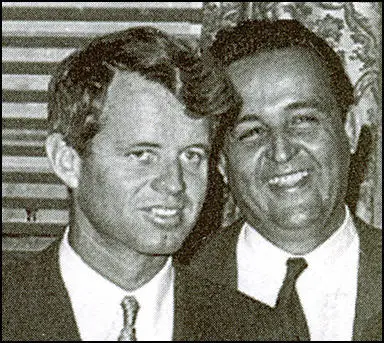
In the weeks that followed Robert F. Kennedy was able to discover the origins if not the actual names of those involved in the assassination. RFK then told the rest of the family but explained he could not reveal in to the public and would go along with the cover-up. The story was so terrible that it would severely damage the reputation of John F. Kennedy and would make it impossible for him and his brother Edward from ever becoming president. As Talbot explains: "In true Kennedy fashion, he wanted to control any investigation of the crime - not only to ensure its authenticity, but to prevent any damage to his brother's legacy and his own political future. Bobby knew that if the Kennedy administration's secret war against Castro - a war that he was supposed to be overseeing - was revealed as the source of the plot against his brother, the family's image could be badly tarnished." (31)
When I was in San Francisco in 2005, I was told by someone who had interviewed a senior member of the Kennedy family that RFK held a meeting about the assassination of JFK. He told family members that he knew the CIA and anti-Castro Cubans had been responsible for the assassination of JFK. However, he was unable to go public with this information because the people involved were part of the CIA's Operation Mongoose, an illegal plan to kill Fidel Castro. An operation that he had given permission to take place. If he revealed what he knew he would never become president. (In 1963, unlike today, it was considered immoral to give instructions to assassinate a foreign political leader). RFK's plan was to become President in 1968 where he would reopen the investigation into the assassination of JFK. RFK told Peter Lawford, the husband of his sister, Patricia Helen Kennedy, that he thought JFK had been killed by a powerful plot that grew out of one of the government's secret anti-Castro operations. "Bobby reportedly told Lawford and other family members that there was nothing he could do at that point, since they were facing a formidable enemy and they no longer controlled the government." (32)
The Warren Report, managed by Lyndon Baines Johnson, was the official means of covering-up the identities of those who planned and carried out the assassinations. For long-term political reasons, RFK, said publicly he didn't believe there was a conspiracy, hadn't and wouldn't read the Warren Commission report, but had been briefed on it, and agreed with the Commission that Lee Harvey Oswald "was solely responsible." However, according to his son, Robert F. Kennedy Jr., who was 9 years old when his uncle was assassinated but had been told about what RFK had said at the family meeting, said that his father was "convinced" others were involved. (33)
The Warren Report was not the most important part of the cover-up. After all it was not published until 27 September 1964. Far more important was the way that the mainstream media reported on the assassination. Journalists who had doubts about Oswald being the lone gunman, could not get their articles published in the mainstream press. Cedric Belfrage, an important figure in the early research in the case, managed to persuade the small left-wing journal, the National Guardian, to publish the material. Writers who wanted to question the guilt of Oswald, for example, Thomas G. Buchanan (Who Killed Kennedy?) and Joachim Joesten (Oswald, Assassin or Fall Guy?) could not find a publisher in America and had to go to Europe to get them published in 1964. Interestingly, Belfrage, Buchanan and Joesten were all accused of being communists because they questioned the official story.
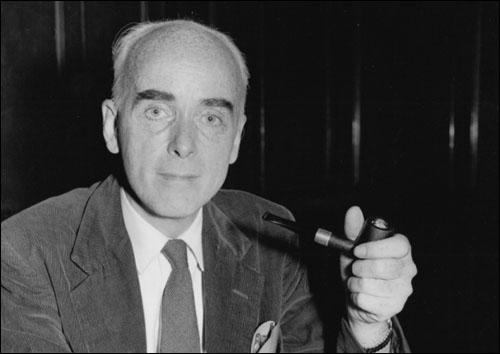
A few people began to ask questions about the relationship between politicians, the intelligence services and the media. This was especially true of the journal The Minority of One Magazine, whose board of sponsors included Bertrand Russel, Albert Schweitzer and Linus Pauling. Contributors to the magazine included Mark Lane, Sylvia Meagher and Vincent Salandria.
Was there a Deep State that was keeping the truth from the American people? As M. S. Arnoni pointed out in 1966: "There are in our midst exceptional people... journalists and writers, amateur and professional, who have been making no less than heroic efforts to unravel the answers to how, who and what - for John F. Kennedy was felled… to them belongs the praise of future generations." (34)
Despite the The Warren Report and the mainstream media constantly saying that Oswald was the only person responsible, the American public rejected this view. Gallup first asked Americans about culpability in Kennedy's assassination immediately after the event and found a slim 52% majority believed there was "some group or element" other than the gunman involved, while 29% thought he acted on his own and 19% were unsure. After the publication of the Warren Report 36% said it was the work of one man, half thought others were involved, and 15% did not know. By the early 1970s over 80% of those polled by Gallup believed that "some group or element" other than the gunman was involved in the assassination. (35)
The Assassination of Martin Luther King Jr
The ruling elite learnt an important lesson from the JFK assassination and its consequent cover-up. They had successfully removed a president who wanted to bring an end to the Cold War. They had changed the direction of history and used the powers of the Deep State to make sure that no one was held responsible for the assassination. If they could do that to Kennedy, they would probably take out any other political figure who was able to motivate large numbers of people to demand a more equal society.
In 1968 the most important political leader who was threatening the status quo was Martin Luther King Jr. The FBI was especially concerned by his increasing radicalism. King had started his political career as being an opponent of racism. However, he was now making speeches about foreign policy and poverty. For example, King announced the Poor People's Campaign on 4 December 4, 1967, during a press conference in Atlanta, Georgia. King travelled the country to assemble "a multiracial army of the poor" that would march on Washington to engage in nonviolent civil disobedience at the Capitol until Congress created an "economic bill of rights". (36)
King and the SCLC called on the government to invest in rebuilding America's cities. He felt that Congress had shown "hostility to the poor" by spending "military funds with alacrity and generosity". He contrasted this with the situation faced by poor Americans, claiming that Congress had merely provided "poverty funds with miserliness". His vision was for change that was more revolutionary than mere reform: he cited systematic flaws of "racism, poverty, militarism and materialism", and argued that "reconstruction of society itself is the real issue to be faced." (37)
King also began making speeches against the Vietnam War. In January 1968, King called for a large march on Washington against "one of history's most cruel and senseless wars" He went onto argue: "We need to make clear in this political year, to congressmen on both sides of the aisle and to the president of the United States, that we will no longer tolerate, we will no longer vote for men who continue to see the killings of Vietnamese and Americans as the best way of advancing the goals of freedom and self-determination in Southeast Asia." (38)
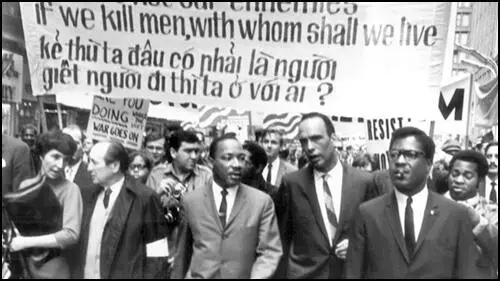
It was while on a visit to Memphis, Tennessee, in support of the black sanitation workers, who had been on strike since 12 March for higher wages and better treatment, that King was assassinated on 4 April 1968. James Earl Ray was eventually arrested in London. He confessed to killing King on 10 March 1969, though he recanted this three days later. Then, for the next three decades, he maintained that he had been ''set up,'' used as an errand boy and decoy by shadowy conspirators who included a mystery man he knew only as Raoul. Ray's lawyers maintained he was a scapegoat like Lee Harvey Oswald. King's widow, Coretta Scott King, and the rest of the family believed that Ray was innocent, and thought agents of the Deep State were responsible. (39)
The Assassination of Robert J. Kennedy
The Deep State also had the problem of Robert J. Kennedy attempting to become the Democratic Party presidential candidate. On 16 March 1968 Kennedy announced his candidacy after a meeting with left-wing trade union leader and civil rights activist César Chávez. He said, "I do not run for the presidency merely to oppose any man, but to propose new policies. I run because I am convinced that this country is on a perilous course and because I have such strong feelings about what must be done, and I feel that I'm obliged to do all I can." (40)
Robert Kennedy scored major victories when he won both the California and South Dakota primaries on June 4. It now looked likely that he would become the Democrat candidate that would take on Richard Nixon for the presidency. If victorious he could initiate a detailed investigation of his brother's death. That was not to be as RFK was assassinated on 6 June 1968 by Sirhan Sirhan, a 24-year-old Palestinian. (41)
Ted Kennedy explained at his brother's funeral why he had been assassinated: "My brother need not be idealized or enlarged in death beyond what he was in life; to be remembered simply as a good and decent man, who saw wrong and tried to right it, saw suffering and tried to heal it, saw war and tried to stop it. Those of us who loved him and who take him to his rest today, pray that what he was to us and what he wished for others will someday come to pass for all the world. As he said many times, in many parts of this nation, to those he touched and who sought to touch him." (42) He ended with a quotation from the socialist campaigner, George Bernard Shaw: "Some men see things as they are and say why. I dream things that never were and say why not." (43)
Ted Kennedy and Chappaquiddick
The torch was now passed to the youngest brother, Ted Kennedy. He was expected to be the Democratic candidate in the 1972 presidential election. However, this time they rejected the idea of a lone-gunman killer because the fourth man to be killed in this way might be even too difficult for Operation Mockingbird to deal with successfully. This time they were going to embroil him in a political scandal that would stop him from ever becoming president.
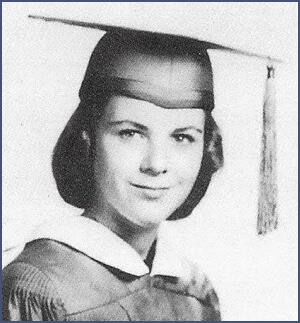
On 18th July 1969, several women who worked for Ted Kennedy travelled across to Chappaquiddick Island for a party at Lawrence Cottage. Kennedy and Mary Jo Kopechne left the party at 11.15pm. Kennedy had offered to take Kopechne back to her hotel. Kennedy later explained what happened: "I was unfamiliar with the road and turned onto Dyke Road instead of bearing left on Main Street. After proceeding for approximately a half mile on Dyke Road I descended a hill and came upon a narrow bridge. The car went off the side of the bridge.... The car turned over and sank into the water and landed with the roof resting on the bottom. I attempted to open the door and window of the car but have no recollection of how I got out of the car. I came to the surface and then repeatedly dove down to the car in an attempt to see if the passenger was still in the car. I was unsuccessful in the attempt." (44)
At the inquest Judge James Boyle raised doubts about Kennedy's testimony. He pointed out that as Kennedy had a good knowledge of Chappaquiddick Island, he could not understand how he managed to drive down Dyke Road by mistake. For example, on the day of the accident, Kennedy had twice driven on Dyke Road to go to the beach for a swim. To get to Dyke Road involved a 90-degree turn off a metalled road onto the rough, bumpy dirt-track. (45)
An investigation at the scene of the accident by Raymond R. McHenry, suggested that Kennedy approached the bridge at an estimated 34 miles (55 kilometres) per hour. At around 5 metres (17 feet) from the bridge, Kennedy braked violently. This locked the front wheels. According to McHenry: "The car skidded 5 metres (17 feet) along the road, 8 metres (25 feet) up the humpback bridge, jumped a 14 centimetre barrier, somersaulted through the air for about 10 metres (35 feet) into the water and landed upside-down." (46)
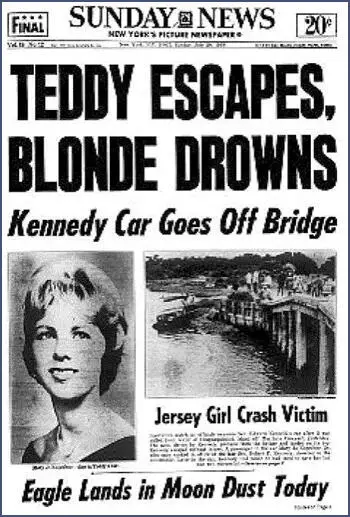
Investigators found it difficult to understand why he was crossing Dyke Bridge when he said he was attempting to reach Edgartown which was in the opposite direction. They also could not understand why he was driving so fast on this unlit, uneven, road. They also could not work out how Kennedy escaped from the car. When it was recovered from the water all the doors were locked. Three of the windows were either open or smashed in. If Kennedy, a large-framed 6 foot 2 inches tall man could manage to get out of the car, why was it impossible for Mary Jo Kopechne, a slender 5 foot 2 inches tall, not do the same? (47)
It seems to me that Richard E. Sprague gives the best explanation of what happened that night. "The Power Control Group faced up to the Ted Kennedy and Kennedy family problem very early. They used the threat against the Kennedy children's lives very effectively between 1963 and 1968 to silence Bobby and the rest of the family and friends who knew the truth. When Teddy began making moves to run for president in 1969 for the 1972 election, the Group decided to put some real action behind their threats. Killing Teddy in 1969 would have been too much. They selected a new way of eliminating him as a candidate. They framed him with the death of a young girl and threw sexual overtones in for good measure."
Sprague goes onto argue: "The Group hired several men and at least one woman to be at Chappaquiddick during the weekend of the yacht race and the planned party on the island. They ambushed Ted and Mary Jo after they left the cottage and knocked Ted out with blows to his head and body. They took the unconscious or semi-conscious Kennedy to Martha's Vineyard and deposited him in his hotel room. Another group took Mary Jo to the bridge in Ted's car, force fed her with a knockout potion of alcoholic beverage, placed her in the back seat, and caused the car to accelerate off the side of the bridge into the water. They broke the windows on one side of the car to insure the entry of water; then they watched the car until they were sure Mary Jo would not escape. Mary Jo actually regained consciousness and pushed her way to the top of the car (which was actually the bottom of the car - it had landed on its roof) and died from asphyxiation."
The men guarding Kennedy in his hotel room "revived him early in the morning and let him know he had a problem. Possibly they told him that Mary Jo had been kidnapped. They told him his children would be killed if he told anyone what had happened and that he would hear from them. On Chappaquiddick, the other group made contact with Markham and Gargan, Ted's cousin and lawyer. They told both men that Mary Jo was at the bottom of the river and that Ted would have to make up a story about it, not revealing the existence of the group." Kennedy probably thought that the story he made up would be believed by the American people. Some did but even so, his behaviour was completely unacceptable and his chances of becoming president was over. (48)
The Watergate Scandal
I also believe the Watergate Scandal is also connected to the JFK assassination. Richard Nixon was told that the Bay of Pigs operation held the key to understanding the assassination of John F. Kennedy. It has been suggested that Nixon was given this information about the CIA involvement in the Kennedy assassination by William C. Sullivan, "Nixon's highest-ranking loyal friend at the FBI". Sullivan was put in charge of the bureau's in-house investigation of the assassination. Sullivan was expected to work closely with John M. Whitten, who was running the CIA investigation of Lee Harvey Oswald. Whitten and his staff of 30 officers were sent a large amount of information from the FBI. According to Gerald D. McKnight "the FBI deluged his branch with thousands of reports containing bits and fragments of witness testimony that required laborious and time-consuming name checks." Whitten later described most of this FBI material as "weirdo stuff". As a result of this initial investigation, Whitten told Richard Helms that he believed that Oswald had acted alone in the assassination of Kennedy. However, on 6th December, Nicholas Katzenbach invited Whitten and Birch O'Neal, Angleton's trusted deputy and senior Special Investigative Group (SIG) officer to read Commission Document 1 (CD1), the report that the FBI had written on Oswald. Whitten now realized that the FBI had been withholding important information on Oswald from him. He also discovered that Richard Helms had not been providing him all the agency's available files on Oswald. This included Oswald's political activities in the months preceding the assassination. (49)
Nixon told his key aides H. R. Haldeman and John Ehrlichman about this and said he would use this information to exert pressure on the CIA during his time as president. Haldeman claims in his book The Ends of Power (1978): "Ehrlichman had found himself in the middle of this feud as far back as 1969, immediately after Nixon assumed office. Nixon had called Ehrlichman into his office and said he wanted all the facts and documents the CIA had on the Bay of Pigs, a complete report on the whole project. About six months after that 1969 conversations, Ehrlichman had stopped in my office. 'Those bastards in Langley are holding back something. They just dig in their heels and say the President can't have it. Period. Imagine that! The Commander-in-Chief wants to see a document relating to a military operation, and the spooks say he can't have it.'" (50)
In his memoirs Richard Nixon has very little to say about the assassination. He admits he was in Dallas on 20th November 1963 at a meeting of the Pepsi-Cola board). Nixon said he contacted J. Edgar Hoover as soon as he heard the news: "He came right on the line and without wasting words I asked, 'What happened? Was it one of those right-wing nuts?' Hoover replied: 'No', he replied, 'it was a Communist.' it was a Communist.' Months later Hoover told me that Oswald's wife had disclosed that Oswald had been planning to kill me when I visited Dallas and that only with great difficulty had she managed to keep him in the house to prevent him from doing so." (51)
Haldeman says that he had always been interested in the assassination of John F. Kennedy and asked Nixon to reopen the case soon after he entered the White House "but Nixon turned me down". Haldeman says that "after Kennedy was killed, the CIA, launched a fantastic cover-up. Many of the facts about Oswald unavoidably pointed to a Cuban connection." Haldeman suggested that this included: "(i) Oswald had been arrested in New Orleans in August 1963, while distributing pro-Castro pamphlets. (ii) On a New Orleans radio programme he extolled Cuba and defended Castro. (iii) Less than two months before the assassination Oswald visited the Cuban consulate in Mexico City and tried to obtain a visa." Haldeman says that when Nixon mentions the "Bay of Pigs" he might have "been reminding Helms" of the "CIA operation that may have triggered the Kennedy tragedy and which Helms desperately wanted to hide." (52)
Although he had his own secret intelligence operation (Operation Sandwedge) Nixon still wanted to get more control over the intelligence services. In 1970 Nixon commissioned one of his aide's Tom Charles Huston, one of the former leaders of the conservative Young Americans for Freedom, to write a report on how the different agencies could work together against the threat from the "New Left". Huston's 43-page document called for six activities, some of which were clearly illegal. They included electronic surveillance of persons and groups "who pose a major threat to internal security"; monitoring of American citizens by international communications facilities; the relaxation of restrictions on the covert opening of mail by federal agents; surreptitious entries and burglaries to gain information on the groups and the recruitment of more campus informants. The most controversial aspect of the recommendations was the creation of a new interagency intelligence command responsible for internal security.. (53)
The Huston Plan was presented at a meeting with J. Edgar Hoover (FBI), Richard Helms (CIA), Lieutenant General Donald V. Bennett (Defense Intelligence Agency) and Noel Gayler (National Security Agency) in early 1970. Hoover and Helms saw this as an attempt by Nixon to gain more control over their agencies. In his memoirs Nixon argued that "Hoover's dissent... was primarily a case of his inability to overcome his natural resistance to cooperating with the CIA or the other intelligence agencies... I knew that if Hoover had decided not to cooperate, it would matter little what I decided or approved... On July 28 (1970), five days later, before the plan could be implemented, I withdrew my approval." (54)
Although he had officially abandoned his plan to introduce a new intelligence organisation that would have more power than the FBI and the CIA. Helms did not trust Nixon not to resurrect this plan in the future, especially if he won the 1972 presidential election. Therefore, like Kennedy before him, Nixon would have to be removed from office.
On 17th June, 1972, Frank Sturgis, Virgilio Gonzalez, Eugenio Martinez, Bernard L. Barker and James W. McCord were arrested at 2.30 am during a break-in at the Watergate Office Building. Later, E. Howard Hunt and Gordon Liddy were also arrested. John Dean, counsel to the president, reported to H. R. Haldeman that the FBI believed that the Watergate break-in was a CIA operation: "The FBI is convinced its the CIA. McCord and the Cubans are all ex-CIA people. Practically everyone who went in there was connected to the agency. And now the FBI finds a Mexican bank involved which also sounds like the CIA." Dean added that L. Patrick Gray (acting FBI director) was "looking for a way out of this mess" and suggested that he should ask Vernon Walters (Deputy Director of CIA) to "turn off" the investigation in Mexico. (55)
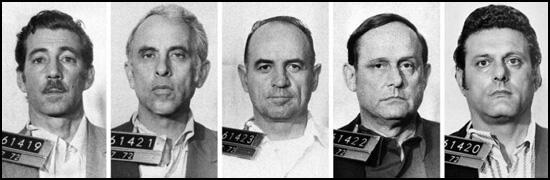
After hearing this news E. Howard Hunt telephoned his lawyer, Douglas Caddy. According to Caddy: "Hunt arrived around 3:40 A.M. and informed me what had happened at Watergate. Five burglars had been arrested inside the DNC. He and Liddy had escaped because they were in a room in the adjacent Watergate Hotel and had been alerted by former FBI agent Alfred Baldwin whom McCord had stationed across the street in the Howard Johnson Hotel…. Only Robert Scott, a former Assistant U.S. Attorney, was in town…. When I telephoned Scott he said, "They must have been set up. They must have been set up." After I informed Hunt what Scott had said, he told me that in addition to representing him he wanted me also to represent the five arrested burglars. He then used my telephone to call Liddy who also asked me to represent him." (56)
Hunt was not the only one to be connected to the CIA. James W. McCord became a CIA agent in 1951 and retired from the agency in 1970. Bernard L. Barker worked as an assistant to the Chief of Police under Fulgencio Batista in Cuba. Later he was recruited by the CIA. After the revolution Barker and his family moved to Miami (January 1960). Barker became a significant figure in the Cuban exile community. He remained a CIA agent and worked under the direction of Frank Bender. Frank Sturgis had been an agent since 1958. Sturgis was also a member of Operation 40 and had been involved in the attempts to assassinate Fidel Castro. Virgilio Gonzalez and Eugenio Martinez were both active in the Cuban Anti-Castro movement and in June 1963 had taken part in Operation Tilt, an attempt to undermine the Cuban government. (57)
John Dean, counsel to the president, reported to H. R. Haldeman that the FBI believed that the Watergate break-in was a CIA operation: "The FBI is convinced that the CIA. McCord and the Cubans are all ex-CIA people. Practically everyone who went in there was connected to the agency. And now the FBI finds a Mexican bank involved which also sounds like the CIA." Dean added that L. Patrick Gray (acting FBI director) was "looking for a way out of this mess" and suggested that he should ask Vernon Walters (Deputy Director of CIA) to "turn off" the investigation in Mexico. (58)
Dean contacted Jack Caulfield to discover what had happened. He confirmed that G. Gordon Liddy and E. Howard Hunt had been involved in the operation. Jeb Magruder, special assistant to the president, then rang Dean on behalf of John N. Mitchell, the Attorney General. "Listen, John, this is all that dumb... Liddy's fault. He blew it. The stupid bastard. He should have never used McCord. He never told us he was using McCord. It was stupid. The mess is all his fault." When Dean contacted Liddy he admitted organizing the break-in but claimed that E. Howard Hunt "was the guy who got me the Cubans." (59)
Dean managed to persuade Gray, the acting FBI director, to take part in the cover up by destroying documents in Hunt's White House safe. This included notebooks that Hunt had used as an operational diary during his CIA years. "These reportedly contained the names of CIA agents and officers, their telephone numbers, code words and operational details that collectively amounted to a diary of E. Howard Hunt's clandestine career" and details of CIA's illegal activities during the presidency of John F. Kennedy. (60)
Douglas Caddy was asked to represent Gordon Liddy, the mastermind behind the Watergate break-in: He later recalled: "At Liddy's request I met with him in the office of the law firm on Saturday, June 24, a week after the arrests. Upon arrival he immediately gave me a one-dollar bill which he said was to cement the attorney-client relationship. I then said to him, ‘Gordon, who dreamed up this thing? It is mind boggling.' He looked me in the eye and proudly replied ‘I did.' Then he switched his eyes to look out my office window that was above Connecticut Avenue not far from the White House, and proudly exclaimed, ‘This is the biggest criminal case of the century.' What struck me about his utterances was there no showing of remorse. Quite the opposite. He was jubilant and exhilarated and on an emotional happy high. His eyes glistened as if in anticipation of something only he knew." (61)
Liddy's comments "This is the biggest criminal case of the century" seemed strange at the time because the Watergate break-in got very little press coverage, and it seemed that the CIA plot to bring down Nixon had failed. This changed when Ben Bradlee (a CIA asset), the editor of the Washington Post, agreed that Bob Woodward and Carl Bernstein should be put on the story. There has been some speculation about why Woodward was given the job. Before becoming a journalist, Woodward worked for naval intelligence under Admiral Thomas Moorer. Woodward left the service in 1970 and began his career in journalism on the Montgomery County Sentinel. The following year he joined the Washington Pos. Fellow journalists were surprised that he was appointed, and some speculated it was because of his intelligence contacts. (62)
If it had not been for the reporting of Woodward and Bernstein, Nixon would not have been forced to resign. Woodward involvement is the case is worth commenting on. The Watergate burglars first appeared in court for their arraignment on Saturday, June 17, 1972, just hours after their early-morning arrest. The only journalist in the courtroom was Bob Woodward. Had he been tipped off by someone that something interesting might be said that morning. Another person there was Doug Caddy. He was a close friend of E. Howard Hunt who had asked him to represent the burglars in court.
During the court hearing James W. McCord was asked by the judge about his current employment. He replied that he was a security consultant and then went on to say he had previously worked for the CIA. As soon as Woodward heard this, he knew he had an interesting news story. Why had McCord revealed this information? Is it possible that Woodward had been told by someone in the CIA that he was going to give that information that morning? (63)
Most of the vital information came from Woodward via his secret sources. Woodward later revealed that on 19 June 1972 he telephoned a man who he called "an old friend" for information about the burglars. This man, who Woodward claims was a high-ranking federal employee, was willing to help him if he was never named as a source. Instead, he became known as Deep Throat. (64)
Most of the information that brought down Nixon came from Deep Throat. Woodward and Bernstein refused to identify their source but in May 2005 a lawyer working for Mark Felt, the former Associate Director of the FBI, told Vanity Fair magazine that his client was Deep Throat. On 3rd June 2005, Bob Woodward wrote an article in The Guardian confirming that Felt was Deep Throat and that he had provided him with important information during the Watergate investigation. (65)
Ben Bradlee, the editor of the Washington Post at the time, also said that Felt was Deep Throat. However, Carl Bernstein was quick to add that Felt was only one of several important sources. David Obst, the former literary agent for Woodward and Bernstein, has long contended that Deep Throat was a composite of several anonymous sources. "Mark Felt was an invaluable source to The Washington Post and to Woodward and Bernstein, but he was not Deep Throat -- there was no Deep Throat." Obst said it defied credibility to suggest that such a high-ranking FB official would take the time and energy required to discuss information to Woodward in the ways the book described, like marking up a newspaper on Mr. Woodward's doorstep to signal his desire for a meeting. (66)
Bernstein is clearly right about this. Some of the information leaked to the journalists could only have come from someone in the higher echelons of the CIA. Whereas other information came from people working at the White House. Deborah Davis, the author of Katharine the Great (1979) suggested that Deep Throat was a former senior official of the CIA. Her candidate was Richard Ober, who worked under James Jesus Angleton at the CIA. Nixon wanted better intelligence on "revolutionary activism". The result was Operation Chaos (domestic espionage project targeting the American people from 1967 to 1974 whose mission was to uncover possible foreign influence on domestic race, anti-war and other protest movements). Ober was given an office in the White House and therefore was able to spy on Nixon. (67)
In her book Davis wrote about Operation Mockingbird. Her claims became even more convincing when the book was originally published in 1979, Katharine Graham (probably under instructions from the CIA) persuaded the publishers William Jovanovich, to pulp the 20,000 printed copies of the book. It was not only revealing Ober as one of Bob Woodward and Carl Bernstein sources that got her into trouble. It was also the fact that she exposed Ben Bradlee as a CIA asset as far back as 1952 when he was serving as a press attaché in the American embassy in Paris. (68) Bradlee was also a childhood friend of Richard Helms and was at Harvard with Ober. Both men left in 1944 to serve in the war: Ober (Office of Strategic Services) and Bradlee (Office of Naval Intelligence). (69)
In his autobiography Richard Helms said he was puzzled by Nixon's belief that the CIA, the Bay of Pigs Operation and the Assassination of John F. Kennedy were in some way connected. (70) It must be remembered that Nixon first made this claim in 1969, three years before Watergate. It was a time when few JFK researchers were making this link. This only became mainstream conspiracy thinking after the publication of The Last Investigation in 1993. The book's author, Gaeton Fonzi, the staff investigator with the House Select Committee on Assassinations, pointed out, this was not just about recruiting angry Cubans from the failed operation, but the way Kennedy reacted to the disaster by threatening to "splinter" the CIA into "a thousand pieces and scatter it to the winds". (71)
In my view Watergate was a "setup" with the intention to remove Richard Nixon from office. If this was the case it was an elaborate operation. Russ Baker has argued: "If, as it appears, Watergate was indeed a setup, it was a fairly elaborate covert operation, with three parts: 1) creating the crime, 2) implicating Nixon by making him appear to be knowledgeable and complicit in a cover-up, and 3) ensuring that an aggressive effort would be mounted to use the 'facts' of the case to prosecute Nixon and force him from office." Baker claims that all those who played an important role in the downfall of Nixon had CIA connections - John Dean, E. Howard Hunt, Frank Sturgis, Virgilio Gonzalez, Eugenio Martinez, Bernard L. Barker, James W. McCord, Alexander P. Butterfield, Jeb Magruder and Leon Jaworski. (72)
There are two important questions that need to be asked about the Watergate break-in. The first is what were the motives behind the crime. As Richard Helms later pointed out in his autobiography: "Press reports soon indicated that Hunt and McCord and their confederates were attempting to photograph files, bug the telephones, and arrange electronic monitoring of the Democratic Committee. I could not understand why anyone would think there was anything to be gained from such a half-baked and technically difficult operation that would possibly warrant the risks involved." (73)
Richard Nixon had similar thoughts when he first read about the Watergate burglary in the Miami Herald while vacationing in Florida: "It sounded preposterous. Cubans in surgical gloves bugging the DNC! I dismissed it as some sort of prank... The whole thing made so little sense. Why, I wondered. Why then? Why in such a blundering way... Anyone who knew anything about politics would know that a national committee headquarters was a useless place to go for inside information on a presidential campaign. The whole thing was so senseless and bungled that it almost looked like some kind of a set-up." (74)
Helms and Nixon are right; the operation does not make any sense at all. The second question is even more important. Why was it done so badly? The operation involved several people who had successfully carried out other intelligence operations. It was also in direct contrast to other Nixon dirty tricks campaigns. Why did the burglars leave so many clues behind that made it inevitable that they would be caught and at the same time provide links to the Nixon administration? Why did James W. McCord at the preliminary hearing confess to being a former member of the CIA. Woodward and Bernstein admitted that this is the main reason why they decided that this was an important story. (75)
Carl Bernstein obviously learned a lot working with Woodward. In October 1977 he published an article, CIA and the Media in the Rolling Stone Magazine. Bernstein claimed that "Joseph Alsop is one of more than 400 American journalists who in the past twenty-five years have secretly carried out assignments for the Central Intelligence Agency, according to documents on file at CIA headquarters." Bernstein goes on to name several of these journalists. However, he did not mention Ben Bradlee and Bob Woodward and others working for the Washington Post . This is not surprising as he was still working for the newspaper at the time. (76)
Frank Church
Frank Church was one of the first senators to publicly oppose the Vietnam War in the 1960s and was the co-author of two legislative efforts to curtail the war: the Cooper–Church Amendment of 1970, and the Case–Church Amendment of 1973. Church argued that the opponents of the Vietnam War needed to prevent the corruption of the nation and its institutions. To Church, the anti-war opposition was the "highest concept of patriotism - which is not the patriotism of conformity - but the patriotism of Senator Carl Schurz, a dissenter from an earlier period, who proclaimed: 'Our country right or wrong. When right, to be kept right: when wrong, to be put right'." (77)
In 1975 Church was appointed chairman of the U.S. Senate Select Committee to Study Governmental Operations with Respect to Intelligence Activities. For the next two years the committee conducted extensive hearings investigating extra-legal FBI and CIA intelligence-gathering and covert operations. The committee investigated CIA drug smuggling activities in the Golden Triangle and secret U.S. backed wars in Third World countries and the overthrow of democratically elected governments. Church argued that as a result of his investigation: "I know the capacity that is there to make tyranny total in America, and we must see to it that this agency and all agencies that possess this technology operate within the law and under proper supervision, so that we never cross over that abyss. That is the abyss from which there is no return." (78)
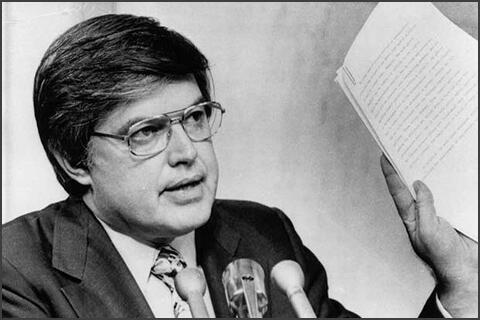
After holding 126 full committee meetings, 40 subcommittee hearings, interviewing some 800 witnesses in public and closed sessions, and combing through 110,000 documents, the committee published its final report in April 1976. "Intelligence agencies have undermined the constitutional rights of citizens," the report concluded, "primarily because checks and balances designed by the framers of the Constitution to assure accountability have not been applied." (79)
The final report included 96 recommendations, legislative and regulatory, designed "to place intelligence activities within the constitutional scheme for controlling government power." The committee observed that "there is no inherent constitutional authority for the President or any intelligence agency to violate the law," and recommended strengthening oversight of intelligence activities. In May 1977 Ted Kennedy introduced it into Congress and President Jimmy Carter signed it into law the Foreign Intelligence Surveillance Act (FISA) in October 1978. (80)
It was later revealed that Frank Church had been one of the targets of a secret operation code-named Project Minaret, the National Security Agency (NSA) monitored the communications of politicians, journalists and athletes, who criticized the U.S. war in Vietnam. The Minaret program had been established by Lyndon Baines Johnson in 1967. Matthew Aid, an intelligence historian, has pointed out that while Church was chairman of U.S. Senate Select Committee to Study Governmental Operations with Respect to Intelligence Activities that he had no idea that "the NSA was tapping his phone." A review by NSA of the Minaret program concluded that Minaret was "disreputable if not outright illegal." (81)
Some of this material was no doubt used to remove Frank Church from power. In 1979 the "Anybody but Church" (ABC) committee, created by the National Conservative Political Action Committee (NCPAC), was formed. The ABC and NCPAC had no formal connection with the 1980 Senate campaign of conservative Republican congressman Steve Symms, which permitted them, under former Federal election law, to spend as much as they could raise to defeat Church. He lost his bid for a fifth term to Symms by less than one percent of the vote. (82)
Jimmy Carter
President Jimmy Carter also intended to clean up the CIA. He put them under pressure on the CIA when he nominated Ted Sorensen, a key figure in the Kennedy administration, as director of the agency. This was withdrawn when it was pointed out that he had been a conscientious objector and there had been allegations of him mishandling classified documents. Carter then nominated Admiral Stansfield Turner as director. Turner promised at his Senate confirmation hearing to conduct intelligence operations "strictly in accordance with the law and American values." (83)
President Carter wanted reforms of the CIA, whose reputation was discredited because of the Frank Church committee such as spying on citizens, the antiwar movement and other dissident groups in the United States, and international assassination plots. Turner sought to revamp the Agency in several ways. He first appointing several high-ranking naval officers, known as the "Navy mafia" to the CIa. In October 1977, Turner eliminated over 800 operational positions, most of them in the clandestine service, in what was dubbed the Halloween Massacre. (84)
Frank Church's committee also discovered that the Central Intelligence Agency and Federal Bureau of Investigation had sent anonymous letters attacking the political beliefs of targets to induce their employers to fire them. Similar letters were sent to spouses to destroy marriages. The committee also documented criminal break-ins, the theft of membership lists and misinformation campaigns aimed at provoking violent attacks against targeted individuals. One of those people targeted was Martin Luther King. The FBI mailed King a tape recording made from microphones hidden in hotel rooms. The tape was accompanied by a note suggesting that the recording would be released to the public unless King committed suicide. (85)
In September 1975, a subcommittee under Richard Schweiker was asked to investigate the performance of the intelligence agencies concerning the assassination of John F. Kennedy. It was reported in the The New York Times that "Senator Richard S. Schweiker predicted today that the Warren Commission report on President Kennedy's assassination was about to collapse and said his subcommittee on intelligence was looking into three conspiracy theories. Senator Schweiker, Republican of Pennsylvania, said at a news conference here that the subcommittee had developed "very significant leads" about the murder and wants to investigate the following possibilities. (i) That President Kennedy was killed by means of a Communist plot originating in Cuba or the Soviet Union. (ii) That the assassination was a result of a right-wing conspiracy in the United States. (iii) That anti-Castro Cubans, angry over diminishing support from the Kennedy Administration, planned the murder. (86)
The House Select Committee on Assassinations concluded that "scientific acoustical evidence establishes a high probability that two gunmen fired at President John F. Kennedy." It added that "on the basis of the evidence available to it, that President John F. Kennedy was probably assassinated as a result of a conspiracy. The committee also reported that the CIA had withheld from the Warren Commission, during its investigation of the assassination of JFK, information about plots by the Government of the United States against Fidel Castro of Cuba; and that the FBI had conducted a counter-intelligence program (COINTELPRO) against Martin Luther King and the Southern Christian Leadership Conference.
The HSCA was "unable to identify the other gunman or the extent of the conspiracy." However, it did discover evidence to suggest that anti-Castro Cubans were involved in the assassination. For example, an undercover agent heard Nestor Castellanos tell a meeting of anti-Castro Cubans, "We're waiting for Kennedy (on) the 22nd. We're going to see him in one way or another." The committee also obtained evidence that Lee Harvey Oswald met David Ferrie in New Orleans in the summer of 1963. It concluded that "individuals active in anti-Castro activities had the motive, means, and opportunity to assassinate President Kennedy". The committee claimed that the Warren Commission "failed to investigate adequately the possibility of a conspiracy to assassinate the President." The report was also highly critical of the Secret Service: "The Secret Service was deficient in the performance of its duties. The Secret Service possessed information that was not properly analysed, investigated or used by the Secret Service in connection with the President's trip to Dallas; in addition, Secret Service agents in the motorcade were inadequately prepared to protect the President from a sniper." (87)
For the first time it seemed that under President Jimmy Carter, Frank Church in Congress and Stansfield Turner as head of the CIA, the United States might discover the truth about the assassinations of John F. Kennedy, Martin Luther King Jr. and Robert F. Kennedy. It therefore became important that Carter, Church and Turner were removed from power.
It was an event that took place in Tehran that destroyed these attempts to discover the truth. On 4 November 1979, a group of Iranian students took over the U.S. Embassy in Tehran. The students belonged to the Muslim Student Followers of the Imam's Line and supported the Iranian revolution captured fifty-two American diplomats and citizens. (88)
Carter carried out secret negotiations with the Iranian government to get the hostages released. Richard V. Allen, Reagan's National Security Advisor, admitted that as many as 120 foreign policy and national security advisers worked with the Reagan-Bush campaign, several of them with military and intelligence backgrounds. Allen's team was supplemented by a network of active and retired CIA and FBI agents overseen by campaign manager William Casey (later appointed by Reagan as Director of the CIA). By October 1980, according to the congressional "Debategate" report, the Reagan-Bush campaign had informants in the CIA, the Defense Intelligence Agency (DIA), the National Security Council (NSC), and even President Carter's own White House situation room. (89)
On 22 September 1980, Iraq invaded Iran. The Iranian government was now in desperate need of spare parts and equipment for its armed forces. President Jimmy Carter now proposed that the US would be willing to hand over supplies in return for the hostages. During the presidential campaign it is believed that Ronald Reagan was informed by Donald Gregg, a CIA officer on Carter's National Security Council, that he had a good chance of having the hostages released. This was disastrous news for the Reagan campaign. If Carter got the hostages out before the election, the public perception of the man might change, and he might be elected for a second term. As Michael Deaver, a political adviser to Reagan, later told The New York Times: "One of the things we had concluded early on was that a Reagan victory would be nearly impossible if the hostages were released before the election... There is no doubt in my mind that the euphoria of a hostage release would have rolled over the land like a tidal wave. Carter would have been a hero, and many of the complaints against him forgotten. He would have won." (90)
Iranian-born arms dealer Houshang Lavi had a meeting with Richard V. Allen on 2 October 1980. It was agreed that President Carter should not receive credit for the hostages' freedom. Lavi arranged for the U.S. hostages to be delivered to the Reagan-Bush camp in Karachi, Pakistan, in exchange for the delivery of approximately $50 million worth of military equipment and spare parts for the Iran's F-14 fighter jets. (91)
Allen arranged for a leak of the alleged imminent Carter arms-for-hostages exchange to the media. On 11 October, the The Washington Post reported rumours of a "secret deal that would see the hostages released in exchange for the American made military spare parts Iran needs to continue its fight against Iraq". (92)
On 15 October 1980, WLS-TV in Chicago, an ABC affiliate station, ran a story, that was instantly picked up by the national press that President Carter was about to send five cargo planes loaded with military spare parts to Iran in exchange for the U.S. hostages. President Carter had to publicly denied that he ever sent, or contemplated sending, arms to Iran. (93)
A couple of days before the election Barry Goldwater was reported as saying that he had information that "two air force C-5 transports were being loaded with spare parts for Iran". This was not true. However, this publicity had made it impossible for Carter to do a deal. Ronald Reagan on the other hand, had promised the Iranian government that he would arrange for them to get all the arms they needed in exchange for the hostages. (94)
In the election Reagan easily defeated Jimmy Carter by 44 million votes to 35 million. The Republican Party also won control of the Senate for the first time in 26 years. According to Mansur Rafizadeh, the former U.S. station chief of SAVAK, the Iranian secret police, CIA agents had persuaded Ruhollah Khomeini not to release the American hostages until Reagan was sworn in. In fact, they were released twenty minutes after his inaugural address. (95)
Reagan appointed William Casey as director of the Central Intelligence Agency. In this position he was able to arrange the delivery of arms to Iran. These were delivered via Israel. By the end of 1982 all Regan's promises to Iran had been made. With the deal completed, Iran was free to resort to acts of terrorism against the United States. In 1983, Iranian-backed terrorists blew up 241 marines in the CIA Middle-East headquarters. (96)
President John F. Kennedy Assassination Records Collection Act
President Jimmy Carter was the last president who appeared interested in finding out the truth about the assassination of John F. Kennedy. It was not until the release of Oliver Stone's film, JFK, in 1991. Although it is possible to question the accuracy of Stone's theory of the assassination, it did mean the subject had to be dealt with in the media. It was a critical and box-office success, grossing over $205 million worldwide and was nominated for eight Academy Awards, including Best Picture and won two for Best Cinematography and Best Film Editing. Despite its success at the box-office the mainstream media did what it could to decry the fil. Pat Dowell, film critic for The Washingtonian, described it as "a brilliantly crafted indictment." The review for the January issue was rejected by her editor Jack Limpert on the grounds he did not want the magazine to give a positive review to a film he felt was "preposterous". Dowell resigned in protest at this decision. (97)
President John F. Kennedy Assassination Records Collection Act of 1992 was passed by the United States Congress and became effective 26 October 1992. It directed the National Archives and Records Administration (NARA) to establish a collection of records to be known as the President John F. Kennedy Assassination Records Collection. It stated that the collection shall consist of copies of all U.S. government records relating to the 1963 assassination of President John F. Kennedy, and that they are to be housed in the NARA Archives II building in College Park, Maryland. The collection also included any materials created or made available for use by, obtained by, or otherwise came into the possession of any state or local law enforcement office that provided support or assistance or performed work in connection with a federal inquiry into the assassination. (98)
The final report of the act's Assassination Records Review Board (ARRB) mentioned the importance of Oliver Stone's film JFK with the passage of the act. "In 1991, Oliver Stone's JFK popularized a version of President Kennedy's assassination that featured U.S. government agents from the Federal Bureau of Investigation (FBI), the Central Intelligence Agency (CIA), and the military as conspirators. While the movie was largely fictional, the information that Stone conveyed in the movie's closing trailer was true: the HSCA had reinvestigated the murder and issued a provocative report, but their records were sealed until the year 2029. Stone suggested at the end of JFK that Americans could not trust official public conclusions when those conclusions had been made in secret. Congress passed legislation - the JFK Act - that released the secret records that prior investigations gathered and created." (99)
In 2013, the ARRB's former chairman John R. Tunheim and former deputy director Thomas E. Samoluk wrote in the Boston Globe that after the ARRB had declassified 5 million documents, "There is a body of documents that the CIA is still protecting, which should be released. Relying on inaccurate representations made by the CIA in the mid-1990s, the Review Board decided that records related to a deceased CIA agent named George Joannides were not relevant to the assassination. Subsequent work by researchers, using other records that were released by the board, demonstrates that these records should be made public." Tunheim and Samoluk pointed out that the CIA had not told the Warren Commission that George Joannides was the CIA lead for the Agency's links with the anti-Castro group with whom Oswald had a public fight in mid-1963; nor had they told the United States House Select Committee on Assassinations (HSCA), of which Joannides was the CIA's liaison. (100)
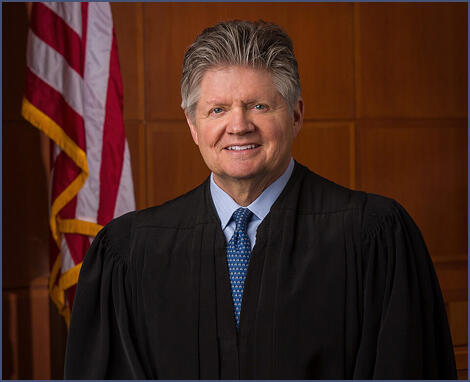
John R. Tunheim said in another interview at the time: "It really was an example of treachery... If (the CIA) fooled us on that, they may have fooled us on other things." As Mark Adamczyk pointed out in his article on the subject: "It is pretty widely known that government agencies are still withholding thousands of ‘protected' files related to the assassination of President John F. Kennedy. As of 2023, 4,684 assassination records are still "fully or partially" withheld from the public. All remaining JFK assassination records were supposed to be released in full by 2017. That is the law created by Congress in the 1992 JFK Assassination Records Collection Act (JFK Act). What happened instead? President Trump ordered a delay of more than 3 years. Biden took over the task of declassifying the JFK records and actually made things worse. Biden placed discretion back in the hands of the very agencies that fight so hard to keep these historical records locked away forever. Both presidents did not comply with the clear language and intent of the JFK Act." (101)
Donald Trump and the JFK Assassination
Donald Trump first became interested in the JFK assassination when he was campaigning against Ted Cruz in his efforts to become the Republican candidate for president in 2016. Trump suggested that Rafael Cruz, his opponent's father, was connected to Lee Harvey Oswald. "His father was with Lee Harvey Oswald prior to Oswald's being - you know, shot… I mean, what was he doing - what was he doing with Lee Harvey Oswald shortly before the death? Before the shooting?" (102)
During the 2016 campaign Trump promised to release the remaining classified JFK assassination documents. However, this did not happen, and it was not until November 2022, after Trump left office, that it was revealed why he did not keep his promise. Released internal correspondence from the National Archives and Records Administration showed that, behind the scenes, there has been a fierce bureaucratic war over the documents pitting the Archives against the CIA, FBI and other agencies that wanted to keep them secret. Philip Shenon reported: "The correspondence, obtained under the Freedom of Information Act, shows that the Archives has tried, and often failed, to insist that other agencies comply with the 1992 law by declassifying more documents. The struggle was especially fierce in 2017, when then-President Donald Trump sided with the CIA and FBI and agreed to waive a supposedly concrete legal deadline that year to release all classified documents related to the JFK assassination." (103)
Donald Trump explained in an interview with the Fox News host Sean Hannity on 22 January 2023 that it was Mike Pompeo, the Director of the CIA, who was the reason he did not release files about President John F. Kennedy's assassination during his first term. "He said that Mike Pompeo begged him... called him and said, this would be a catastrophe to release these." (104)
Once out of power Trump expressed regret that he had not released the JFK assassination files. He also claimed that there were other possible conspiracies, especially those that involved leading Democratic politicians such as Joe Biden and Bill Clinton. The Make America Great Again (MAGA) movement took Trump's campaign in favour of transparency seriously. One of the cases they were interested in was the Jeffery Epstein case as it was rumoured that several Democrat politicians had been involved in having sex with underage girls. It was said that maybe this was the reason why Biden had not released the Epstein files when he was in office. (105)
Trump insisted during the 2024 presidential campaign that he would not allow the CIA and FBI to block the Kennedy assassination files if he won the election. In June 2024, Trump was asked if he would release various files - including the John F. Kennedy and Martin Luther King Jr. assassination files and the Epstein files - during an interview with Fox News. "Would you declassify the Epstein files?" Rachel Campos-Duffy asked. Trump responded, "Yeah, yeah, I would." That clip was circulated widely online, including by the Trump War Room - the social media account of Trump's campaign operation. The account posted it to X with the caption: "President Trump says he will DECLASSIFY the 9/11 Files, JFK Files, and Epstein Files." Trump went on to say in the exchange with Campos-Duffy: "I don't know about Epstein so much as I do the others. Certainly, about the way he died. It'd be interesting to find out what happened there, because that was a weird situation and the cameras didn't happen to be working, etc., etc. But yeah, I'd go a long way toward that one." (106)
In September 2024, Trump made a firm pledge to release Epstein files during a podcast with Lex Fridman. The podcaster said: "it's just very strange for a lot of people that the list of clients that went to the island has not been made public." Fridman asked him if he would release the Epstein files. He replied: "Yeah, I'd certainly take a look at it. Now, Kennedy's interesting because it's so many years ago," Trump said. "They do that for danger too, because it endangers certain people, et cetera, et cetera, so Kennedy is very different from the Epstein thing, but I'd be inclined to do the Epstein. I'd have no problem with it." (107)
On 23 January 2025, President Donald Trump ordered officials to make plans to declassify documents related to three of the most consequential assassinations in US history - the killings of John F Kennedy, Robert F Kennedy, and Martin Luther King Jr. "A lot of people are waiting for this for long, for years, for decades," Trump told reporters in the Oval Office. "And everything will be revealed." The order directed top administration officials to present a plan to declassify the documents within 15 days. (108)
After his election victory Donald Trump nominated Pamela Jo Bondi as his attorney general. Bondi. In 2020, Bondi was one of Trump's defense lawyers during his first impeachment trial. By 2024, she led the legal arm of the Trump-aligned America First Policy Institute. On Bondi's first day in office, she shut down the FBI's Foreign Influence Task Force and the DOJ's Task Force KleptoCapture, and cut back enforcement of the Foreign Agents Registration Act. (109)
Trump's MAGA supporters began asking when the Jeffery Epstein files would be released. On 27 February 2025, Bondi's team handed out big white binders labelled "The Epstein Files: Phase 1" and "The Most Transparent Administration in History" to a group of 15 right-wing activists and self-styled "citizen journalists" visiting the White House. Arwa Mahdawi pointed out: "Grinning gleefully, these influencers proceeded to pose for the press with the binders like they were trophies from a school sports day. So, what was in those binders? A whole lot of heavily redacted nothing, basically. A bunch of people at Bondi's office appear to have hastily printed out Epstein's contact book, which was published by the (now shuttered) website Gawker a decade ago, along with other information that has been in the public domain for years. They then shoved 200 pages of printouts into binders and gave them to a handpicked collection of useful idiots." (110)
Even Laura Loomer, a white nationalist conspiracy theorist, thought the stunt was distasteful. "I hate to say it, but the American people can't trust the validity of the Epstein files released today. It was released in an unprofessional manner with paid, partisan social media influencers to curate their binders for us". (111)
During a 21 February interview on Fox News, host John Roberts asked Bondi whether the Department of Justice would release a "list of Jeffrey Epstein's clients." Bondi responded: "It's sitting on my desk right now to review. That's been a directive by President Trump. I'm reviewing that." In other words, Bondi didn't commit to releasing such a list, but she affirmatively indicated it existed and that it was in her possession. And the question was specifically about the purported list – not about other files related to Epstein. Bondi also previously claimed there were "tens of thousands of videos" showing Epstein "with children or child porn". (112)
On 5 June 2005 Elon Musk slamming Trump for "ingratitude" over the 2024 election, agreeing with a call for his impeachment, knocking the president's signature legislation and claimed Trump was in the Epstein files. Musk posted about Trump and Jeffery Epstein, accused of sex trafficking of minors in 2019, "Time to drop the really big bomb: @realDonaldTrump is in the Epstein files. That is the real reason they have not been made public." (113)
On 7 July 2025 the US Department of Justice and FBI announced that sex offender Jeffrey Epstein did not have a so-called client list that could implicate high-profile associates, and that he did take his own life - contradicting MAGA's long-held conspiracy theories about the case. (114) The Wall Street Journal later reported that the reason for this decision not to release the client list was that during a briefing on the Justice Department's review of the files in May, Bondi informed Trump that his name was included among the documents. (115)
Elon Musk now returned to the debate on the Epstein files. In one post, Musk called the Trump administration's actions "a cover up (obviously)" and claimed in another that "so many powerful people want that list suppressed." In response to Trump calling the matter the "Epstein Hoax," Musk mockingly wrote, "Wow, amazing that Epstein 'killed himself' and Ghislaine is in federal prison for a hoax." Musk also took a shot at how Trump has handled past issues, listing, "1. Admit nothing; 2. Deny everything; 3. Make counterclaims" - before adding, "But it won't work this time." He also reposted a photo of the binders that Attorney General passed out to MAGA influencers at the White House in February that were labelled "Epstein files: Phase 1." "Where is 'Phase 2'? Musk asked. (116)
Elon Musk and other members of MAGA movement are asking the question: "Will Donald Trump expose the Deep State or is he a member of it?" On Truth Social, Donald Trump offered a stern rebuke to his detractors, claiming that the Epstein files were actually a hoax, because they were written by "Obama, Crooked Hillary, Comey, Brennan, and the Losers and Criminals of the Biden Administration". Some of his most loyal supporters questioned this statement. "This is the worst response I've ever seen from President Trump," said the right-wing commentator, Benny Johnson. Another leading supporter of the MAGA movement, Matt Walsh, called Trump's statement "extremely obtuse", adding: "We don't accept obvious bullshit from our political leaders." (117)
On 31 January 2026 the Justice Department released a trove of 3.5m files related to the sex trafficker Jeffrey Epstein. The deputy attorney general Todd Blanche declaring that the release would likely be the last major declassification of files relating to Epstein. Federal prosecutors had identified 6 million files that were "potentially responsive" to the law, meaning that there are millions of files that have still not been released. The release marked a belated and partial compliance with a bill passed by Congress late last year, which had mandated that all government documents pertaining to Epstein and the various law enforcement investigations into his sexual abuse of girls be made public by 19 December 2025. (118)
The US government released the final batch of documents on the assassination of President John F Kennedy (JFK) on 19 March 2025. (119) Officially there are 515 documents still withheld for national security reasons. Anna Paulina Luna, a member of the House Committee on Foreign Affairs, believes that the CIA are still involved in a cover-up: "I don't think that the C.I.A. gave the authorization. I think that there were radical factions within the agency that were working with other networks that assassinated Kennedy, and I think it stood to benefit many people to include the military industrial complex, and to include people that thought that Kennedy was too much of a radical thought leader in the sense that he wanted peace." (120)
The Impact on American History
It is interesting to speculate what America would be like today if John F. Kennedy had served a second term. Would he had been able to negotiate and end to the Cold War and used those billions of dollars wasted on armaments to help improve the standard of living of most Americans. Would the United States have got bogged down in the Vietnam War.
What reforms would Robert Kennedy have introduced if he had become president? If Martin Luther King Jr had survived the assassination attempt, would he have become the leader of the progressive left and become the first black president.
If President Carter had been elected for a second term, would he with the support of Stansfield Turner and Frank Church discovered the truth about the assassinations. If Carter had won would America have been saved from Reaganomics and the neoliberal economic policies that caused so much economic inequality in the United States? If that had not happened would Donald Trump have ever become president?
References
(1) John F. Kennedy, Second TV Debate (7 October 1960)
(2) McGeorge Bundy, memorandum to the Standing Group of the National Security Council (21 April, 1963)
(3) Richard Helms, memorandum to several figures in the CIA and the John Kennedy administration (1 May, 1963)
(4) James W. Douglas, JFK and the Unspeakable: Why He Died and Why It Matters (2008) page 61
(5) John McCone, memorandum to McGeorge Bundy (2 May, 1963)
(6) Anthony Summers, The Kennedy Conspiracy: The Truth? (1992) pages 400-401
(7) Lisa Howard, War and Peace Report (September 1963)
(8) William Attwood, memorandum (8 November, 1963)
(9) William Attwood, The Twilight Struggle: Tales of the Cold War (1987) page 260
(10) William Attwood, memorandum (8 November, 1963)
(11) Carlos Lechuga, Cuban Officials and JFK Historians Conference (7 December, 1995)
(12) William Attwood, The Twilight Struggle: Tales of the Cold War (1987) pages 260-261
(13) Frank Church, Alleged Assassination Plots Involving Foreign Leaders: An Interim Report of the United States Senate Committee to Study Government Operations (1976) page 88
(14) James W. Douglas, JFK and the Unspeakable: Why He Died and Why It Matters (2008) page 84
(15) McGeorge Bundy, memorandum (12 November, 1963)
(16) John F. Kennedyy, speech (18 November 1963)
(17) James W. Douglas, JFK and the Unspeakable: Why He Died and Why It Matters (2008) page 84
(18) Jean Daniel, The New Republic (14 December, 1963)
(19) Frank Church, Alleged Assassination Plots Involving Foreign Leaders: An Interim Report of the United States Senate Committee to Study Government Operations (1976) page 94
(20) William Attwood, The Twilight Struggle: Tales of the Cold War (1987) page 262
(21) James W. Douglas, JFK and the Unspeakable: Why He Died and Why It Matters (2008) page 251
(22) Jean Daniel, The New Republic (7 December, 1963)
(23) Arthur Schlesinger, Robert Kennedy and His Times (1979) page 616
(24) Haynes Johnson, Washington Post (17 April 1981)
(25) David Talbot, Brothers: The Hidden History of the Kennedy Years (2007) page 12
(26) Evan Thomas, Robert Kennedy: A Life (2000) page 177
(27) Edwin O. Guthman & Jeffrey Shulman (editors), Robert Kennedy: In His Own Words (1988) page 376
(28) Lamar Waldron, Ultimate Sacrifice (2005) page 30
(29) Warren Hinckle & William Turner, The Fish Is Red: The Story of the Secret War Against Castro (1981) page 151
(30) David Talbot, Brothers: The Hidden History of the Kennedy Years (2007) page 277
(31) Larry Tye, Cape Cod Times (29 October 2017)
(32) David Talbot, Brothers: The Hidden History of the Kennedy Years (2007) page 18
(33) David Talbot, Brothers: The Hidden History of the Kennedy Years (2007) page 267
(34) M. S. Arnoni, The Minority of One Magazine (November 1966)
(35) Megan Brenan, Decades Later, Most Americans Doubt Lone Gunman Killed JFK (13 November 2023)
(36) Ernesto B. Vigil, The Crusade for Justice: Chicano Militancy and the Government's War on Dissent (1999) page 54
(37) Steven F. Lawson, Charles M. Payne and James T. Patterson, Debating the Civil Rights Movement, 1945–1968 (2006) pages 148-149
(38) The New York Times (13 January 1968)
(39) The New York Times (24 April 1998)
(40) The New York Times (16 March 1998)
(41) The New York Times (6 June 1968)
(42) Edward Kennedy, speech, St. Patrick's Cathedral (8 June 1968)
(43) George Bernard Shaw, Back to Methuselah (1921)
(44) Statement issued by Edward Kennedy (18th July 1969)
(45) Nellie Bly, The Kennedy Men: Three Generations of Sex, Scandal and Secrets (1996) page 213
(46) The Washington Post (15 January 1980)
(47) John Simkin, Mary Jo Kopechne (31 August 2009)
(48) Richard E. Sprague, The Taking of America (1976) chapter seven
(49) Gerald D. McKnight, Breach of Trust: How the Warren Commission Failed the Nation and Why (2005) pages 82-88
(50) H. R. Haldeman, The Ends of Power (1978) page 49
(51) Richard Nixon, Memoirs (1978) page 252
(52) H. R. Haldeman, The Ends of Power (1978) page 63
(53) Jim Hougan, Secret Agenda: Watergate, Deep Throat and the CIA (1984) page 99
(54) Richard Nixon, Memoirs (1978) page 474
(55) E. Howard Hunt, American Spy: My Secret History in the CIA, Watergate, and Beyond (2007) page 240
(56) Douglas Caddy, How I got involved as an attorney in the Watergate case (10 August 2023)
(57) John Simkin, The Connections between Watergate and the JFK Assassination (2 April 2021)
(58) H. R. Haldeman, The Ends of Power (1978) page 54
(59) John Dean, Blind Ambition: The White House Years (1976) pages 92-97
(60) Jim Hougan, Secret Agenda: Watergate, Deep Throat and the CIA (1984) page 225
(61) Douglas Caddy, How I got involved as an attorney in the Watergate case (10 August 2023)
(62) John Simkin, The Connections between Watergate and the JFK Assassination (2 April 2021)
(63) Bob Woodward and Carl Bernstein, All the President's Men (1974) page 16
(64) Bob Woodward and Carl Bernstein, All the President's Men (1974) pages 71-74
(65) Bob Woodward, The Guardian (3 June, 2005)
(66) Anne E. Kornblut, New York Times (2nd June 2005)
(67) Deborah Davis, Katharine the Great (1979) pages 266-267
(68) Deborah Davis, interviewed by Kenn Thomas of Steamshovel Press (1992)
(69) Deborah Davis, Katharine the Great (1979) page 225
(70) Richard Helms, A Look Over My Shoulder: A Life in the Central Intelligence Agency (2003) page 7
(71) Gaeton Fonzi, The Last Investigation (1993) page 44
(72) Russ Baker, Family of Secrets: The Bush Dynasty (2009) pages 220-245
(73) Richard Helms, A Look Over My Shoulder: A Life in the Central Intelligence Agency (2003) pages 7-8
(74) Richard Nixon, Memoirs (1978) pages 625-629
(75) Bob Woodward and Carl Bernstein, All the President's Men (1974) page 18
(76) Carl Bernstein, CIA and the Media, Rolling Stone Magazine (20 October, 1977)
(77) Frank Church, The Doves Have Won and Don't Know It (6 September 1970)
(78) Frank Church, quoted by Daniel Ellsberg in The Guardian (10 June 2013)
(79) Frank Church, Alleged Assassination Plots Involving Foreign Leaders: An Interim Report of the United States Senate Committee to Study Government Operations (1976)
(80) The Foreign Intelligence Surveillance Act (25 October 1978)
(81) The Guardian (26 September 2013)
(82) John J. Lindsay, Endangered Liberals (30 June 1980)
(83) CNN News (18 January 2018)
(84) James Bamford, The Washington Post (9 June 1985)
(85) The Final Report of the U.S. Senate Select Committee to Study Governmental Operations with Respect to Intelligence Activities (29 April 1976)
(86) The New York Times (16 October 1975)
(87) Final Report of the Select Committee to Study Government Operations With Respect to Intelligence Activities (29 April 1976)
(88) The New York Times (5 November 1979)
(89) Barbara Honegger, October Surprise (1989) page 11
(90) The New York Times (31 October 1980)
(91) Barbara Honegger, October Surprise (1989) page 17
(92) The Washington Post (11 October 1980)
(93) WLS-TV (15 October 1980)
(94) John Simkin, George H. W. Bush and Ted Shackley (26 December 2005)
(95) Mansur Rafizadeh, Witness: From the Shah to the Secret Arms Deal (1987) page 347
(96) Timothy J. Geraghty, Peacekeepers at War (2009), pages 185–186
(97) James Petras, The Discrediting of the Fifth Estate: The Press Attacks on JFK (May 1992)
(98) President John F. Kennedy Assassination Records Collection Act of 1992 (26 October 1992)
(99) Final Report of the Assassination Records Review Board (30 September 1998) pages 1-2
(100) John R. Tunheim and Thomas E. Samoluk, Boston Globe (21 November 2013)
(101) Mark Adamczyk, American Greatness (20 September 2024)
(102) BBC News (3 May 2016)
(103) Philip Shenon, Why We Still Don't Have the JFK Assassination Files (15 November 2022)
(104) New York Times (23 January 2023)
(105) Peter Pinedo, Fox News (19 July 2025)
(106) CNN News (17 July 2025)
(107) Alexandra Hutzler, ABC News (16 July 2025)
(108) BBC News (23 January 2025)
(109) NBC News (6 February 2025)
(110) Arwa Mahdawi, The Guardian (1 March 2025)
(111) Laura Loomer, quoted in The Independent (27 February 2005)
(112) Aaron Blake, CNN News (7 July 2025)
(113) ABC News (5 June 2025)
(114) BBC News (7 July 2025)
(115) Wall Street Journal (23 July 2025)
(116) ABC News (17 July 2025)
(117) The Guardian (15 July 2025)
(118) The Guardian (31 January 2026)
(119) BBC News (19 March 2025)
(120) Anna Paulina Luna, New York Times (5 June 2026)
Previous Posts
UK's Governments since 2008 have created a massive National Debt (11 July 2026)
How the Wealthy Elite Undermine Democracy in the UK (4th June 2026)
Cicero on Friendship and Old Age (4th June 2026)
Wes Streeting and Labour Together (17th May 2026)
The Strange appintment of Peter Mandelson (5th May, 2026)
Why at the age of 80 I have joined the Green Party (29th March, 2026)
The Vassal State: How America Runs Britain (25th March, 2026)
Should the Government try to control was appears on the Internet? (26th February, 2026)
The Political Ideas of Rutger Bregman (25th January, 2026)
Technofeudalism: Is AI going to destroy Capitalism and Democracy? (19th November, 2025)
How do we stop Nigel Farage from forming a government (14th October, 2025)
Donald Trump and the Deep State (13th August, 2025)
The History of Fascism: Are Vladimir Putin and Donald Trump Fascists? (10th June, 2025)
The CIA memorandum on the death of Gary Underhill (6th April, 2025)
Should George Orwell have chosen the title, 2030, instead of 1984? Keir Starmer as Big Brother. (17th March, 2025)
The Evolution of the Brain. Can you make yourself happy? (16th January, 2025)
Technology and the History Classroom: Should the Teaching Profession Embrace AI? (20th November, 2024)
Venetia Stanley, H. H. Asquith and the First World War (22nd August, 2024)
The General Election Campaign: The Tyranny of the Centre (4th July, 2024)
In Defence of the New History (20th March, 2024)
The Political History of Keir Starmer (25th January, 2024)
JFK Assassination: What Happened in the Trauma Room (23rd November, 2023)
Sir Keir Starmer and his Broken Pledges (1st September, 2023)
Should history students be using ChatGBT? (28th May, 2023)
A historical account of the Daily Mail, the Conservative Party and Migration (18th March, 2023)
Art and the Women's Suffrage Movement (20th January, 2023)
Emancipation of Women: 1870-1928 (15th November, 2022)
The Struggle for Women's Rights: 1500-1870 (21st September, 2022)
The real reason why the FA banned women from playing on their grounds (1st August, 2022)
The WSPU Young Hot Bloods and the Arson Campaign (26th May, 2022)
Interpretations in History (18th April, 2022)
The Student as Teacher (31st December, 2021)
History Simulations in the Classroom (30th November, 2021)
Walter Tull: Football and War Hero (20th October, 2021)
Child Labour and Freedom of the Individual (26th July, 2021)
Don Reynolds and the Assassination of John F. Kennedy (15th June, 2021)
Richard Nixon and the Conspiracy to kill George Wallace in 1972 (5th May, 2021)
The Connections between Watergate and the JFK Assassination (2nd April, 2021)
The Covid-19 Pandemic: An Outline for a Public Inquiry (4th February, 2021)
Why West Ham did not become the best team in England in the 1960s (24th December, 2000)
The Lyndon Baines Johnson Tapes and the John F. Kennedy Assassination (9th November, 2020)
It is Important we Remember the Freedom Riders (11th August, 2020)
Dominic Cummings, Niccolò Machiavelli and Joseph Goebbels (12th July, 2020)
Why so many people in the UK have died of Covid-19 (14th May, 2020)
Why the coronavirus (Covid-19) will probably kill a higher percentage of people in the UK than any other country in Europe.. (12th March, 2020 updated 17th March)
Mandy Rice Davies and Christine Keeler and the MI5 Honey-Trap (29th January, 2020)
Robert F. Kennedy was America's first assassination Conspiracy Theorist (29th November, 2019)
The Zinoviev Letter and the Russian Report: A Story of Two General Elections (24th November, 2019)
The Language of Right-wing Populism: Adolf Hitler to Boris Johnson (11th October, 2019)
The Political Philosophy of Dominic Cummings and the Funding of the Brexit Project (15th September, 2019)
What are the political lessons to learn from the Peterloo Massacre? (19th August, 2019)
Crisis in British Capitalism: Part 1: 1770-1945 (9th August, 2019)
Richard Sorge: The Greatest Spy of the 20th Century? (29th July, 2020)
The Death of Bernardo De Torres (26th May, 2019)
Gas Masks in the Second World War killed more people than they saved (9th May, 2019)
Did St Paul and St Augustine betray the teachings of Jesus? (20th April, 2019)
Stanley Baldwin and his failed attempt to modernise the Conservative Party (15th April, 2019)
The Delusions of Neville Chamberlain and Theresa May (26th February, 2019)
The statement signed by Robert F. Kennedy Jr. and Kathleen Kennedy Townsend (20th January, 2019)
Was Winston Churchill a supporter or an opponent of Fascism? (16th December, 2018)
Why Winston Churchill suffered a landslide defeat in 1945? (10th December, 2018)
The History of Freedom Speech in the UK (25th November, 2018)
Are we heading for a National government and a re-run of 1931? (19th November, 2018)
George Orwell in Spain (15th October, 2018)
Anti-Semitism in Britain today. Jeremy Corbyn and the Jewish Chronicle (23rd August, 2018)
Why was the anti-Nazi German, Gottfried von Cramm, banned from taking part at Wimbledon in 1939? (7th July, 2018)
What kind of society would we have if Evan Durbin had not died in 1948? (28th June, 2018)
The Politics of Immigration: 1945-2018 (21st May, 2018)
State Education in Crisis (27th May, 2018)
Why the decline in newspaper readership is good for democracy (18th April, 2018)
Anti-Semitism in the Labour Party (12th April, 2018)
George Osborne and the British Passport (24th March, 2018)
Boris Johnson and the 1936 Berlin Olympics (22nd March, 2018)
Donald Trump and the History of Tariffs in the United States (12th March, 2018)
Karen Horney: The Founder of Modern Feminism? (1st March, 2018)
The long record of The Daily Mail printing hate stories (19th February, 2018)
John Maynard Keynes, the Daily Mail and the Treaty of Versailles (25th January, 2018)
20 year anniversary of the Spartacus Educational website (2nd September, 2017)
The Hidden History of Ruskin College (17th August, 2017)
Underground child labour in the coal mining industry did not come to an end in 1842 (2nd August, 2017)
Raymond Asquith, killed in a war declared by his father (28th June, 2017)
History shows since it was established in 1896 the Daily Mail has been wrong about virtually every political issue. (4th June, 2017)
The House of Lords needs to be replaced with a House of the People (7th May, 2017)
100 Greatest Britons Candidate: Caroline Norton (28th March, 2017)
100 Greatest Britons Candidate: Mary Wollstonecraft (20th March, 2017)
100 Greatest Britons Candidate: Anne Knight (23rd February, 2017)
100 Greatest Britons Candidate: Elizabeth Heyrick (12th January, 2017)
100 Greatest Britons: Where are the Women? (28th December, 2016)
The Death of Liberalism: Charles and George Trevelyan (19th December, 2016)
Donald Trump and the Crisis in Capitalism (18th November, 2016)
Victor Grayson and the most surprising by-election result in British history (8th October, 2016)
Left-wing pressure groups in the Labour Party (25th September, 2016)
The Peasant's Revolt and the end of Feudalism (3rd September, 2016)
Leon Trotsky and Jeremy Corbyn's Labour Party (15th August, 2016)
Eleanor of Aquitaine, Queen of England (7th August, 2016)
The Media and Jeremy Corbyn (25th July, 2016)
Rupert Murdoch appoints a new prime minister (12th July, 2016)
George Orwell would have voted to leave the European Union (22nd June, 2016)
Is the European Union like the Roman Empire? (11th June, 2016)
Is it possible to be an objective history teacher? (18th May, 2016)
Women Levellers: The Campaign for Equality in the 1640s (12th May, 2016)
The Reichstag Fire was not a Nazi Conspiracy: Historians Interpreting the Past (12th April, 2016)
Why did Emmeline and Christabel Pankhurst join the Conservative Party? (23rd March, 2016)
Mikhail Koltsov and Boris Efimov - Political Idealism and Survival (3rd March, 2016)
Why the name Spartacus Educational? (23rd February, 2016)
Right-wing infiltration of the BBC (1st February, 2016)
Bert Trautmann, a committed Nazi who became a British hero (13th January, 2016)
Frank Foley, a Christian worth remembering at Christmas (24th December, 2015)
How did governments react to the Jewish Migration Crisis in December, 1938? (17th December, 2015)
Does going to war help the careers of politicians? (2nd December, 2015)
Art and Politics: The Work of John Heartfield (18th November, 2015)
The People we should be remembering on Remembrance Sunday (7th November, 2015)
Why Suffragette is a reactionary movie (21st October, 2015)
Volkswagen and Nazi Germany (1st October, 2015)
David Cameron's Trade Union Act and fascism in Europe (23rd September, 2015)
The problems of appearing in a BBC documentary (17th September, 2015)
Mary Tudor, the first Queen of England (12th September, 2015)
Jeremy Corbyn, the new Harold Wilson? (5th September, 2015)
Anne Boleyn in the history classroom (29th August, 2015)
Why the BBC and the Daily Mail ran a false story on anti-fascist campaigner, Cedric Belfrage (22nd August, 2015)
Women and Politics during the Reign of Henry VIII (14th July, 2015)
The Politics of Austerity (16th June, 2015)
Was Henry FitzRoy, the illegitimate son of Henry VIII, murdered? (31st May, 2015)
The long history of the Daily Mail campaigning against the interests of working people (7th May, 2015)
Nigel Farage would have been hung, drawn and quartered if he lived during the reign of Henry VIII (5th May, 2015)
Was social mobility greater under Henry VIII than it is under David Cameron? (29th April, 2015)
Why it is important to study the life and death of Margaret Cheyney in the history classroom (15th April, 2015)
Is Sir Thomas More one of the 10 worst Britons in History? (6th March, 2015)
Was Henry VIII as bad as Adolf Hitler and Joseph Stalin? (12th February, 2015)
The History of Freedom of Speech (13th January, 2015)
The Christmas Truce Football Game in 1914 (24th December, 2014)
The Anglocentric and Sexist misrepresentation of historical facts in The Imitation Game (2nd December, 2014)
The Secret Files of James Jesus Angleton (12th November, 2014)
Ben Bradlee and the Death of Mary Pinchot Meyer (29th October, 2014)
Yuri Nosenko and the Warren Report (15th October, 2014)
The KGB and Martin Luther King (2nd October, 2014)
The Death of Tomás Harris (24th September, 2014)
Simulations in the Classroom (1st September, 2014)
The KGB and the JFK Assassination (21st August, 2014)
West Ham United and the First World War (4th August, 2014)
The First World War and the War Propaganda Bureau (28th July, 2014)
Interpretations in History (8th July, 2014)
Alger Hiss was not framed by the FBI (17th June, 2014)
Google, Bing and Operation Mockingbird: Part 2 (14th June, 2014)
Google, Bing and Operation Mockingbird: The CIA and Search-Engine Results (10th June, 2014)
The Student as Teacher (7th June, 2014)
Is Wikipedia under the control of political extremists? (23rd May, 2014)
Why MI5 did not want you to know about Ernest Holloway Oldham (6th May, 2014)
The Strange Death of Lev Sedov (16th April, 2014)
Why we will never discover who killed John F. Kennedy (27th March, 2014)
The KGB planned to groom Michael Straight to become President of the United States (20th March, 2014)
The Allied Plot to Kill Lenin (7th March, 2014)
Was Rasputin murdered by MI6? (24th February 2014)
Winston Churchill and Chemical Weapons (11th February, 2014)
Pete Seeger and the Media (1st February 2014)
Should history teachers use Blackadder in the classroom? (15th January 2014)
Why did the intelligence services murder Dr. Stephen Ward? (8th January 2014)
Solomon Northup and 12 Years a Slave (4th January 2014)
The Angel of Auschwitz (6th December 2013)
The Death of John F. Kennedy (23rd November 2013)
Adolf Hitler and Women (22nd November 2013)
New Evidence in the Geli Raubal Case (10th November 2013)
Murder Cases in the Classroom (6th November 2013)
Major Truman Smith and the Funding of Adolf Hitler (4th November 2013)
Unity Mitford and Adolf Hitler (30th October 2013)
Claud Cockburn and his fight against Appeasement (26th October 2013)
The Strange Case of William Wiseman (21st October 2013)
Robert Vansittart's Spy Network (17th October 2013)
British Newspaper Reporting of Appeasement and Nazi Germany (14th October 2013)
Paul Dacre, The Daily Mail and Fascism (12th October 2013)
Wallis Simpson and Nazi Germany (11th October 2013)
The Activities of MI5 (9th October 2013)
The Right Club and the Second World War (6th October 2013)
What did Paul Dacre's father do in the war? (4th October 2013)
Ralph Miliband and Lord Rothermere (2nd October 2013)