

Spartacus Blog
UK's governments since 2008 have created a massive National Debt
The UK's national debt is currently standing at roughly £2.9 trillion, or about 101% of GDP. It is primarily caused by the government continuously spending more than it collects in taxes, resulting in fiscal deficits. When a deficit occurs, the government covers the gap by borrowing, which accumulates over time to form the total national debt. Other countries have debt ratios higher than that of the UK. For example, Japan (201%), Greece (170%) Italy (133%) United States (103%) and Portugal (102%). However, other countries have much lower debt ratios than us: Switzerland (13%), Norway (14%), Denmark (20%) Sweden (34%) and Germany (43%). These are countries with high taxes and good public services. (1)
Japan’s government debt as a percentage of its gross domestic product (GDP) has been the highest share among major advanced economies for many years. This high level of government debt mainly stems from decades of persistent fiscal deficits and near-zero economic growth, both largely driven by Japan’s aging population. "By the mid-1970s, Japan’s fertility rate had fallen below the replacement rate of 2.1 children per woman. The fertility rate continued to decline steadily over subsequent decades. Combined with increased life expectancy, this trend placed Japan on a path to becoming a rapidly aging society. In 2001, the share of Japan’s population ages 65 and older was 18.4%. By 2024, this share had grown to 30.2%." (2)
While Japan's debt-to-GDP ratio is the highest among developed nations, it avoids immediate financial collapse due to unique economic factors The vast majority of Japanese debt is held internally. The Bank of Japan (BOJ) holds nearly half of the government bonds, effectively leveling out the debt servicing costs and minimizing the threat of a foreign default. The Japanese government holds massive financial assets, including significant investments in both domestic and foreign stocks. Once these assets are accounted for, Japan's consolidated debt is much lower and on par with other major economies. The BOJ has kept interest rates incredibly low, meaning that debt repayment consumes a relatively small fraction of the annual national budget compared to the UK (3) .
The UK is very different from Japan. It currently spends about £126 billion annually on national debt interest payments, accounting for about 8% to 9% of all government spending. This makes debt servicing one of the largest single outlays in the budget, The Resolution Foundation has pointed out: "The UK now has the highest borrowing costs of any rich OECD country, despite its middle-of-the-pack debt position, due to ‘sticky' inflation and a borrowing-cost premium driven by our vulnerability to changes in the whims of international investors". (4)
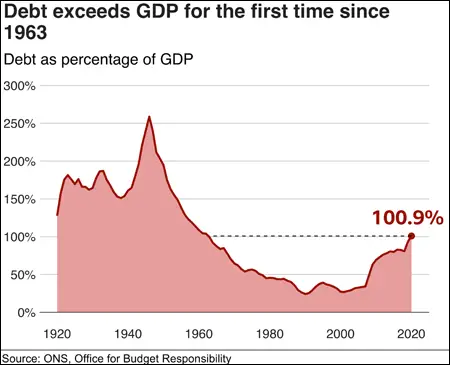
At the beginning of the 21st century the government appeared to have control over its National Debt. For example, in 2001, the UK's net debt-to-GDP ratio was 30.4%. Since then the world has suffered two massive economic shocks that has required massive emergency government spending while simultaneously reducing tax revenues. The first was the 2008 Global Financial Crisis. Margaret Thatcher's financial deregulation in the 1980s transformed the City of London into a global financial powerhouse, primarily culminating in the sweeping structural changes of the 1986 Big Bang. This was combined with a "light-touch" regulatory approach, allowed UK banks to take excessive risks, build massive debt, and heavily invest in complex, unregulated financial products. (5)
2008 Global Financial Crisis
The 2008 Global Financial Crisis was triggered by the bursting of the U.S. housing bubble, which collapsed due to predatory subprime lending. Financial institutions had bundled these risky mortgages into complex, highly rated securities, such as Mortgage-Backed Security (MBS) and derivatives. Financial deregulation allowed originators to bypass traditional lending standards and push risky loans, knowing they could sell them to Wall Street. When U.S. property values finally peaked and began to decline, borrowers could no longer refinance or afford their mortgages. Defaults and foreclosures surged. Because financial institutions worldwide held these inflated, opaque securities on their balance sheets, the resulting losses caused a severe liquidity crisis. (6)
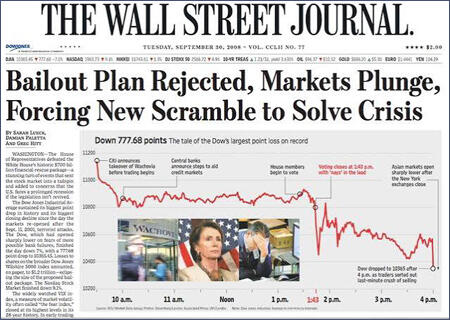
As a result of the 2008 Global Financial Crisis the UK government injected £137 billion of public money in the form of loans and capital to prevent the total collapse of the banking system (including the partial nationalisation of the Royal Bank of Scotland and Lloyds Banking Group). Most of the loans were paid back and the government sold off its bank shares over the following decade, the Office for Budget Responsibility (OBR) calculated the final realized cost to taxpayers to be between £23 billion and £33 billion. (7)
By 2018, the UK economy was 16% smaller than it would have been had it followed its pre-crisis growth path. This equated to a structural loss of £300 billion per year in economic output. In total it cost the UK economy an estimated £1.8 trillion in lost economic growth. National income was hit so severely that GDP per capita dropped by £5,900 per person relative to pre-crisis trends. The initial crash caused the economy to shrink by more than 6% between 2008 and 2009. It took five full years for the UK's Gross Domestic Product (GDP) to recover to its pre-recession size. (8)
The 2010 Coalition Government
The 2010 Coalition government decided to deal with the problem by flooding the economy with cheap money. These policies - primarily Quantitative Easing (QE) and record-low interest rates - drove up the value of existing assets like real estate, stocks, and private businesses. Wealthy individuals and investors who already owned these assets saw their net worth soar, while those relying on wages were left behind. (9)
At the same time the government's post-crisis shift to austerity policies and welfare cuts - such as freezes to working-age benefits - subsequently placed downward pressure on the incomes of lower-income and vulnerable households. Therefore, the gap between rich and poor increased dramatically. George Osborne, the Chancellor in the Conservative-Liberal Democrat coalition government of 2010, admitted that the increase in asset values was an inevitable result of the policy. "QE's purpose is that people who already have something like a house or a pension or some shares will see the value of those things go up. That's what the policy is designed to do and it feels unfair because the people who don't have those things aren't getting the benefits of the policy." Mervyn King, the governor of the Bank of England at the time said. "This seemed deeply unfair, and it is deeply unfair." (10)
Covid-19 Pandemic
The second financial crisis was triggered by the Covid-19 pandemic. It caused unprecedented economic disruption in the United Kingdom, highlighted by a 9.9% collapse in Gross Domestic Product (GDP) in 2020. This represented the sharpest annual economic decline in the UK in over 300 years. A record-breaking GDP drop of 20.4% occurred during the first national lockdown in the second quarter of 2020. Industries reliant on social interaction, including hospitality, tourism, high street retail, and entertainment, collapsed completely during lockdowns. Major supply chain disruptions, social distancing mandates, and material delays caused an estimated 35% drop in industrial productivity. (11)
The government spent roughly £70 billion on the Coronavirus Job Retention Scheme (furlough) to pay millions of people not to work, masking immediate mass redundancies. Self-employed professionals, casual staff, and those on zero-hour contracts suffered rapid, heavy financial losses. Total costs for pandemic emergency measures range from £310 billion to £410 billion. Public spending spiked dramatically to fund corporate loan guarantees and income lifelines. The national debt ballooned to around 100% of the UK's total GDP, creating long-term structural fiscal deficits. (12)
The UK government spent a total of £14.9 billion on personal protective equipment (PPE) for healthcare workers during the Covid-19 pandemic . Of this, nearly £10 billion was officially categorized as wasted due to defective equipment, items that were unsuitable for NHS use, and over-ordering at heavily inflated market price. The British Medical Journal pointed out: "The Department of Health and Social Care's annual report and accounts for 2020-21, show that £8.7bn worth of PPE purchased early in the pandemic was written off. This included £673m for defective PPE not suitable for any use, £2.6bn for items not suitable for NHS use that may be suitable for other uses, £4.7bn from paying inflated prices because of global demand, and £750m for "excess" inventory that passed its expiry date and is held for resale or donation." (13)
For example, Full Support Healthcare agreed a £1.78bn deal in April 2020 to deliver face masks, respirators, eye protection and aprons - the largest Covid PPE order from a single supplier, accounting for 13% of the government’s total spend. Before the pandemic, the Northamptonshire-based company, which was already a specialist manufacturer of PPE, had 25 employees and annual profits of £800,000. Figures obtained by the BBC revealed that at least 1.57 billion items of PPE provided by Full Support Healthcare, will never be used, despite being manufactured to the proper standard. About £1.4bn worth of personal protective equipment (PPE) has been destroyed or written off. At least £100m of public money has additionally been spent on storing and incinerating the excess stock since its purchase. It has been argued that the money lost "could have been used to pay the salaries of 37,000 nurses". (14)
Tom Hayhoe was appointed to investigate Covid-19 pandemic spending in December 2024. He discovered that pandemic-era PPE contracts cost the British taxpayer £1.4bn on undelivered contracts and unusable gowns, masks and gloves. Only a small fraction of that - £400m - has been recovered by HM Treasury. Overall, Hayhoe left the front door open to covid fraud with £10.9 billion lost to pandemic fraudsters. He claimed that a lack of anti-fraud controls in Covid schemes that were set up quickly by ministers in Boris Johnson's government was blamed for the huge figure. Rushed rollouts meant "accepting a high level of fraud risk, without plans for managing or mitigating this risk". (15)
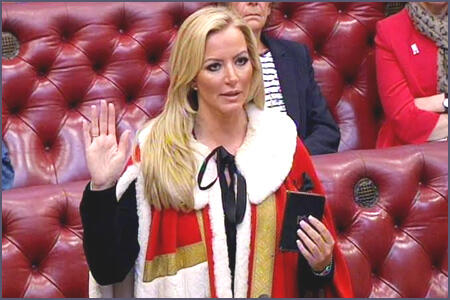
On 14 July 2026, the Covid-19 inquiry chair, Heather Hallett, criticised the then Conservative government’s controversial “VIP lane”, which gave high priority for PPE contracts to companies with political connections to the Conservative Party.. The most high-profile scandal of the VIP lane contracts was PPE Medpro, a newly formed company linked to the then Conservative peer Michelle Mone, which was awarded two contracts worth £203m after Mone first approached Michael Gove, the then Cabinet Office minister, in May 2020. Hallett said in her report: "The 'high priority lane', also known as the 'VIP lane'', was a misguided attempt to give priority to the most credible offers," and that it "embedded unfairness" in the procurement. "Some suppliers received favourable treatment because they had connections to government," she found, "undermining public trust at a moment when it was needed most." (16)
One of the ways that the Conservative government attempted to balance the budget was to freeze people's personal tax allowance. This has been frozen at its current level, £12,570, since April 2021. Until this time, the UK income tax thresholds were increased each year in line with inflation. When the then chancellor, Rishi Sunak, delivered his budget that year he announced that thresholds would be frozen from April 2022 until 2026. (17)
Later, when Rachel Reeves, became chancellor, she announced that income tax thresholds will be frozen until the 2030-31 tax year. As a result, growing numbers of people were dragged into paying tax at higher rates – steadily raising billions of pounds more for the exchequer. The OBR forecasts the policy will result in an additional 5.2 million individuals moving into paying the basic 20% income tax by 2031; a further 4.8 million more will move into the 40% higher rate; and 600,000 more will have moved into the 45% additional rate band. (18)
The freezing of tax allowances has had a major impact on government revenues. Under current government plans, tax revenue is forecast to rise to 37.7% of GDP by 2027–28. If this happens, it will represent the highest level of tax ever seen in the UK. "As might be expected given the extra expenditure required, taxation rose substantially during both World Wars. In both cases, taxation did not fall back to its pre-war level after the outbreak of peace, leaving government revenue permanently expanded in the wake of the conflict. In the decades following the Second World War, revenue from taxation rose sharply in the late 1960s, was highly volatile in the 1970s (partly reflecting large fluctuations in economic growth) and then fell steadily as a proportion of GDP from the early 1980s until the mid 1990s. Tax revenue grew from the mid 1990s until the turn of the millennium, and in recent years it has increased again, bringing the UK tax take broadly back to the level seen at its post-war peak in the late 1940s." (19)
The top rate of tax has varied over the years. During the Second World War the standard rate of income tax was raised, combined with a steeply graduated surtax, resulting in top marginal rates that exceeded 97% on the highest incomes. The top marginal rate on earned and investment income stayed at high levels during the 1950s and 1960s. In 1974 the top rate on earned income sat at 83%. During the time Margaret Thatcher was prime minister the top rate was progressively cut to 60% in 1980, and subsequently to 40% in 1989. In 2013, as a consequence of the 2008 Global Financial Crisis the top additional rate was adjusted to 45%. In opposition the Labour Party proposed increasing it to 50 per cent rate for those with taxable income over £150,000 whereas the Green Party advocated that it should be 60 per cent. (20)
The 2024 General Election
By the 2024 General Election the UK economy was in a terrible state. However, in an attempt to get elected, the two main parties, Labour and Conservative, ignored this and promised not to raise taxes. Paul Johnson of the Institute of Fiscal Studies pointed out: "The Conservatives have promised some £17 billion per year of tax cuts, and a big hike in defence spending. That is supposedly funded by reducing the projected welfare bill by £12 billion; cracking down on tax avoidance and evasion; and saving billions from cutting civil service numbers, reducing spending on management consultants, and quango efficiencies". (21)
The Labour Party's 2024 general election manifesto explicitly pledged not to increase the rates of the three main revenue-generating taxes - Income Tax, National Insurance, and VAT - for working people. The Institute of Fiscal Studies warned that it was ignoring the £18 billion black hole in the government finances. Soon after taking power Rachel Reeves. Labour's new the Chancellor of the Exchequer, said that there was a £22 billion "black hole" in the nation's finances. As the Institute of Fiscal Studies pointed out: "Frankly, nobody comes out of this smelling of roses. Not the Conservatives who really did leave a lot for the new government to clear up, and were not honest about the challenges ahead. Not Labour, which knew the broad outline of these challenges, but refused to confront them in its manifesto and pre-election statements." (22)
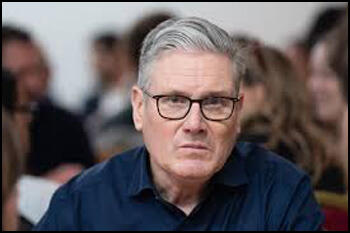
When he was campaigning for the leadership of the Labour Party, Sir Keir Starmer argued for a wealth tax and an increase in income tax for the top 5% of earners who currently pay at the rate of 45%. Increasing the top rate of income tax by 1% to make it 46% would raise an estimated £230 million per year for the UK Treasury. If you increased, it by 2% it would raise around £460 million. Other possibilities included raising basic rate of income tax by 1p (£8.2bn) and the higher rate of income tax by 1p: £2.1bn (23)
The top rate of tax had varied a great deal since the Second World War: 1940 (99%); 1945-1970 (90%); 1971 (75%); 1974 (83%); 1988 (40%) and 2013 (45%). The basic rate of tax has gradually declined from 33% to 25%. However, in 2021 the government froze tax allowances. In March 2021, Rishi Sunak announced that the personal allowance would be fixed at £12,570 for the tax years 2021/22 to 2025/26 inclusive. As a result of this freeze, the personal allowance has not increased in line with inflation or the cost of living since April 2021 (a period where we have had over 30% inflation. This has resulted in a phenomenon known as fiscal drag. (24)
Fiscal drag occurs when income growth linked to inflation pushes taxpayers into higher tax brackets, resulting in an increased tax take for the government without them having to raise tax rates. As a result of this measure the total tax of national income is 37%, the most since the Second World War. As the Institute of Fiscal Studies has pointed out: "Maintaining government services in the face of an ageing population, increasing health and social care costs, and the costs associated with responding to climate change would require taxes to increase further in coming decades. UK public debt – as measured for the purpose of fiscal rules – is currently around 90% of national income. Future governments would need to run a primary surplus – meaning raising revenues higher than non-interest spending – simply to stop debt rising further." (25)
There was also talk of changes to Capital Gains Tax (a levy on the profit made after selling an asset, such as property). The annual tax-free allowance for the levy is £3,000. It was suggested that CGT rates should mirror the three bands of income tax - 20%, 40%, 45%. A report by Centre for the Analysis of Taxation, external in 2024 estimated reforming CGT could raise £14bn. (26)
The Starmer Government
However, because of his campaign promises Starmer decided not to increase taxes but to tackle the welfare budget. In July 2024 Keir Starmer suspended seven MPs (John McDonnell, Richard Burgon; Rebecca Long-Bailey; Apsana Begum; Imran Hussain; Ian Byrne; and Zarah Sultana) from the Labour party after they supported an amendment to scrap the two-child benefit limit, the main cause in the increase in the number of children living in poverty. Scrapping the UK's two-child benefit cap costs £2.3 billion for its first full year of implementation. (27)
In July 2024 Chancellor Rachel Reeves announced cuts to the Winter Fuel Payment to Senior Citizens to save £1.3 billion in the 2024/2025 financial year, and £1.5 billion in subsequent years. Reeves claimed the policy was to help fill a reported £22 billion fiscal gap, meant that the £200 to £300 payments were restricted only to pensioners receiving Pension Credit or other means-tested benefits. This reduced the number of eligible recipients in England and Wales from nearly 11 million down to just 1.5 million. Labour MPs who missed the vote on removing the winter fuel payment from most pensioners were stripped of potential privileges and warned about their future conduct. (28)
Starmer argued that the best way of dealing with the National Debt was to dramatically increase economic growth. Between 1997 and 2008 the UK had an average of about 2.5% economic growth a year. UK's GDP grew by an average of around 1.5% per year between 2010 and 2023. By 2024, growth had slowed to approximately 1.0%, with GDP per head remaining significantly impacted by the pandemic and austerity. (29)
Nick Ridpath has argued: "Until the Great Recession in 2008, the British economy was growing…. If that had carried on, we would have produced an average of £47,000 for every person in the country last year. If we had grown a bit slower than that, and only grown as fast as the USA has since 2008, we would have produced an average of £41,000 per person. Instead, we produced an average of £37,000. This has big knock on effects for everyday life: once you adjust for inflation, the average working person in Britain earned a lower wage in 2022 than the average working person in 2008." (30)
Labour has failed to significantly to increase economic growth and as it is unwilling to increase taxes on the wealthy, it will have to cut the welfare budget to reduce the National Debt. This is important as debt servicing (£126 billion) one of the largest single outlays in the budget, larger than the entire defence budget. Currently the government spends on Healthcare (NHS): £180+ billion (approx. 18% to 20% of spending); Pensions: £130+ billion (approx. 13% of spending); Defence: £50–£60 billion (approx. 5% of spending); Education: £110+ billion (approx. 11% of spending). The UK's total social security and welfare budget is forecast to be approximately £333.7 billion. This massive sum - driven by an aging population and soaring sickness and disability claims - accounts for around a quarter of total government expenditure and represents about 10.6% of the UK's GDP. (31)
Welfare expenditure is broadly split between pensioners and working-age individuals. The funds are distributed across the following key areas: Pensioners: Approximately 55% of all social security expenditure goes to older people. The State Pension alone accounts for roughly £146.1 billion, which is protected by the government's triple lock policy. (32)
Disability Benefits
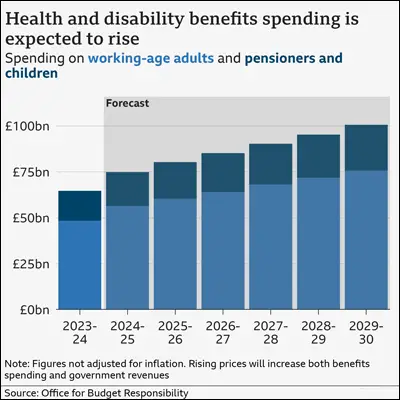
Benefits to support disabled people and those with long-term health conditions cost around £77.1 billion. This is the fastest-growing category of welfare spending in the UK. In May 2025 Rachael Reeves proposed a series of health and disability welfare cuts projected to save the government £5 billion a year by 2030. This policy was abandoned when 120 Labour MPs, more than a quarter of the party's parliamentary numbers, signed a letter urging ministers to scale back the benefit cuts. (33)
In a response to this rebellion Starmer asked Stephen Timms to carry out a review of Personal Independence Payments (PIP), the key disability benefit. Chancellor George Osborne introduced PIP in 2013 to replace Disability Living Allowance (DLA) as part of a swathe of benefits and tax changes made as part of cost-cutting measures. The new PIP system brought in a new face-to-face assessment and regular reviews of a claimant's ability to carry out daily tasks. Osborne claimed these reforms would reduce spending by 20 per cent less each year. However, in 2015 the Office of Budget Responsibility (OBR) have shown PIP has instead cost far more than if the Government had stuck to the previous system - as much as £1.5bn to £2bn more a year. (34)
PIP assessments are carried out by organisations such as Ingeus, Serco, Capita, or Maximus. It is a benefit which is used to help people live independently and cover the extra costs of a disability or health condition. The standard rate is just over £100 a week and the full rate £184 a week, a lifeline for millions of disabled people in the UK. A little more than half (56%) of people are awarded PIP after an assessment. If the decision is negative, claimants can appeal the decision. According to The Big Issue: "The government spent tens of millions of pounds fighting – and in many cases losing – appeals over disability benefit decisions last financial year... More than £50m was forked out by the Department for Work and Pensions (DWP) on staff costs in attempt to uphold decisions about personal independence payments (PIP), according to a freedom of information request." (35)
Stephen Timms interim review was published on 9 July 2025. Timms argued that PIP was not working for millions of disabled people and was "not fit for purpose". He discovered that people applying for the benefit said the process was "dehumanising" and a barrier to work. Timms said his final report due out later this year was not expected to make "crude proposals" on payment changes. (36)
Conservative shadow work and pensions secretary Helen Whately accused the government of being "in denial about the seriousness of the situation of our welfare system and the fact that we have to make savings". Whately argued that: "Disability and sickness benefits have become tantalisingly low-hanging fruit for those who are seeking easy cash from our benefits system… The system is perverse and we will change it." Whately claimed that she had plans to cut at least £23 billion a year from the disability budget. (37)
As Frances Ryan has pointed out: If there is a call to change the benefits system, it is only through the lens of bringing down the so-called bloated bill – not for making the system fairer for disabled people or even for it to work properly to get value for taxpayer money (assessments are so inaccurate that nearly two-thirds of appeals over Pip decisions are successful at tribunal).... The Timms review rightly highlights that the points system – in which claimants are asked a series of questions on everyday tasks and given a score out of 12 – is ill equipped to deal with the changing nature of disability, particularly the growth in mental health and fluctuating conditions." (38)
Abolishing the points-based assessment would also cut out the costly reliance on the private companies that are paid vast sums of public money to carry them out. Between 2012 and 2024, private firms were handed almost £1.8bn to administer Pip tests even as their reports were frequently littered with factual errors and misrepresentation. For some reason you don't hear much about this from those lamenting the "bloated benefits bill". (39)
This figure doesn't include the hundreds of millions spent over the past decade on the appeals system every year, which is only necessary at the current rate because of the widespread inaccuracy of the assessments. The government spends tens of millions each year fighting disabled and ill people who are appealing a benefits decision – only to have the majority of those overturned in favour of the claimant. A Freedom of Information request revealed that the DWP has forked out more than £350 million over the last decade in staff costs in an attempt to uphold decisions about personal independence payments. (40)
The money that would be saved from all this could be used to invest in the services that prevent more people needing disability benefits, from mental health support and preventive NHS care to grants to help with the cost of living. It has been argued that we should bring back indefinite awards for people with permanent conditions. When PIP was introduced in 2013, the Conservatives scrapped the "lifetime awards" that came with DLA as part of their narrative that people were being allowed to fester on benefits. In practice, all it's achieved is using public money to put disabled people through frequent unnecessary retesting. Research by the anti-poverty charity Z2K shows there were more than half a million 'pointless reassessments' last year of people with conditions such as cerebral palsy, learning disabilities and amputations – presumably to check someone's leg hadn't grown back." (41)
One of the main arguments put forward by these rebel Labour MPs is that according to the Rowntree Foundation: "Wealth inequality is high and rising and more marked than income inequality. In the UK, the bottom 50% of the population owned less than 5% of wealth in 2021, and the top 10% a staggering 57% (up from 52.5% in 1995)... The ratio of wealth to income has risen in the UK from 2.3 to 1 in 1948, to 5.7 to 1 in 2020. It has a significant impact on life chances and outcomes, and it generates high levels of poverty amongst those with no wealth assets to fall back on. There are no nations which have high levels of economic inequality and low levels of poverty." (42)
In 2025, the top 1% of households in the UK owned 23% of the country's total aggregate wealth. For the top 5% it was 45% and the top 10% it was 55%. In 1975, the top 1% of the population owned about 18% of the total net personal wealth in the UK. The bottom 50% owned roughly 7% of the country's total marketable wealth. (43)
Another area that should be looked at is housing benefits. It's a means-tested benefit paid to people on low incomes. Housing benefit is withdrawn as income rises, but an increasing number of people in work claim at least some housing benefit. It currently costs £37.3 billion. In 1975 it was £1 billion. That is more than we spend on the police, roads and buying military equipment combined. George Osborne did introduce a number of cuts to the housing benefit system. The most high profile was the so called "bedroom tax" (properly known as the social sector size criteria) which reduced the amount of benefit social tenants could claim if they lived in a property deemed too big for them given the size of their family. (44)
The reason for escalating costs of housing benefits was the selling of council houses. In 1979, there were nearly 6.5 million council homes in the UK. This social housing stock represented a historic peak, with approximately 42% of the British population residing in council housing. By 2025, there were roughly 1.56 million council homes. Now only 7% live in council homes. (45)
If the government had used the money raised from selling council houses (£54 billion) to build more houses we would not have the problems we have now. Under the current rules tenants can buy their council home after living there for three years for 60% of its value if it's a house or 70% if it's a flat. The maximum discount is £102,400 or £136,400 in London. Councils are understandably reluctant to build new homes with the money they receive because it doesn't cover the costs of building a new property, which they may well have to later sell at a discount. (46)
Youth Unemployment
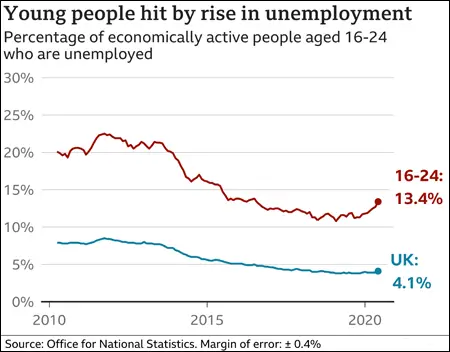
One area of savings identified by Labour, Conservative and Reform concerns youth unemployment. There are approximately 735,000 unemployed individuals aged between 16 to 24. The unemployment rate for young people was 16.2%, up from 14.3% from the year before. In March 2026, there were 1.01 million people aged 16 to 24 who were not in employment, education or training (NEET). That is 13.5% of all 16-to-24-year-olds. The UK has one of the highest rates of youth unemployment in Europe. (47)
One of the major concerns is that there has been a significant rise in young people reporting that health issues, particularly mental health, prevent them from working. As many people predicted would happen, closing schools and forcing young people to stay at home during the Covid lockdowns created an epidemic of mental health problems. (48)
The number of young people claiming Universal Credit for health and disability support has risen by more than 50% over the last five years. A rise in long-term sickness, mental illness and neurodivergence in young people has been one of the main causes of economic inactivity over the past three years, according to research by the Youth Futures Foundation. The report "highlights financial insecurity, deteriorating sleep quality, social media use and cuts to children's and youth services as the leading factors contributing to the recent alarming decline in mental health among young people in England." (49)
It is estimated that there are currently 550,610 children and young people, who have been referred to mental health services in England and on NHS waiting lists for treatment. The average wait exceeds 300 days, with some waiting over two years. Many patients are turned away at assessment because referral thresholds have been raised due to under-capacity. (50)
The types of jobs that traditionally provided a first step onto the career ladder have diminished. The BBC reported: "The UK is experiencing a weak jobs market, with young people particularly affected by cuts in hospitality and graduate schemes." Louise Murphy, senior economist at the Resolution Foundation, said: "Today's data adds to the picture of a generation up against real and complex barriers to finding a good job and improving their living standards. But acting sooner rather than later can help prevent these worrying trends becoming an entrenched crisis." (51)
Alan Milburn was asked by Keir Starmer to carry out a review of Britain's youth jobs crisis. Young People and Work: Interim Report was published on 28th May 2026. Milburn quoted official figures to claim that the number of young people not working or studying had surpassed a million for the first time in more than a decade, Alan Milburn said the government had a responsibility to the next generation to take action.
In the first phase of his review before making final recommendations to the government this autumn, Milburn said Britain was exposed to £125bn in annual losses from a youth jobs crisis that far outstripped almost any other country in Europe. The report showed the lost contribution to the economy and cost to the exchequer from supporting young people through the benefits system was leaving a multibillion-pound financial hole, which he said meant a "whole system reset" involving schools, welfare and employers was needed.
It said the lifetime cost to the exchequer from a young person not in education, employment or training (Neet) between the ages of 18 and 24 was £29,000 a year on average. Highlighting the long-term damage, the report found an individual who was Neet in the period of early adulthood could lose out on £52,000 on average over the course of their working life for every year spent Neet. (52)
Kemi Badenoch believes the problem is that the welfare benefit system is too generous. Badenoch said that she would stop some households being able to get unlimited benefit payments, by reforming the household benefit cap. The cap is a limit on the total amount of benefit payments most working age people can receive. She said its proposals would deliver at least £1bn of savings annually. Badenoch added that the plans would "stop those who abuse the system getting almost unlimited welfare payments". Labour has disputed the figures in the Tory plans and warned it would affect carers and parents of disabled children. The party has also promised to reinstate the two-child benefit cap, which was scrapped by the government in April 2026 lifting 450,000 children out of poverty. This measure cost £2.3 billion. (53)
Is it possible to force the one million people not in education, employment or training (Neet) between the ages of 18 and 24 into work. One of the major problems is the number of unfilled vacancies. A recent report by the Office for National Statistics (ONS) said that the number of job vacancies in the March to May period fell to 707,000, the lowest level since 2021. Liz McKeown, the ONS's director of economic statistics, said the further drop in job vacancies suggested that "firms are becoming more cautious about taking on new staff". The professional services sector saw the largest fall in vacancies, but retail and hospitality also saw significant drops. (54)
The economist Michael Burke has argued that politicians have exaggerated the problem that exists and has criticised the Milburn Report. He argues: (i) The number of NEETs is not out of control, it is below the 25yr average (when records began). (ii) The number has not been rising until very recently; it has been stable at a low level; (iii) Nearly 50% of NEETs don't claim benefits, so the genuine problem of lack of work has nothing to do with benefits; (iv) Another 20% have such severe disabilities that even DWP doesn't expect them to work; (v) This means that 2/3rds of all NEETS cannot be affected by benefit cuts, yet this is the aim of the report; (vi) Contrary to Milburn's assertions, the Low Pay Commission has examined the impact of the higher minimum wage (and 85% of under-25s get more than that) and found no linkage; (vii) The most recent data, produced since the report, does show a rise (still well within pre-existing ranges). But this is evidence of a change in objective circumstances for youth employment and training, not any adverse change in pay, or benefits. (55)
References
(1) World Population Review, Debt to GDP Ratio by Country (2026)
(2) YiLi Chien & Ashley H. Stewart, What’s behind Japan’s High Government Debt? (1 April, 2025)
(3) Timothy Taylor, How Does Japan Sustain Such High Government Debt? (23 December, 2025)
(4) The Resolution Foundation (12 September 2025)
(5) BBC News (27 October 2016)
(6) Forbes Magazine (14 July 2009)
(7) House of Commons Library (8 October 2018)
(8) Institute of Fiscal Studies (12 September 2018)
(9) BBC News (8 March 2018)
(10) BBC News (25 January 2022)
(11) The Guardian (12 February 2021)
(12) House of Commons Library (2026)
(13) The British Medical Journal (3 February 2022)
(14) BBC News (25 June 2024)
(15) BBC News (7 December 2025)
(16) The Guardian (14 July 2026)
(17) The Guardian (26 November 2025)
(18) The Guardian (21 July 2026)
(19) How have government revenues changed over time? (23 August 2023)
(20) Alan Manning, The top rate of income tax (22 April 2015)
(21) Paul Johnson, Institute of Fiscal Studies (11 June 2024)
(22) Paul Johnson, Institute of Fiscal Studies (5 August 2024)
(23) Jill Rutter, National Institute for Government (14 February 2025)
(24) Low Income Tax Group (28 July 2025)
(25) Institute of Fiscal Studies (23 August 2023)
(26) Reform Capital Gains Tax to make it fairer and more efficient (11 October 2024)
(27) The Guardian (23 July 2024)
(28) The Guardian (17 September 2024)
(29) Institute of Fiscal Studies, A decade and a half of historically poor growth has taken its toll (3 June 2024)
(30) Nick Ridpath, Why isn't Britain getting richer anymore? (29 October 2024)
(31) House of Lords Library (5 June 2026)
(32) The Daily Telegraph (7 July 2026)
(33) The Guardian (17 May 2025)
(34) Ruchira Sharma, George Osborne’s PIP reform to disability benefits actually cost Government an extra £1.5bn a year (16 January 2019)
(35) The Big Issue (26 February 2025)
(36) BBC News (7 July 2026)
(37) Disability News Service (9 July 2026)
(38) Frances Ryan, The Guardian (14 July 2026)
(39) Andrew Western, House of Commons (24 February 2026)
(40) The Big Issue (18 September 2023)
(41) Frances Ryan, The Guardian (14 July 2026)
(42) The Rowntree Foundation (2 May 2024)
(43) Journal of Public Economics (14 February 2018)
(44) BBC News (21 September 2015)
(45) The Guardian (4 January 2018)
(46) The Big Issue (16 October 2024)
(47) Youth Unemployment Statistics (18 June 2026)
(48) Larry Elliott, The Guardian (11 June 2026)
(49) Youth Futures Foundation Report (15 July 2025)
(50) Royal College of Psychiatrists, press release (11 February 2026)
(51) BBC News (26 February 2025)
(52) Alan Milburn, Young People and Work: Interim Report (28 May 2026)
(53) BBC News (2 May 2026)
(54) BBC News (18 June 2026)
(55) Michael Burke, NEETs: The Milburn report offers punishment where jobs and education should be (4 June 2026)
Previous Posts
UK's Governments since 2008 have created a massive National Debt (11 July 2026)
How the Wealthy Elite Undermine Democracy in the UK (4th June 2026)
Cicero on Friendship and Old Age (4th June 2026)
Wes Streeting and Labour Together (17th May 2026)
The Strange appintment of Peter Mandelson (5th May, 2026)
Why at the age of 80 I have joined the Green Party (29th March, 2026)
The Vassal State: How America Runs Britain (25th March, 2026)
Should the Government try to control was appears on the Internet? (26th February, 2026)
The Political Ideas of Rutger Bregman (25th January, 2026)
Technofeudalism: Is AI going to destroy Capitalism and Democracy? (19th November, 2025)
How do we stop Nigel Farage from forming a government (14th October, 2025)
Donald Trump and the Deep State (13th August, 2025)
The History of Fascism: Are Vladimir Putin and Donald Trump Fascists? (10th June, 2025)
The CIA memorandum on the death of Gary Underhill (6th April, 2025)
Should George Orwell have chosen the title, 2030, instead of 1984? Keir Starmer as Big Brother. (17th March, 2025)
The Evolution of the Brain. Can you make yourself happy? (16th January, 2025)
Technology and the History Classroom: Should the Teaching Profession Embrace AI? (20th November, 2024)
Venetia Stanley, H. H. Asquith and the First World War (22nd August, 2024)
The General Election Campaign: The Tyranny of the Centre (4th July, 2024)
In Defence of the New History (20th March, 2024)
The Political History of Keir Starmer (25th January, 2024)
JFK Assassination: What Happened in the Trauma Room (23rd November, 2023)
Sir Keir Starmer and his Broken Pledges (1st September, 2023)
Should history students be using ChatGBT? (28th May, 2023)
A historical account of the Daily Mail, the Conservative Party and Migration (18th March, 2023)
Art and the Women's Suffrage Movement (20th January, 2023)
Emancipation of Women: 1870-1928 (15th November, 2022)
The Struggle for Women's Rights: 1500-1870 (21st September, 2022)
The real reason why the FA banned women from playing on their grounds (1st August, 2022)
The WSPU Young Hot Bloods and the Arson Campaign (26th May, 2022)
Interpretations in History (18th April, 2022)
The Student as Teacher (31st December, 2021)
History Simulations in the Classroom (30th November, 2021)
Walter Tull: Football and War Hero (20th October, 2021)
Child Labour and Freedom of the Individual (26th July, 2021)
Don Reynolds and the Assassination of John F. Kennedy (15th June, 2021)
Richard Nixon and the Conspiracy to kill George Wallace in 1972 (5th May, 2021)
The Connections between Watergate and the JFK Assassination (2nd April, 2021)
The Covid-19 Pandemic: An Outline for a Public Inquiry (4th February, 2021)
Why West Ham did not become the best team in England in the 1960s (24th December, 2000)
The Lyndon Baines Johnson Tapes and the John F. Kennedy Assassination (9th November, 2020)
It is Important we Remember the Freedom Riders (11th August, 2020)
Dominic Cummings, Niccolò Machiavelli and Joseph Goebbels (12th July, 2020)
Why so many people in the UK have died of Covid-19 (14th May, 2020)
Why the coronavirus (Covid-19) will probably kill a higher percentage of people in the UK than any other country in Europe.. (12th March, 2020 updated 17th March)
Mandy Rice Davies and Christine Keeler and the MI5 Honey-Trap (29th January, 2020)
Robert F. Kennedy was America's first assassination Conspiracy Theorist (29th November, 2019)
The Zinoviev Letter and the Russian Report: A Story of Two General Elections (24th November, 2019)
The Language of Right-wing Populism: Adolf Hitler to Boris Johnson (11th October, 2019)
The Political Philosophy of Dominic Cummings and the Funding of the Brexit Project (15th September, 2019)
What are the political lessons to learn from the Peterloo Massacre? (19th August, 2019)
Crisis in British Capitalism: Part 1: 1770-1945 (9th August, 2019)
Richard Sorge: The Greatest Spy of the 20th Century? (29th July, 2020)
The Death of Bernardo De Torres (26th May, 2019)
Gas Masks in the Second World War killed more people than they saved (9th May, 2019)
Did St Paul and St Augustine betray the teachings of Jesus? (20th April, 2019)
Stanley Baldwin and his failed attempt to modernise the Conservative Party (15th April, 2019)
The Delusions of Neville Chamberlain and Theresa May (26th February, 2019)
The statement signed by Robert F. Kennedy Jr. and Kathleen Kennedy Townsend (20th January, 2019)
Was Winston Churchill a supporter or an opponent of Fascism? (16th December, 2018)
Why Winston Churchill suffered a landslide defeat in 1945? (10th December, 2018)
The History of Freedom Speech in the UK (25th November, 2018)
Are we heading for a National government and a re-run of 1931? (19th November, 2018)
George Orwell in Spain (15th October, 2018)
Anti-Semitism in Britain today. Jeremy Corbyn and the Jewish Chronicle (23rd August, 2018)
Why was the anti-Nazi German, Gottfried von Cramm, banned from taking part at Wimbledon in 1939? (7th July, 2018)
What kind of society would we have if Evan Durbin had not died in 1948? (28th June, 2018)
The Politics of Immigration: 1945-2018 (21st May, 2018)
State Education in Crisis (27th May, 2018)
Why the decline in newspaper readership is good for democracy (18th April, 2018)
Anti-Semitism in the Labour Party (12th April, 2018)
George Osborne and the British Passport (24th March, 2018)
Boris Johnson and the 1936 Berlin Olympics (22nd March, 2018)
Donald Trump and the History of Tariffs in the United States (12th March, 2018)
Karen Horney: The Founder of Modern Feminism? (1st March, 2018)
The long record of The Daily Mail printing hate stories (19th February, 2018)
John Maynard Keynes, the Daily Mail and the Treaty of Versailles (25th January, 2018)
20 year anniversary of the Spartacus Educational website (2nd September, 2017)
The Hidden History of Ruskin College (17th August, 2017)
Underground child labour in the coal mining industry did not come to an end in 1842 (2nd August, 2017)
Raymond Asquith, killed in a war declared by his father (28th June, 2017)
History shows since it was established in 1896 the Daily Mail has been wrong about virtually every political issue. (4th June, 2017)
The House of Lords needs to be replaced with a House of the People (7th May, 2017)
100 Greatest Britons Candidate: Caroline Norton (28th March, 2017)
100 Greatest Britons Candidate: Mary Wollstonecraft (20th March, 2017)
100 Greatest Britons Candidate: Anne Knight (23rd February, 2017)
100 Greatest Britons Candidate: Elizabeth Heyrick (12th January, 2017)
100 Greatest Britons: Where are the Women? (28th December, 2016)
The Death of Liberalism: Charles and George Trevelyan (19th December, 2016)
Donald Trump and the Crisis in Capitalism (18th November, 2016)
Victor Grayson and the most surprising by-election result in British history (8th October, 2016)
Left-wing pressure groups in the Labour Party (25th September, 2016)
The Peasant's Revolt and the end of Feudalism (3rd September, 2016)
Leon Trotsky and Jeremy Corbyn's Labour Party (15th August, 2016)
Eleanor of Aquitaine, Queen of England (7th August, 2016)
The Media and Jeremy Corbyn (25th July, 2016)
Rupert Murdoch appoints a new prime minister (12th July, 2016)
George Orwell would have voted to leave the European Union (22nd June, 2016)
Is the European Union like the Roman Empire? (11th June, 2016)
Is it possible to be an objective history teacher? (18th May, 2016)
Women Levellers: The Campaign for Equality in the 1640s (12th May, 2016)
The Reichstag Fire was not a Nazi Conspiracy: Historians Interpreting the Past (12th April, 2016)
Why did Emmeline and Christabel Pankhurst join the Conservative Party? (23rd March, 2016)
Mikhail Koltsov and Boris Efimov - Political Idealism and Survival (3rd March, 2016)
Why the name Spartacus Educational? (23rd February, 2016)
Right-wing infiltration of the BBC (1st February, 2016)
Bert Trautmann, a committed Nazi who became a British hero (13th January, 2016)
Frank Foley, a Christian worth remembering at Christmas (24th December, 2015)
How did governments react to the Jewish Migration Crisis in December, 1938? (17th December, 2015)
Does going to war help the careers of politicians? (2nd December, 2015)
Art and Politics: The Work of John Heartfield (18th November, 2015)
The People we should be remembering on Remembrance Sunday (7th November, 2015)
Why Suffragette is a reactionary movie (21st October, 2015)
Volkswagen and Nazi Germany (1st October, 2015)
David Cameron's Trade Union Act and fascism in Europe (23rd September, 2015)
The problems of appearing in a BBC documentary (17th September, 2015)
Mary Tudor, the first Queen of England (12th September, 2015)
Jeremy Corbyn, the new Harold Wilson? (5th September, 2015)
Anne Boleyn in the history classroom (29th August, 2015)
Why the BBC and the Daily Mail ran a false story on anti-fascist campaigner, Cedric Belfrage (22nd August, 2015)
Women and Politics during the Reign of Henry VIII (14th July, 2015)
The Politics of Austerity (16th June, 2015)
Was Henry FitzRoy, the illegitimate son of Henry VIII, murdered? (31st May, 2015)
The long history of the Daily Mail campaigning against the interests of working people (7th May, 2015)
Nigel Farage would have been hung, drawn and quartered if he lived during the reign of Henry VIII (5th May, 2015)
Was social mobility greater under Henry VIII than it is under David Cameron? (29th April, 2015)
Why it is important to study the life and death of Margaret Cheyney in the history classroom (15th April, 2015)
Is Sir Thomas More one of the 10 worst Britons in History? (6th March, 2015)
Was Henry VIII as bad as Adolf Hitler and Joseph Stalin? (12th February, 2015)
The History of Freedom of Speech (13th January, 2015)
The Christmas Truce Football Game in 1914 (24th December, 2014)
The Anglocentric and Sexist misrepresentation of historical facts in The Imitation Game (2nd December, 2014)
The Secret Files of James Jesus Angleton (12th November, 2014)
Ben Bradlee and the Death of Mary Pinchot Meyer (29th October, 2014)
Yuri Nosenko and the Warren Report (15th October, 2014)
The KGB and Martin Luther King (2nd October, 2014)
The Death of Tomás Harris (24th September, 2014)
Simulations in the Classroom (1st September, 2014)
The KGB and the JFK Assassination (21st August, 2014)
West Ham United and the First World War (4th August, 2014)
The First World War and the War Propaganda Bureau (28th July, 2014)
Interpretations in History (8th July, 2014)
Alger Hiss was not framed by the FBI (17th June, 2014)
Google, Bing and Operation Mockingbird: Part 2 (14th June, 2014)
Google, Bing and Operation Mockingbird: The CIA and Search-Engine Results (10th June, 2014)
The Student as Teacher (7th June, 2014)
Is Wikipedia under the control of political extremists? (23rd May, 2014)
Why MI5 did not want you to know about Ernest Holloway Oldham (6th May, 2014)
The Strange Death of Lev Sedov (16th April, 2014)
Why we will never discover who killed John F. Kennedy (27th March, 2014)
The KGB planned to groom Michael Straight to become President of the United States (20th March, 2014)
The Allied Plot to Kill Lenin (7th March, 2014)
Was Rasputin murdered by MI6? (24th February 2014)
Winston Churchill and Chemical Weapons (11th February, 2014)
Pete Seeger and the Media (1st February 2014)
Should history teachers use Blackadder in the classroom? (15th January 2014)
Why did the intelligence services murder Dr. Stephen Ward? (8th January 2014)
Solomon Northup and 12 Years a Slave (4th January 2014)
The Angel of Auschwitz (6th December 2013)
The Death of John F. Kennedy (23rd November 2013)
Adolf Hitler and Women (22nd November 2013)
New Evidence in the Geli Raubal Case (10th November 2013)
Murder Cases in the Classroom (6th November 2013)
Major Truman Smith and the Funding of Adolf Hitler (4th November 2013)
Unity Mitford and Adolf Hitler (30th October 2013)
Claud Cockburn and his fight against Appeasement (26th October 2013)
The Strange Case of William Wiseman (21st October 2013)
Robert Vansittart's Spy Network (17th October 2013)
British Newspaper Reporting of Appeasement and Nazi Germany (14th October 2013)
Paul Dacre, The Daily Mail and Fascism (12th October 2013)
Wallis Simpson and Nazi Germany (11th October 2013)
The Activities of MI5 (9th October 2013)
The Right Club and the Second World War (6th October 2013)
What did Paul Dacre's father do in the war? (4th October 2013)
Ralph Miliband and Lord Rothermere (2nd October 2013)