
Donald Trump and the Economic Crisis
The election of Donald Trump on 8th November, 2016, was the most significant political event since Adolf Hitler managed to persuade the Reichstag to pass the Enabling Act on 24th March 1933. I say this not because I believe Trump is a fascist who is about to become some sort of dictator. In fact, I think over the next four years he will illustrate just how difficult it is for the President of the United States to implement his political ideas. Even if he could carry out his proposed programme, it would not solve the economic problems faced by those who voted for him. If there is a great deal of dissatisfaction now, it will be far greater in 2020.
When I started this course I made it clear that the main objective was to use history to explain current events. So I intend to spend a little time today to try to explain what happened last week. The story begins when the emergence of capitalism in Britain. This was going to be the subject of the next session. The first signs of capitalism began in the 15th century when the country began to move from being a producer of wool to being a manufacturer of cloth. As A. L. Morton, the author of A People's History of England (1938) has pointed out: "Though employing far fewer people than agriculture, the clothing industry became the decisive feature of English economic life, what which marked it off sharply from that of most other European countries and determined the direction and speed of its development."
During this period most of the cloth was produced in the family home and therefore became known as the domestic system. There were three main stages to making cloth. Carding was usually done by children. This involved using a hand-card that removed and untangled the short fibres from the mass. Hand cards were essentially wooden blocks fitted with handles and covered with short metal spikes. The spikes were angled and set in leather. The fibres were worked between the spikes and, be reversing the cards, scrapped off in rolls (cardings) about 12 inches long and just under an inch thick.
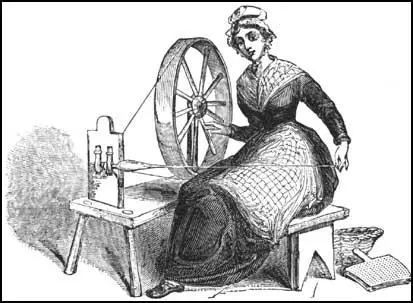
The mother turned these cardings into a continuous thread (yarn). The distaff, a stick about 3 ft long, was held under the left arm, and the fibres of wool drawn from it were twisted spirally by the forefinger and thumb of the right hand. As the thread was spun, it was wound on the spindle. The spinning wheel was invented in Nuremberg in the 1530s. It consisted of a revolving wheel operated by treadle and a driving spindle.
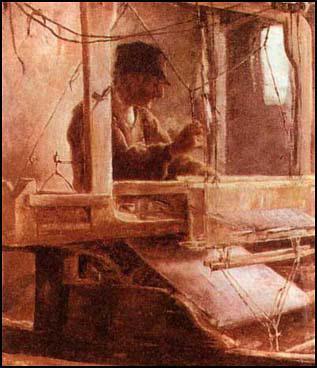
Finally, the father used a handloom to weave the yarn into cloth. The handloom was brought to England by the Romans. The process consisted of interlacing one set of threads of yarn (the warp) with another (the weft). The warp threads are stretched lengthwise in the weaving loom. The weft, the cross-threads, are woven into the warp to make the cloth. Daniel Defoe, the author of A Tour Through the Whole Island of Great Britain (1724) "Among the manufacturers' houses are likewise scattered an infinite number of cottages or small dwellings, in which dwell the workmen which are employed, the women and children of whom, are always busy carding, spinning, etc. so that no hands being unemployed all can gain their bread, even from the youngest to the ancient; anyone above four years old works."
The woven cloth was sold to merchants called clothiers who visited the village with their trains of pack-horses. These men became the first capitalists. To increase production they sometimes they sold raw wool to the spinners. They also sold yarn to weavers who were unable to get enough from family members. Some of the cloth was made into clothes for people living in this country. However, a large amount of cloth was exported to Europe.
In 1555 Parliament became concerned by the growth in wealth of these merchants and passed legislation to deal with the problem: "For as much as the weavers of the realm have as well at this present parliament as at diverse other times complained that the rich and the wealthy clothiers do many ways oppress them, some by setting up and keeping in their houses diverse looms, and keeping and maintaining them by journeymen and persons unskilful, to the decay of a great number of weavers, their wives and households". The legislation limited the number of handlooms that a clothier might keep in his house.
The production and export of cloth continued to grow. In order to protect the woolen cloth industry the import of cotton goods was banned in 1700. In the time of Charles II the export of woolen cloth was estimated to be valued at £1 million. By the beginning of the 18th century it was almost £3 million and by 1760 it was £4 million. However, this was all changed when James Hargreaves invented the spinning-jenny in 1764. Unlike previous spinning machines, the jenny could spin a large number of threads at once.
In 1769, Richard Arkwright patented his water frame. Arkwright's new machine involved three sets of paired rollers that turned at different speeds. While these rollers produced yarn of the correct thickness, a set of spindles twisted the fibres firmly together.
In 1779 by spinning mule that had been invented by Samuel Crompton. Handloom weavers were now guaranteed a constant supply of yarn, full employment and high wages. This period of prosperity did not last long. In 1785, Edmund Cartwright, the younger brother of Major John Cartwright, invented a weaving machine which could be operated by horses or a waterwheel. Cartwright began using power looms in a mill that he part-owned in Manchester. An unskilled boy could weave three and a half pieces of material on a power loom in the time a skilled weaver using traditional methods, wove only one.
These new machines required external power, supplied at first by water. People working from home could no longer compete with the large number of factories being built next to fast flowing rivers. The invention of the steam engine meant that factories could be to be built in a variety of different places.
The building of large factories marked the beginning of modern capitalism. In 1776 the moral philosopher, Adam Smith, published the world's first book on economics. In Inquiry into the Nature and Causes of the Wealth of Nations, Smith outlined the advantages of capitalism. He claimed that the capitalist was motivated by self-interest: "He generally, indeed, neither intends to promote the public interest, nor knows how much he is promoting it.... By pursuing his own interest he frequently promotes that of the society more effectually than when he really intends to promote it.... It is not from the benevolence of the butcher, the brewer, or the baker, that we expect our dinner, but from their regard to their own interest. We address ourselves, not to their humanity but to their self-love, and never talk to them of our own necessities but of their advantages"
Smith argued that capitalism results in inequality. For example, he wrote about the impact poverty had on the lives of the labouring class: "It is not uncommon... in the Highlands of Scotland for a mother who has borne twenty children not to have two alive... In some places one half the children born die before they are four years of age; in many places before they are seven; and in almost all places before they are nine or ten. This great mortality, however, will every where be found chiefly among the children of the common people, who cannot afford to tend them with the same care as those of better station."
To protect the poor Smith argued for government intervention: "The man whose whole life is spent in performing a few simple operations, of which the effects are perhaps always the same, or very nearly the same, has no occasion to exert his understanding or to exercise his invention in finding out expedients for removing difficulties which never occur. He naturally loses, therefore, the habit of such exertion, and generally becomes as stupid and ignorant as it is possible for a human creature to become. The torpor of his mind renders him not only incapable of relishing or bearing a part in any rational conversation, but of conceiving any generous, noble, or tender sentiment, and consequently of forming any just judgment concerning many even of the ordinary duties of private life... But in every improved and civilized society this is the state into which the labouring poor, that is, the great body of the people, must necessarily fall, unless government takes some pains to prevent it."
Adam Smith pointed out the dangers of a system that allowed individuals to pursue individual self-interest at the detriment of the rest of society. He warned against the establishment of monopolies. "A monopoly granted either to an individual or to a trading company has the same effect as a secret in trade or manufactures. The monopolists, by keeping the market constantly under-stocked, by never fully supplying the effectual demand, sell their commodities much above the natural price, and raise their emoluments, whether they consist in wages or profit, greatly above their natural rate."
Capitalism was not without its critics. In 1844, Karl Marx, a young lawyer from Germany, was living in Paris, wrote an article for a newspaper attacking the way capitalism treated the working-classes in France. At the same time, Friedrich Engels, the son of a wealthy German industrialist, was managing his cotton-factory in Manchester. Engels was shocked by the poverty in the city and began writing an account that was published as Condition of the Working Class in England (1844).
Engels met Marx while on a visit to France and decided to work together. It was a good partnership, whereas Marx was at his best when dealing with difficult abstract concepts, Engels had the ability to write for a mass audience. Engels also helped to financially support Marx while he was writing. Marx spent his time trying to understand the workings of capitalist society, the factors governing the process of history and how the proletariat could help bring about a socialist revolution. Unlike previous philosophers, Marx was not only interested in discovering the truth. As he was to write later, in the past "philosophers have only interpreted the world in various ways; the point is, to change it".
The Communist Manifesto was published in 1848. It begins with the assertion, "The history of all hitherto existing society is the history of class struggles." Marx argued that if you are to understand human history you must not see it as the story of great individuals or the conflict between states. Instead, you must see it as the story of social classes and their struggles with each other. Marx explained that social classes had changed over time but in the 19th century the most important classes were the bourgeoisie and the proletariat. By the term bourgeoisie Marx meant the owners of the factories and the raw materials which are processed in them. The proletariat, on the other hand, own very little and are forced to sell their labour to the capitalists.
Marx believed that these two classes are not merely different from each other, but also have different interests. He went on to argue that the conflict between these two classes would eventually lead to revolution and the triumph of the proletariat. With the disappearance of the bourgeoisie as a class, there would no longer be a class society. As Engels later wrote, "The state is not abolished, it withers away."
Marx and Engels were seen as dangerous men and moved around Europe until they settled in London in 1849. In 1867 Marx published the first volume of Das Kapital. The book dealt with important concepts such as surplus value (the notion that a worker receives only the exchange-value, not the use-value, of his labour); division of labour (where workers become a "mere appendage of the machine") and the industrial reserve army (the theory that capitalism creates unemployment as a means of keeping the workers in check).
Marx argued that the laws of capitalism will bring about its destruction. Capitalist competition will lead to a diminishing number of monopoly capitalists, while at the same time, the misery and oppression of the proletariat would increase. Marx claimed that as a class, the proletariat will gradually become "disciplined, united and organised by the very mechanism of the process of capitalist production" and eventually will overthrow the system that is the cause of their suffering.
Karl Marx died on the 14th March, 1883. Capitalism continued and despite going through several periods of recession it continued. One of the main reasons for this was that the workers were fairly successful in organizing in unions in obtaining better wages. The system also developed successful ways of developing what Marx had caused "false political consciousness".
After the First World War it was the United States that became the most advanced capitalist country. In October, 1929, the Wall Street Crash took place, when shares lost 47 per cent of its value in twenty-six days. This created the Great Depression. At the time many thought this was the end of capitalism and large numbers of people became socialists and communists. Others were attracted to the far-right and became committed fascists.
Politicians responded to the crisis in different ways. Ramsay MacDonald, the 63-year-old British prime-minister, was slow to react to the crisis that caused large-scale unemployment. Relying on the advice of the economist John Maynard Keynes, the former prime-minister, David Lloyd George, published a pamphlet, We Can Conquer Unemployment, where he proposed a government scheme where 350,000 men were to be employed on road-building, 60,000 on housing, 60,000 on telephone development and 62,000 on electrical development. The cost would be £250 million, and the money would be raised by loan.
Philip Snowden, his 65-year-old Chancellor of the Exchequer, rejected this proposal and wrote in his notebook on 14th August 1930, that "the trade of the world has come near to collapse and nothing we can do will stop the increase in unemployment." By December 1930, 2,725,000 people in Britain were recorded as being unemployed (20% of the insured workforce), and exports had fallen in value by 50%.
Snowden was mainly concerned about the impact of the increase in public-spending. At a cabinet meeting in January 1931, he estimated that the budget deficit for 1930-31 would be £40 million. Snowden argued that it might be necessary to cut unemployment benefit. Margaret Bondfield looked into this suggestion and claimed that the government could save £6 million a year if they cut benefit rates by 2s. a week and to restrict the benefit rights of married women, seasonal workers and short-time workers.
In March 1931 MacDonald asked Sir George May, the retired former company secretary of the Prudential Assurance Company, to form a committee to look into Britain's economic problems. At the same time, John Maynard Keynes, the chairman of the Economic Advisory Council, published his report on the causes and remedies for the depression. This included an increase in public spending and by curtailing British investment overseas.
Philip Snowden rejected these ideas and this was followed by the resignation of Charles Trevelyan, the Minister of Education. "For some time I have realised that I am very much out of sympathy with the general method of Government policy. In the present disastrous condition of trade it seems to me that the crisis requires big Socialist measures. We ought to be demonstrating to the country the alternatives to economy and protection. Our value as a Government today should be to make people realise that Socialism is that alternative."
When the May Committee produced its report in July, 1931, it forecast a huge budget deficit of £120 million and recommended that the government should reduce its expenditure by £97,000,000, including a £67,000,000 cut in unemployment benefits. The two Labour Party representatives on the committee, Arthur Pugh and Charles Latham, refused to sign the report.
On 5th August, Keynes wrote to MacDonald, describing the May Report as "the most foolish document I ever had the misfortune to read." He argued that the committee's recommendations clearly represented "an effort to make the existing deflation effective by bringing incomes down to the level of prices" and if adopted in isolation, they would result in "a most gross perversion of social justice".
The vast majority of Labour MPs refused to support the May Report and MacDonald went to see King George V and offered his resignation. Under pressure from the king he was persuaded to form a National Government that was mainly made up of Conservative and Liberal MPs.
On 8th September 1931, the National Government's programme of £70 million economy programme was debated in the House of Commons. This included a £13 million cut in unemployment benefit and a 10% cut in public sector wages. Tom Johnson, who wound up the debate for the Labour Party, declared that these policies were "not of a National Government but of a Wall Street Government". In the end the Government won by 309 votes to 249, but only 12 Labour M.P.s voted for the measures.
Of course the measures were a complete failure. Snowden's measures were deflationary and merely reduced purchasing power in the economy, worsening the situation, and by the end of 1931 unemployment had reached nearly 3 million. By 1933 over 25% of the insured workforce were out of work.
In the 1932 Presidential Election, the American people rejected the austerity policies of Herbert Hoover and elected Franklin D. Roosevelt to office. As William E. Leuchtenburg, the author of Franklin D. Roosevelt and the New Deal (1963), has argued: "Franklin Roosevelt swept to victory with 22,800,000 votes to Hoover's 15,750,000. With a 472-59 margin in the Electoral College, he captured every state south and west of Pennsylvania. Roosevelt carried more counties than a presidential candidate had ever won before, including 282 that had never gone Democratic. Of the forty states in Hoover's victory coalition four years before, the President held but six."
During the election campaign Roosevelt promised to reduce taxation. After taking office he initially rejected the idea of increased public spending. However, by the spring of 1933, the needs of more than fifteen million unemployed had overwhelmed the resources of local governments. In some areas, as many as 90 per cent of the people were on relief and it was clear something needed to be done. His close advisors and colleagues, Frances Perkins, Harry Hopkins, Rexford Tugwell, Robert LaFollette Jr. Robert Wagner, Fiorello LaGuardia, George Norris and Edward Costigan eventually won him over to a new approach to the problem.
On 9th March 1933, Roosevelt called a special session of Congress. He told the members that unemployment could only be solved "by direct recruiting by the Government itself." For the next three months, Roosevelt proposed, and Congress passed, a series of important bills that attempted to deal with the problem of unemployment. The special session of Congress became known as the Hundred Days and provided the basis for Roosevelt's New Deal.
The government employed people to carry out a range of different tasks. These projects included the Works Projects Administration (WPA), the Civilian Conservation Corps (CCC), the National Youth Administration (NYA), the National Recovery Act (NRA) and the Public Works Administration (PWA). As well as trying to reduce unemployment, Roosevelt also attempted to reduce the misery for those who were unable to work. One of the bodies Roosevelt formed was the Federal Emergency Relief Administration which provided federal money to help those in desperate need.
To help pay for these measures Roosevelt persuaded Congress to pass the Wealth Tax Act in August, 1935. It was a progressive tax that took up to 75 percent on incomes over $5 million. Roosevelt admitted that the tax had created a great deal of hostility: "The forces of organized money... are unanimous in their hate for me - and I welcome their hatred. I should like to have it said of my first administration that in it the forces of selfishness and of lust for power met their match."
When Roosevelt took office the national deficit was nearly $3,000,000,000 and the unemployment-rate was 23.6%. His Treasury Secretary Henry Morgenthau, and aides within the Treasury Department favored an approach that sought to balance the federal budget. But other advisers in the President's inner circle, including Harry Hopkins, Marriner Eccles and Henry Wallace, had accepted the recent theories of John Maynard Keynes, who argued that technically advanced economies would need permanent budget deficits or other measures (such as redistribution of income away from the wealthy) to stimulate consumption of goods and to maintain full employment. It was argued that it was the attempt to balance the budget that was causing the recession.
President Roosevelt was eventually convinced by these arguments and he recognized the need for increased government expenditures to put people back to work. An important part of his New Deal programme was increased spending on government expenditures for relief and work schemes. From 1933 to 1937, unemployment was reduced from 25% to 14%.
Roosevelt was much attacked by his political opponents for not concentrating on reducing the national deficit. However, as Roosevelt explained in a speech in 1936: "To balance our budget in 1933 or 1934 or 1935 would have been a crime against the American people. To do so we should either have had to make a capital levy that would have been confiscatory, or we should have had to set our face against human suffering with callous indifference. When Americans suffered, we refused to pass by on the other side. Humanity came first."
Roosevelt was attacked for not keeping his promise to balance the budget. Some went as far as accusing Roosevelt of being a communist. Those on the left hated Roosevelt because they believed that his policies helped save capitalism. However, his economic policies were popular with the American people and he defeated his Republican presidential candidates in 1936 (Alfred M. Landon), 1940 (Wendell Willkie) and 1944 (Thomas E. Dewey).
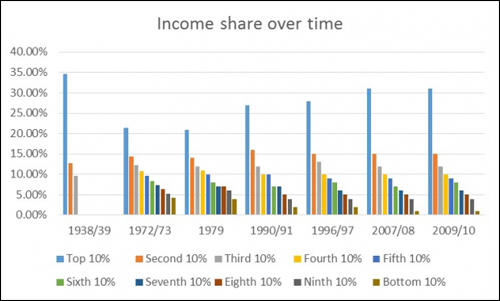
After the Second World War it European countries that were attracted to the economic ideas of John Maynard Keynes. Up until the late 1970s it provided a growing economy and low unemployment rates. It also help to narrow the gap between the rich and the poor. For example, the data available shows that the share of income going to the top 10% of the population fell over the 40 years to 1979, from 34.6% in 1938 to 21% in 1979, while the share going to the bottom 10% rose slightly.
The 1973 oil crisis resulted in high inflation. In the UK inflation reached 26.9% in the 12 months to August 1975. In an effort to maintain the living standards of their members, trade unions demanded higher wages which in turn led to even higher inflation. The number of industrial disputes also increased during this period. On 22nd January 1979 more people in the UK took strike action, than on any day since the General Strike of 1926.
Margaret Thatcher was elected to power in Britain in 1979 and Ronald Reagan in 1980. They both embraced the economic theories of Friedrich Hayek and Milton Friedman that became known as Neo-Liberalism. This was a return to the world before the Great Depression in the 1930s. It was the resurgence of 19th century ideas associated with laissez-faire economic liberalism. They were also the economic policies that Karl Marx believed would lead to a socialist revolution.
Neo-Liberalism meant privatization, fiscal austerity, deregulation, free trade, and reductions in government spending in order to enhance the role of the private sector in the economy. It also involved passing legislation that weakened the trade union movement. These policies completely reversed the move towards a more equal society. Since the early 1980s the gap between rich and poor has widened considerably.
During this period China has emerged as America's main economic rival. Although it claims to be a communist country, in reality it is state capitalist economy. This gives it great advantages over laissez-faire capitalism. For example, it has totally control over the cost of labour. (This is what happened in Germany in the 1930s.) It also has complete control over investment in certain industries. It can therefore give out state subsidies to industries in trouble, for example, steel. It also invests in other countries and controls over 30% of America's national debt.
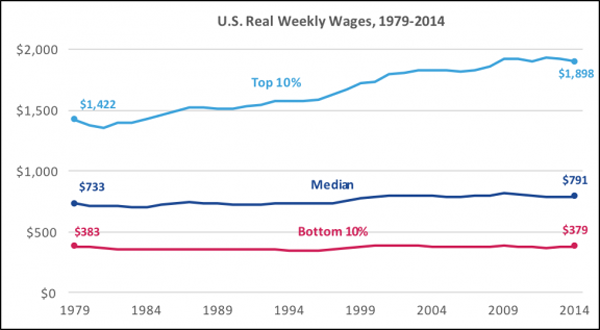
The second Great Depression took place in 2007. Its consequences are still being felt today. This time the major problem is not unemployment. Yesterday it was announced that Britain has an unemployment rate of 4.8%. The lowest in 11 years. USA has an unemployment rate of 4.9%. Why, therefore, did American workers vote for Trump? The reason is low wages. The majority of the American people have seen a fall in their living standards since the end of the 1970s.
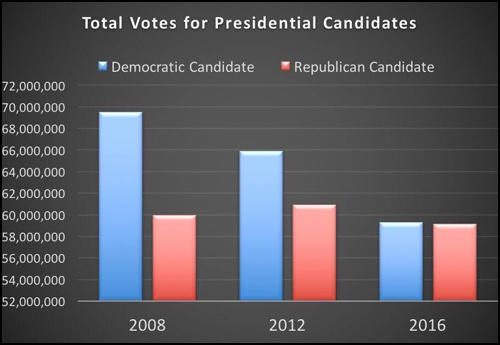
Donald Trump did not win the popular vote in the 2016 Presidential Election. In fact, his 61,125,956 votes were not much higher than those figures obtained by Mitt Romney (60,933,504) and John McCain (59,948,323). The main problem was Clinton's vote (62,391,335) compared to that of Barack Obama - 65,915,795 (2012) and 69,498,516 (2008).
Will the proposals of Donald Trump work? Will Congress allow him to place high tariffs on goods imported from abroad? If they do it will cause inflation and is unlikely to persuade capitalists to invest in manufacturing in the United States. Do the businessmen who fund the political parties in America really want an end to the cheap labour provided by Mexico?
In his first speech after being elected Trump spoke of a massive investment in America's infra-structure. In other words, something similar to Roosevelt's New Deal. However, he is also committed to reducing taxes for the wealthy. How is he going to pay for this? Will Congress allow him to increase public borrowing?
I think he will probably cut defence spending and significantly reduce America military commitment to Europe and other areas, especially in the Middle-East. But this will not be enough to please those people who voted for Trump in the election. What kind of candidate will Americans vote for in 2020?