

Carl M Shoffler
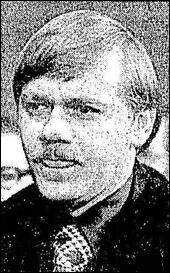
Carl M Shoffler, the son of Allen Marion Schoffler and Eleanor Larue Smith was born in Ashland, Pennsylvania, in 1945. After attending university in Washington, he spent four years in the Army, including a tour in Vietnam. (1) Carl Oglesby has claimed that during this period he met James W. McCord. (2)
Shoffler served for years in the Vint Hill Farm Station in Virginia. This is one of the NSA's most important domestic "listening posts." Staffed by personnel assigned to the Army Security Agency (ASA), Vint Hill Farm is thought to be responsible for making intercepting communications traffic emanating from Washington's Embassy Row. (3)
Jim Hougan claims that "Shoffler was a born conspirator, forever setting traps for the wicked. Affable and very intelligent, he was a veteran of the Army Security Agency and... working closely with the National Security Agency (NSA), Vint Hill was an antenna farm whose classified mission was to intercept Soviet Bloc radio transmissions – as well as communications among anti-war organizations, radical groups, and left-wing think tanks headquartered in the capital." (4)
In 1969 Shoffler became a member of the Metropolitan Police Department Intelligence Division. According to the The Washington Post Shoffler "was involved in the kinds of cases they make into movies. The cases included terrorist acts, hate crimes and investigations of political extremist groups. He was called a master of disguise, a detective with an enormously wide range of sources and informants and an authority on criminal psychology." (5)
Ira Silverman argued: "Other cops call their informants snitches or stoolies, and often treat them with contempt. Carl Shoffler... called them 'sources' and, sometimes, friends. He gave out his home telephone number to mobsters on the run, to suspected terrorists, and to defectors from hate groups. For most people engaged in police work, especially those devoted to their families, such a practice would be unthinkable. But for Shoffler it was a way to build trust. He needed those unsavory informants; he didn't coddle them, but they knew that he would always be up front and straight with them...Shoffler put together the informants, cops, federal agents, and investigative strategies that led to the closing of dozens of major cases. His style was stealth." (6)
Jim Hougan investigated Shoffler and one of his Confidential Informants, Robert Sorkin told him about his own enforced recruitment as an "undercover" agent for Shoffler's "organised crime intelligence bureau". Sorkin described the "bureau" as a multi-jurisdictional unit that included agents from the IRS, FBI, DEA, AFT, and police. In other words, it was a top secret super-COINTELPRO2 team." (7)
Robert Merritt
Shoffler recruited Robert Merritt as a "Confidential Informant". Merritt later recalled "From the spring of 1970 until October 1971 I worked for Carl and for the MPD Intelligence Division… In October 1971… Carl arranged for me to be transferred to the Washington, D. C. field office of the Federal Bureau of Investigation." (8)
Robert Merritt also had his own informants, one of whom tipped him off on 1 June 1972, of the burglars' plan to break into the Democratic National Committee at the Watergate Building two weeks later. Merritt passed this information to Carl Shoffler who set up an entrapment scheme. His plan was to become the most famous detective in the world. Shoffler arrested the burglars inside the Watergate building on 17 June 1972, shortly after midnight. (9)
Jim Hougan has raised questions why Shoffler volunteered for a second shift that night. This meant two eight-hour shifts back-to-back. "The following day was Shoffler's birthday. His wife and children had gone to Pennsylvania on the afternoon of 16 June to spend the weekend at Shoffler's parents' home. Shoffler was to join them that weekend to celebrate his birthday with his parents. Given the long journey in front of him, it seems odd that he chose to work a second shift on that particular night." (10)
Shoffler, who had been injured on duty some months before, was assigned to desk work on the evening of 16 June 1972. His shift ended at 10.00 p.m., but he voluntarily undertook a second shift, joining a plainclothes tactical unit cruising the streets in the early-morning hours. Shoffler was sitting with three other officers, in a parked police car, a minute from Watergate building when Watergate Security Guard Frank Wills found the second taped door and called the police for help. (11)
Watergate
On 17th June 1972, Frank Sturgis, Virgilio Gonzalez, Eugenio Martinez, Bernard L. Barker and James W. McCord were arrested during a break-in into the Democratic Party headquarters at Watergate Office Building. When arrested Barker had his hotel key in his pocket. In his hotel room the police found a briefcase containing $4,600. The money was in hundred-dollar bills in sequential serial numbers that linked to the money found on the Watergate burglars. They also found two address books with the name Howard Hunt and details that he worked in the White House. (12)
E. Howard Hunt was also highly suspicious of Carl Shoffler. In an interview with Time Magazine he asked why Shoffler was in a position to arrest the Watergate burglars on 17 June 1972: "There were just too many fishy things that occurred. What was the Mod Squad (Shoffler's group) doing out on the street some two or three hours after they were supposed to be off duty? McCord was an electronic hitchhiker who shouldn't have been allowed on our operation… There were just too many things that went wrong for them all to be a coincidence." (13)
Captain Edmund Chung was Shoffler's commanding officer at Vint Hill Farm Station in Virginia. Chung claims that he had dinner several months after the Watergate break-in. According to Chung, Shoffler told him that the arrests were the result of a tip-off and that he had been in contact with Alfred Baldwin prior to the break-in. Shoffler added that if he ever made the whole story public, "his life wouldn't be worth a nickel". Shoffler later denied the story and suggested that Chung was a CIA agent. (14)
Jim Hougan has suggested it was Carl Shoffler who tipped off Bob Woodward to be in court to see the Watergate burglars when they first appeared in court for their arraignment on Saturday, June 17, 1972, just hours after their early-morning arrest. It may be more than a chain of coincidences, though Shoffler himself, admitted, considering the information available, said: "If I was a jury, I'd convict me." (15)
Bob Woodward later wrote about his attendance at the courtroom. "One person stood out. In a middle row sat a young man with fashionably long hair and an expensive suit with slightly flared lapels, his chin high, his eyes searching the room as if he were in unfamiliar surroundings." Woodward sat down next to him and asked if he was in court because of the Watergate arrests. "Perhaps," the man said. "I'm not the attorney of record. I'm acting as an individual." He then said his name was Douglas Caddy. (16)
Douglas Caddy later recalled: "As the five were being arraigned in court late that Saturday, a Washington Post reporter named Bob Woodward, himself a former military intelligence agent assigned to the Nixon White House, sought me out. I found myself in the awkward position of providing evasive answers, because at that point few persons knew of the involvement of Hunt and Liddy, and anything I might say could place them in legal jeopardy." (17)
During the court hearing James W. McCord was asked by the judge about his current employment. He replied that he was a security consultant and then went on to say he had previously worked for the CIA. As soon as Woodward heard this, he knew he had an interesting news story. Why had McCord revealed his association with the CIA? Is it possible that Woodward had been told by someone in the CIA that he was going to give that information that morning? (18)
Robert Merritt
According to Robert Merritt: "Shoffler came to my apartment in Washington, DC, late in the morning of the day of the events at Watergate and exulted in having made the arrests. He told me that he had had secretly telephoned the Washington Post soon after the arrests to tip the newspaper off to what had occurred… Shoffler said, ‘The intention of the Watergate break-in was to destroy the Nixon presidency. President Nixon was guilty of nothing in its planning'. Shoffler said that there were hidden motivations involved, such as the fear of law enforcement agencies that their turf would be reduced by President Nixon through a scheme known as the Huston Plan, the CIA's concern that President Nixon planned to reorganize the intelligence agencies and their operations, and the Defense Department's opposition to President Nixon's new China policy." (19)
Merritt, who was bi-sexual, claimed that Shoffler approached him and told him to establish a homosexual relationship with Caddy, stating falsely that Caddy was gay and a supporter of Communist causes. In fact, Caddy had a long record of being a right-wing activist being the National Director of the Young Americans for Freedom. (20)
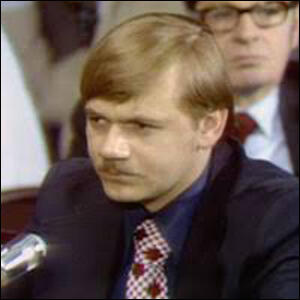
Robert Merritt recalled that on 20 June 1972, "Shoffler showed up at my apartment with his supervisor, Police Sergeant. Paul Leeper. They asked me if I knew someone by the name of Douglas Caddy, who lived at the Georgetown House, a high-rise apartment, at 2121 P St., N.W. which was directly across the street from my apartment. They wanted me to establish a sexual relationship with Douglas Caddy knew to show up for the arraignment of the burglars after the arrest. They asserted that Douglas Caddy had to be in on the conspiracy with the burglars and that in the past he had been shadowed when he frequented a leather-Levi gay bar in Greenwich Village in Manhattan… They told me that this was the most important thing that I could do for my country and that I would be well-paid if I undertook the assignment. Their initial offer was $10,000. I did not commit to doing the assignment." (21)
Merritt eventually told Shoffler that he was unwilling to carry out the assignment. In March 1973, nine months after the initial overture and a month after the first Watergate trial ended, Merritt met with Shoffler, Paul Leeper, and two FBI agents, Terry O'Connor and William T. Tucker. Once again, they attempted to persuade him to take the Caddy assignment, this time offering an initial $25,000. When he refused Leeper said that he could be paid as much as $100,000 if he took the assignment. According to his own testimony, Merritt again refused. (22)
Daoud Salahuddin
David Theodore Belfield changed his name to Daoud Salahuddin when he was converted to Islam. He met Said Ramadan, an Egyptian lawyer and Islamic scholar, in 1975, and Ramadan later became his mentor. An article in the New Yorker quotes him stating that as an "angry and alienated" African-American, "my biggest aspiration was to bring America to its knees, but I didn't know how". (23)
Federal and local authorities are convinced that in 1980, Salahuddin, posing as a postal carrier, shot and killed Ali Akbar Tabatabai in the victim's Bethesda home. A press officer in the Iranian Embassy in Washington during the reign of the shah, Tabatabai had become a leading critic of the Ayatollah Ruhollah Khomeini. After Tabataba was murdered Salahuddin fled to Iran. (24)
According to the The Washington Post Shoffler served on the task force that assisted Montgomery County police in the case and, through his sources, made contact with Salahuddin. A former reporter said that while other authorities were treating Salahuddin as a murderer and a terrorist, Mr. Shoffler was speaking with him on the phone, attempting to persuade him to return and treating him as a 'revolutionary soldier.' Only recently, Salahuddin is said to have called to check on Mr. Shoffler's health and wish him well. (25)
Shoffler spent 16 years in the Metropolitan Police Department Intelligence Division before retiring with a pension in 1989. Then he became an investigator for the Fire Department of Prince Georges County, Maryland. (26)
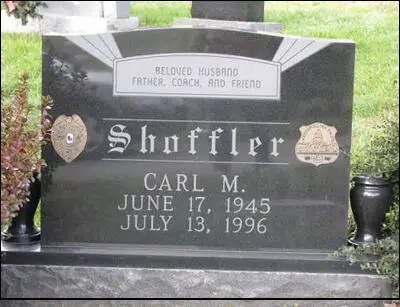
Carl M. Shoffler died on 13 July 1998 at Johns Hopkins Hospital in Baltimore from pancreatitis. He was survived by his wife of 30 years, Helen Boyd Shoffler and three children, Karl, Loren and Michelle. (27)
Primary Sources
(1) The Washington Post (14 July 1996)
Carl M. Shoffler, 51, a Prince George's County fire official and former D.C. police undercover detective who became a legend among observers and peers for his investigations of everything from organized crime to the Watergate break-in, died of pancreatitis July 13 at Johns Hopkins Hospital in Baltimore.
The 20-year police veteran was involved in the kinds of cases they make into movies. The cases included terrorist acts, hate crimes and investigations of political extremist groups. He was called a master of disguise, a detective with an enormously wide range of sources and informants and an authority on criminal psychology.
Although he was widely known in the law enforcement community, his work, by its nature, kept him largely out of the public eye. But that changed in 1972, when a series of serendipitous accidents resulted in his taking part in the arrest of five people in the most famous "third-rate burglary" in U.S. history.
At 1:52 a.m. on June 17, 1972, he and two other plainclothes officers had just driven under the Whitehurst Freeway on their way to Georgetown when a dispatcher alerted them to a "door's open" call at the Watergate office complex and asked them to check for a possible robbery.
The officers, who were going off duty, agreed to investigate. A marked police cruiser, which initially had been dispatched to the scene, had run out of gas. The officers met with a Watergate security guard, who told them of his suspicions of burglars. The detectives eventually found themselves in the offices of the Democratic National Committee and were the captors of five men who would become known as the Watergate burglars.
The burglars, whose crimes eventually were linked to the Republican White House of Richard M. Nixon, had thought they were protected by a lookout in the Howard Johnson Motor Lodge across from the Watergate. But the appearance of the scruffy "casual clothes" detectives in their battered, unmarked car did not raise suspicions. The Watergate burglars were not warned in time to flee the building.
The lookout was spotted by Mr. Shoffler while he was crawling, with gun in hand, along a building ledge. The detectives booked their captives at 2nd District police headquarters, and by that time, they had become more than a little suspicious.
The burglars seemed too neatly attired, in jackets and ties, to be typical criminals, and the fact that they casually waived their rights to attorneys only heightened suspicions. The burglars, who had carefully prepared false identities for just such an emergency, then suffered a setback when two of them became confused and claimed to be the same person. It was the first thread to unravel in a drama that lasted until Nixon resigned as president in 1974.
Long before Watergate, Mr. Shoffler had gained the trust and admiration of many officers, reporters and even criminals. After learning of the detective's death, former police colleagues recalled him as a master of interrogation and criminal psychology. Colleagues and observers said his ability to get a confession or gain a valuable piece of information had to do with his quiet honesty and an ability to understand the intent of ideologically motivated criminals rather than trickery or threats.
He also was described as a dogged and determined officer who was proud of working an "11-day week" and of relentlessly continuing a hunt when others had given up.
That might be illustrated by his dealings with Daoud Salahuddin. Salahuddin, born as David Belfield, was a college student, martial arts expert and Shiite Muslim. Federal and local authorities are convinced that in 1980, Salahuddin, posing as a postal carrier, shot and killed Ali Akbar Tabatabai in the victim's Bethesda home. A press officer in the Iranian Embassy in Washington during the reign of the shah, Tabatabai had become a leading critic of the Ayatollah Ruhollah Khomeini.
Salahuddin escaped to Iran, beyond the reach of U.S. law. Mr. Shoffler served on the task force that assisted Montgomery County police in the case and, through his sources, made contact with Salahuddin. A former reporter said that while other authorities were treating Salahuddin as a murderer and a terrorist, Mr. Shoffler was speaking with him on the phone, attempting to persuade him to return and treating him as a "revolutionary soldier." Only recently, Salahuddin is said to have called to check on Mr. Shoffler's health and wish him well.
Mr. Shoffler, who lived in Bowie, was a native of Ashland, Pa. He served in the Army in the mid- to late 1960s, including tours with the Army Security Agency and in Vietnam. He attended American University and Prince George's Community College.
He served with the D.C. police, mainly as a detective in its criminal intelligence unit, from 1969 to 1989. He then joined the Prince George's County Fire Department, where he was a fire investigator and chief intelligence investigator at the time of his death.
Mr. Shoffler was a charter member of the Combined Law Enforcement Intelligence Group and was certified as a polygraph expert. He was a member of the D.C. Fraternal Order of Police, the D.C. Retired Detectives Association and the Maryland Arson Association.
For more than 20 years, he coached a variety of Bowie community athletic teams including football and girls softball. He also had coached at Bowie and Eleanor Roosevelt high schools and at Riverdale Baptist School.
Survivors include his wife of 30 years, Helen Elizabeth Boyd Shoffler of Bowie; three children, Karl Shawn Shoffler of Laurel, Loren Allen Shoffler of Berlin, Md., and Michelle Scarlett Shoffler of Bowie; and his parents, Allen and Eleanor Shoffler, a brother, David, and two sisters, Barbara Hoover and Fay Fausnaught, all of Pennsylvania.
(2) The New York Times (16 July 1996)
Carl M. Shoffler, one of three Washington policemen whose arrest of five burglars 24 years ago touched off the Watergate scandals and ultimately brought down a Presidency, died on Saturday at Johns Hopkins Hospital in Baltimore. He was 51 and lived in Bowie, Md. The cause was pancreatitis.
Mr. Shoffler, another plainclothes officer and a police sergeant were not far from the Watergate hotel and office complex in Washington early on June 17, 1972, when they received a report that a door had been found open at the Democratic National Committee's offices there.
Arriving at the scene, they discovered five men trying to burglarize and wiretap the Democratic offices, in what was later found to be part of a pattern of Republican political espionage.
The five men seized at the Watergate were Bernard L. Barker, Virgilio R. Gonzalez, Eugenio R. Martinez, James W. McCord Jr. and Frank A. Sturgis. They and two other men -- E. Howard Hunt Jr. and G. Gordon Liddy -- all either pleaded guilty or were convicted at trial in connection with the break-in, and all, it turned out, had been working, directly or indirectly, for President Richard M. Nixon's re-election campaign committee.
Mr. Nixon easily won re-election in November 1972. But the ever widening scandals from which the Watergate arrests proceeded, largely involving Administration efforts to keep the burglars silent about their ties to the White House, ultimately led him to resign in 1974, the only United States President to do so.
Mr. Shoffler was apparently the right officer to handle the Watergate arrests. As National Review put it in a 1992 article: "When Watergate burglar Eugenio Martinez and his team were apprehended, Martinez struggled with arresting officer Carl Shoffler to conceal something on his person. Shoffler wrestled from him a key, which the F.B.I. identified as fitting the desk of Ida Wells," a member of the Democratic National Committee staff.
And in a 1976 book, Sam Dash, who had been chief counsel to the Senate Watergate committee, described Mr. Shoffler as one of "the foundation-laying witnesses" at the committee's hearings, which found a broad pattern of White House wrongdoing.
But if Mr. Shoffler played a leading role in Watergate's opening act, "he never bragged about it," Detective Ronald Robertson, chairman of the Washington police officers' and sergeants' union, said yesterday.
"He just did his job," Detective Robertson said, "and went quietly on his way. I don't think it changed his life one bit."
Mr. Shoffler, a native of Ashland, Pa., attended American University in Washington, spent four years in the Army, including a tour in Vietnam, and then joined the Washington police force in 1969. He became a detective and spent 16 years in the department's intelligence unit before retiring with a pension in 1989. Then he became an investigator for the Fire Department of Prince Georges County, Md. At his death, his title there was chief intelligence investigator.
He is survived by his wife of three decades, Helen Elizabeth Boyd Shoffler; three children, Karl Shawn Shoffler of Laurel, Md., Loren Allen Shoffler of Berlin, Md., and Michelle Scarlett Shoffler of Bowie; his parents, Allen and Eleanor Shoffler, who live in Pennsylvania; two sisters, Barbara Hoover and Fay Fausnaught, both of Pennsylvania, and a brother, David, also of Pennsylvania.
(3) Ira Silverman, The New Yorker (22 July 1996)
Other cops call their informants snitches or stoolies, and often treat them with contempt. Carl Shoffler, the legendary Washington, D.C., police intelligence detective, who died on July 13th, called them "sources" and, sometimes, friends. He gave out his home telephone number to mobsters on the run, to suspected terrorists, and to defectors from hate groups. For most people engaged in police work, especially those devoted to their families, such a practice would be unthinkable. But for Shoffler it was a way to build trust. He needed those unsavory informants; he didn't coddle them, but they knew that he would always be up front and straight with them.
In 1982, Shoffier and another detective, Michael Hubbard, wrote a confidential police memorandum that would eventually cause havoc in D.C. The detectives had found three reliable informants who were ready to testify before a grand jury that they had witnessed the mayor, Marion Barry, snorting cocaine at a private party in a strip club. A copy of their memo was hand-carried to the U.S. Department of Justice. To Shoffier and Hubbard's bewilderment, little action was taken on Barry's case until 1990, when F.B.I. agents videotaped him in a hotel room with a former model and arrested him for cocaine possession. He was later convicted and sent to prison for six months.
When Shoffler was stricken with pancreatitis last month, among the first to call his wife with words of comfort was a fugitive wanted for murder. "This is Daoud," he said, and Helene Shoffler knew at once that it was David Belfield, now known as Daoud Salahuddin, a former Howard University student and Muslim militant wanted for the 1980 assassination of a onetime press officer for the Iranian Embassy. Until Shoffier fell ill, he was trying to arrange Belfield's surrender. To elude a worldwide F.B.I. manhunt, Belfield had taken refuge in paramilitary training camps in Iran, Afghanistan, and Lebanon. He was in deep cover, but Shoffler, working his sources, had somehow managed to make contact. The fugitive and the detective talked frequently; Shoffler even got Belfield to agree to a television interview earlier this year in which he admitted that he was indeed the triggerman in the 1980 assassination.
One of Shoifier's favorite sources was a former Mob strong-arm man who worked undercover to penetrate a Mafia loan-sharking ring that targeted government employees. When the source, who is now in hiding, learned that Shoffler had died, he sobbed uncontrollably. "I owe my life to this man," the former mobster said. "My family owes him everything. What do I do now?"
Shoffler put together the informants, cops, federal agents, and investigative strategies that led to the closing of dozens of major cases. His style was stealth. The one time he was not able to avoid the limelight was in the early morning of June 17, 1972. It was his twenty-seventh birthday, and Shoffler was working undercover with two other policemen in an unmarked car when a dispatcher asked them to check out a possible burglary in progress at the Watergate office complex. When Shoffier and the other cops arrived at the offices of the Democratic National Committee, they made the arrests that eventually led to the resignation of President Nixon.
Among the tributes to Carl Shoffler last week was this: "He always told the truth and let the chips fall where they may. You cannot ask more of a man or a law-enforcement officer." The words came from G. Gordon Liddy, the man who plotted the Watergate burglary. Years after the burglary, the arresting officer and the toughest bird in the whole Watergate scandal became unlikely buddies.
(4) Jim Hougan, Garrison: A Journal of History and Deep Politics (August 2019) pages 50-51
Recently, a second Confidential Informant of Shoffler's wrote to me about his own enforced recruitment as an "undercover" agent for Shoffler's "organised crime intelligence bureau". The former C.I. describes the "bureau" as a multi-jurisdictional unit that included agents from the IRS, FBI, DEA, AFT, and police. In other words, it was a top secret super-COINTELPRO2 team that the informant, Robert Sorkin, claims targeted the Mob and terrorist organizations.
Having known Shoffler well, I can confirm that this is an accurate description of what the detective was up to and about. In his own way, Shoffler was a "globalist". Though ostensibly a part of the Washington D.C. Police Department's Vice and Intelligence squads, his de facto jurisdiction was Planet Earth. For years he worked cases targeting mobsters such as Joe Nesline, whose "business interests" included casinos in Amsterdam, London and Beirut, and fugitive Iranian hitmen and terrorists such as David Belfield (a/k/a "Daoud Salahuddin"…
No ordinary cop, Shoffler was a born conspirator, forever setting traps for the wicked. Affable and very intelligent, he was a veteran of the Army Security Agency and its "listening" post" in the Vint Hill Farm station in Northern Virginia working closely with the National Security Agency (NSA), Vint Hill was an antenna farm whose classified mission was to intercept Soviet Bloc radio transmissions – as well as communications among anti-war organizations, radical groups, and left-wing think tanks headquartered in the capital.