

Evelyn Lincoln
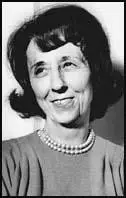
Evelyn Norton was born June 25, 1909, on a farm in Polk County, Nebraska. She moved to Washington when her father, John Nathaniel Norton (1878-1960), was elected to the House of Representatives in 1927. (1)
Evelyn graduated from George Washington University where she majored in English and drama. She also attended its law school for two years, graduating in 1930. Evelyn met her husband, Harold W. Lincoln, when she was at university. The two became involved in politics and were both active members of the Democratic Party. (2)
Harold 'Abe' Lincoln got a job teaching government at New York University, where he was also working on his doctorate. The couple lived in a small Greenwich Village apartment when he was offered a position on the staff of one of the House committees. Evelyn later wrote: "At the time I was very happy in our little Greenwich Village apartment, but Abe's offer was too good to pass up, and it would give us a chance to be near my parents, who were then living in Washington." In 1952 Evelyn joined the clerical staff of Congressman Elijah Lewis Forrester of Georgia. (3)
John F. Kennedy's Secretary
The work in Forrester's office was not very difficult and the heavy responsibilities fell on the two women ahead of her. In January 1953 she became the personal secretary to John F. Kennedy. who had just been elected as Senator for Massachusetts. According to Godfrey Hodgson: "Capable as she undoubtedly was, Evelyn Lincoln was not infallible. When the Kennedys were married in 1953 and flew to Mexico for their honeymoon in Acapulco, Lincoln failed to discover that the Mexican authorities would need to see their birth certificates. While the then senator, in some embarrassment, called Lincoln in his senate office to send the certificates, Jacqueline Kennedy irritated her new husband with a string of pointed comments about how even one of the most powerful US senators could not get himself admitted to Mexico." (4)
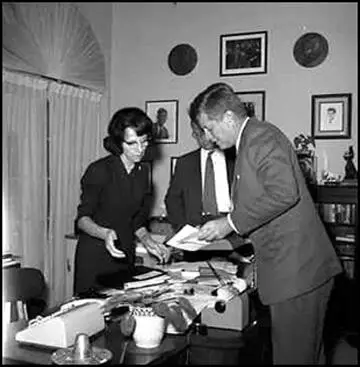
It has been claimed by Robert McGill Thomas that: "Within weeks of their first meeting, she had made herself virtually indispensable. In addition to her official duties, she once recalled, she was also required to telephone the women he was interested in to ask them for movie dates with the Senator. Mrs. Lincoln claimed to be one of the first to know that his romance with Jacqueline Bouvier was serious." (5)
Evelyn Lincoln found Kennedy was a demanding boss: "I learned that if he wanted something done, he wanted it done immediately. If he selected you to do it, it was because you were on the job and near him at the time. If you proved up to the task, he called on you again. If you were slow on performance, the next time he asked someone else to do it. If he thought you were taking a little longer than necessary to get the job done, he would ask you about the delay. If you had a logical answer, he was satisfied. But if you said, 'I haven't had time to do it,' once again he would lose confidence in you." (6)
Personal Secretary to the President
Kennedy's election to the Presidency elevated his personal secretary to a public figure. Her office, next to the President's, became a nerve center at the White House, "partly because of the candy dish she kept there along with the humidor full of gift cigars not up to Presidential standards, and partly because of the West Wing's layout." Lincoln had a direct view of the President in his office. And the President had to walk through her office to get to Cabinet meetings. Her office also had a television set on which the President and aides watched the nation's first manned space flight and other major events." (7)
Evelyn Lincoln later admitted that she helped to facilitate the amorous President's rendezvous. As one journalist pointed out: "Those of us who waited in the West Wing for briefings and statements about this international crisis or that tense confrontation in domestic politics, imagined that Lincoln spent all of her time marshalling the flow of calls from heads of state and congressional callers. 'Half my time', she divulged in a recent interview, "was spent with women calling to find out about him." Lincoln was expected to "contact young women - socialite friends from New York, call-girls, or government secretaries - and arrange for them to be picked up in one of the White House's black Mercury limousines and brought to the executive mansion, where they would be escorted to the pool or the private quarters by Kennedy's principal procurer", Dave Powers. Lincoln admitted that she knew about Kennedy's prolonged affair with Judith Campbell Exner, whose favours he shared with the well-known Mafia don Sam Giancana. (8)
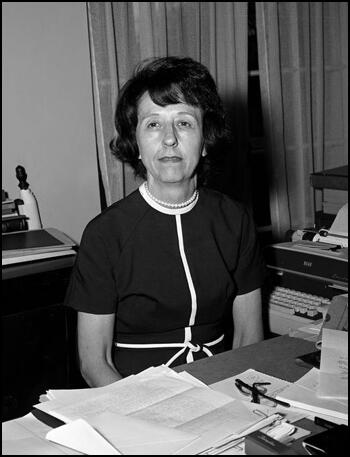
Evelyn loyally carried out Kennedy's instructions: "I became the one link to whom everyone turned, the family, the friends, the important people, if they wanted to talk to him or leave messages for him. It, therefore, became very important that I know his whereabouts. I always had the telephone number where he could be reached, and he had a telephone number in case he wanted to call me. As for the people he was with, that too, was important, I kept this record for him... The women who did have relations with him are not publicly announcing that fact for all the world to know but regard the relationship as one of the pleasantries of life. Some of these women are dear friends of mine.... He has been referred to as a woman chaser, but from my vantage point, it would be more accurate to say that the women chased him. However, being a man he never discouraged them. (9)
Lyndon Baines Johnson
By 1963 John F. Kennedy realised that Lyndon B. Johnson had been drawn into political scandals involving Fred Korth, Billie Sol Estes and Bobby Baker. According to James Wagenvoord, the editorial business manager of Life, the magazine was working on an article that would have revealed Johnson's corrupt activities. "Beginning in later summer 1963 the magazine, based upon information fed from Bobby Kennedy and the Justice Department, had been developing a major newsbreak piece concerning Johnson and Bobby Baker. On publication Johnson would have been finished and off the 1964 ticket (reason the material was fed to us) and would probably have been facing prison time. At the time LIFE magazine was arguably the most important general news source in the US. The top management of Time Inc. was closely allied with the USA's various intelligence agencies and we were used after by the Kennedy Justice Department as a conduit to the public." (10)
The fact that it was Robert Kennedy who was giving this information to Life Magazine suggests that Kennedy intended to drop Johnson as his vice-president. This is supported by Evelyn Lincoln. In her book, Kennedy and Johnson (1968) she claimed that in November, 1963, Kennedy decided that because of the emerging Bobby Baker scandal he was going to drop Johnson as his running mate in the 1964 election. Kennedy told Lincoln that he was going to replace Johnson with Terry Sanford, the Governor of North Carolina. (11)
Phil Brennan, a journalist working for The National Review, argued that the Washington press corps had buried the stories about the Bobby Baker scandal and the connections with Johnson. However, John J. Williams, the Republican Party senator for Delaware, was called upon the Committee on Rules and Administration to conduct an investigation of the financial and business interests and possible improprieties of Baker. Brennan points out: "A few days later, the attorney general, Bobby Kennedy, called five of Washington's top reporters into his office and told them it was now open season on Lyndon Johnson. It's OK, he told them, to go after the story they were ignoring out of deference to the administration." (12)
Assassination of John F. Kennedy
In November 1963, Kennedy decided to travel to Texas to smooth over frictions within the state's Democratic Party between liberal U.S. senator Ralph Yarborough and conservative governor John Connally. The visit was first agreed upon by Kennedy, Johnson, and Connally during a meeting in El Paso in June. The motorcade route was finalized on November 18 and announced soon afterwards. Kennedy also viewed the Texas trip as an informal launch of his 1964 reelection campaign. (13)
As Evelyn Lincoln points out: "In visiting Texas, the President hoped to win greater support in this state, in which the Kennedy-Johnson ticket was barely victorious in 1960. Also he hoped to patch a bitter internal dispute among Texas Democrats, who had begun to insult each other. Bitterness developed even over this trip. Some Texas Democrats did not want Senator Ralph Yarborough to sit on the platform with the President, but the President said the Senator had gone down the line with him; he insisted that the Senator ride in the motorcade and be with him on the platform." (14)
Lincoln, who was in the third bus back of the President's car when he was shot in Dallas on Nov. 22, 1963. (15) Her last view of him was at the start of the motorcade: "There was the President, his right hand in the air, waving at the people as he drove by. I can still see that scene - the President waving as he passed that vast and friendly crowd of people. And I'll always remember him that way because that's the way he really was: a handsome, young, energetic President who had grace and intellect, a man who loved every inch of his country, especially its people. (16)
Aftermath
Lincoln did not enjoy a good relationship with Lyndon B. Johnson and her "reign as executive secretary in the White House ended with brutal abruptness". The morning after President Kennedy's body was brought back from Dallas, she went to the office, only to find that the new President was already there. "I have a meeting at 9.30", he said, "and I would like you to clear your things out of your office so that my own girls can come in." In the end, she was given an extension until noon. By 11.30am, she was gone. (17)
Every year on the anniversary of the assassination Evelyn Lincoln would go to the Arlington National Cemetery and place three long-stemmed red roses on Kennedy's grave. In 1965 she published My Twelve Years With John F. Kennedy. Three years later she published Kennedy and Johnson (1968). She returned to Capitol Hill as a secretary from 1967 to 1973, but always had an eye out for a potential President. In 1982, convinced she had found one, she campaigned for Senator Gary Hart of Colorado, telling one crowd, "The people who loved John Kennedy should love Gary Hart." (18) However, his candidacy came to an end when The Miami Herald reported that Hart was having a sexual relationship with Donna Rice. (19)
Lincoln continued to take a keen interest in the assassination of John F. Kennedy. She firmly believed he was a victim of a conspiracy. She told Richard Duncan, a teacher at Northside Middle School in Roanoke on 7th October, 1994: "As far as the assassination is concerned it is my belief that there was a conspiracy because there were those that disliked him and felt the only way to get rid of him was to assassinate him. These five conspirators, in my opinion, were Lyndon B. Johnson, J. Edgar Hoover, the Mafia, the CIA, and the Cubans in Florida." (20)
Lincoln went into more detail about the assassination in an unpublished memoir, I Was There. "From the catbird seat that I had during my 12 years as John F. Kennedy's Personal Secretary I would have to say that, in my opinion, President Kennedy's death in Dallas, Texas, was a deliberate professional political murder, planned by a group in government who wanted him removed from office... I do not point a finger at any one of the individuals or factions who might have disliked Kennedy so much they had him assassinated, but I am struck by coincidental things which happened along the way - they puzzle me."
Lincoln speculated that J. Edgar Hoover and organisations like the Ku Klux Klan could have been responsible. "There were also many, many people in the United States at that time who were hysterically opposed to the civil rights movement. In 1961 it was considered political bravery to endorse equality before the law in front of an audience of southern whites. The Kennedys brought protection to the freedom riders when at that time the local and state police refused to protect them. A gang of whites, including the Ku Klux Klan attacked the buses of freedom riders in Alabama. Evidence of that opposition was also seen in the difficulty the Kennedys had in upholding the law to integrate the schools in Mississippi and Alabama. Also, the killings of civil rights activists and the violence when the blacks took to the streets. These anti-civil rights organizations and groups, who didn't want the President to proceed further in his efforts on behalf of the colored people, were outwardly opposed to him. Likewise, J. Edgar Hoover, Director of the F.B.I. detested Dr. Martin Luther King, whom the Kennedys had befriended in 1960, and did everything possible to destroy him."
Evelyn Lincoln also suggests that the Vietnam War might have been a factor in the assassination. "After the Cuban Missile Crisis in October 1962, and there was no military involvement, the President felt that the time was ripe to promote the cause for peace. And because of this desire on the part of the President he expressed his concern over the involvement or the United States military in Vietnam". She points out that Kennedy said at a Press Conference on October 31st he was asked: "Mr. President, back to the question of troop reductions… is there any speedup in the withdrawal from Vietnam intended?" The President answered: "Well, as you know, when Secretary McNamara and General Taylor came back they announced that would expect to withdraw a thousand men from South Vietnam before the end of the year, and there has been reference to that by General Harkins. If we are able to do that, that would be our schedule." (21)
Evelyn Lincoln died on 11th May, 1995, in Georgetown University Hospital of complications after surgery for cancer. (21)
Primary Sources
(1) Evelyn Lincoln, My Twelve Years With John F. Kennedy (1965)
This morning we arrived, as usual, slightly before eight o’clock and I was at my desk a few minutes later. But this time it was in a different office in a different building. The old familiar objects were there - the President’s padded rocking chair, his leather desk chair, the Presidential flag, the books and pictures - but they were shoved against the wall or stuffed into cartons. I couldn't’t stand seeing the things he loved so much in a state of confusion, and I started searching through boxes looking for pictures of Caroline sitting solemnly in his Harvard chair. It had been taken on one of her evening visits to his office and was one of his favorite pictures. I wanted to bring it out to hide the ugly bareness of the room. I guess I wanted to reassure myself that nothing had changed.
(2) Evelyn Lincoln, Kennedy and Johnson (1968)
The first, the Bobby Baker case, came to light in September 1963 when a vending company filed a suit against Baker for not fulfilling a contract. The news and the reports that were filtering in about Bobby and his transactions were disturbing to the occupants of the White House for two reasons. First, Bobby Baker had used his connections to help swing doubtful business deals his way. Although he was no longer on Mr. Johnson's staff, he had a way of beginning a business conversation with, "Well, Lyndon told me the other day."
If you worked for a United States Senator, Democratic or Republican you knew Bobby Baker, Secretary to the Majority. His relationship with Mr. Johnson, then Majority Leader, was extremely close, so close that during the campaign in Dixie in 1960 Mr. Johnson asked him to take charge of his "Corn Ball Express."
As they crisscrossed the South they came into South Carolina, very close to Pickens, Baker's hometown. At that stop they got off the train, piled into a helicopter and flew to Pickens to do a little hand shakin' with home folks. With his arm around Bobby, Mr. Johnson said to them, "Bobby is my strong right arm. He is the last person I see at night and the first person I see in the morning."
Mr. Kennedy's high standards were now rubbing against the ragged surface of the Bobby Baker case. There were bound to be sparks-and they would fly, fairly or unfairly, at Mr. Johnson.
Senator John Williams, a Republican from Delaware, became interested in the case and started to do some investigating on his own. (Much, much later came the report about "Johnson warning the Republicans via the grapevine that if they press him too hard on Bobby Baker, some G.O.P. tax returns will be audited.") At the same time, the Department of Justice started an investigation. They both dug in more deeply. Pressures were mounting: Bobby Baker was in trouble and, October 7, 1963, he resigned.
(3) Evelyn Lincoln, Kennedy and Johnson (1968)
As Mr. Kennedy sat in the rocker in my office, his head resting on its back he placed his left leg across his right knee. He rocked slightly as he talked. In a slow pensive voice he said to me, 'You know if I am re-elected in sixty-four, I am going to spend more and more time toward making government service an honorable career. I would like to tailor the executive and legislative branches of government so that they can keep up with the tremendous strides and progress being made in other fields.' 'I am going to advocate changing some of the outmoded rules and regulations in the Congress, such as the seniority rule. To do this I will need as a running mate in sixty-four a man who believes as I do.' Mrs. Lincoln went on to write "I was fascinated by this conversation and wrote it down verbatim in my diary. Now I asked, 'Who is your choice as a running-mate?' 'He looked straight ahead, and without hesitating he replied, 'at this time I am thinking about Governor Terry Sanford of North Carolina. But it will not be Lyndon.'"
(4) Evelyn Lincoln, I Was There (c. 1982)
In the past twenty years, following the President's assassination in Dallas, I have appeared on many, many radio and television talk shows. I have also granted interviews for newspaper and magazine articles, and authors writing books. It has become apparent from all of these interviews that there are two questions that supersede all others: Kennedy's sex life and his assassination....
I have evaded an answer to both of these questions because I felt that what Kennedy contributed in his lifetime was more important than what he did personally or who conspired to kill him. Since I am rounding out the last third of my diary, and since stories become more farfetched as time goes on, I am making an effort to put these two questions into their proper perspective….
From the catbird seat that I had during my 12 years as John F. Kennedy's Personal Secretary I would have to say that, in my opinion, President Kennedy's death in Dallas, Texas, was a deliberate professional political murder, planned by a group in government who wanted him removed from office.
Evelyn Lincoln suggests several possible groups behind the assassination: I have spent many, many hours trying to figure out who, or what faction, or organization conspired and did the actual planning to bring about his assassination. It is ironic, I feel, that so many of these factions, who felt so strongly against the President had their people in or around Dallas at the time of the assassination. It was reported that... members of the John Birch Society and organized crime were there, as well as, Texans who hated him.
Any one of these factions, I reasoned, could have hired a hit man. I have heard that they come dime a dozen. Likewise, the atmosphere in Dallas at the time was filled with hatred and suspicion. There was terrific infighting going on among the politicians and many of the citizens. The time was ripe to pull this off. Just a few days before, Adlai Stevenson visited Dallas. He was bombarded with tomatoes.
Another thing which bothers me is why so much time and effort is spent on where the bullet hit the body. It seems to me that it is not so much where the bullet hit, as it is, did someone hire a man to fire the shot which hit the body. Kennedy died.
I do not point a finger at any one of the individuals or factions who might have disliked Kennedy so much they had him assassinated, but I am struck by coincidental things which happened along the way - they puzzle me.
Over the years there have been people - there have been organizations - that have wanted to do away with person or persons whom they felt were in their way or did not prescribe (subscribe) to their way of life.
Many factions had their reasons for wanting the President to get out of their way. There were those in the 1960 campaign who wanted to stop him, but they were unsuccessful and he became President. As he went along he collected others who saw him a danger to their cause.
He was a Catholic. That gave him a built in opposition right from the start. The anti-Catholic, Ku Klux Klan faction had opposed Al Smith when he ran for the Presidency, and their opposition was one of the factors that helped defeat him. This same faction tried hard to defeat the President, and even though he won, their dislike toward him did not disappear.
There were also many, many people in the United States at that time who were hysterically opposed to the civil rights movement. In 1961 it was considered political bravery to endorse equality before the law in front of an audience of southern whites. The Kennedys brought protection to the freedom riders when at that time the local and state police refused to protect them. A gang of whites, including the Ku Klux Klan attacked the buses of freedom riders in Alabama. Evidence of that opposition was also seen in the difficulty the Kennedys had in upholding the law to integrate the schools in Mississippi and Alabama. Also, the killings of civil rights activists and the violence when the blacks took to the streets. These anti-civil rights organizations and groups, who didn't want the President to proceed further in his efforts on behalf of the colored people, were outwardly opposed to him. Likewise, J. Edgar Hoover, Director of the F.B.I. detested Dr. Martin Luther King, whom the Kennedys had befriended in 1960, and did everything possible to destroy him.
Ngo Dinh Diem's wife (Diem was a bachelor; Lincoln is referring to Madame Nhu, the wife of Diem's brother/adviser who was also killed.) who at the time of her husband's [correction: "brother in law's"] death was traveling all over the United States charging that the President was turning his back on Vietnam. As soon as she learned that her husband [correction: "brother in law"] had been killed, she lashed out hysterically against the President, calling him a "murderer." She and her followers were vehement. And that was in November 1963.
There was resentment, to be sure be the terrorist revolutionists in the communist community for the successful handling by the President in standing up against Khrushchev in the Cuban Missile Crisis. Their subversive operations were no doubt disturbed their being outsmarted and their prestige was at stake.
Within many countries where dictators hold sway there are groups or individuals who dislike or hate our form government. They could easily be persuaded to enter into any scheme or plot to do away with a President, even given ample funds to pursue this objective.
The underlying current that ran through all the mob activity was their inability to regain their massive operations in Cuba, after Castro had overthrown the Batista regime. The Mob and extreme right-wing elements, with the assistance of the CIA, together with the Cuban exiles were constantly conspiring to overthrow Castro.
The Eisenhower Administration, and especially Richard Nixon who was a rabid communist hater, went along with the Bay of Pigs plan devised by these same elements, and this plan was passed along to President Kennedy, who approved it. The President, however, when it became apparent that the plan would fail, unless there was American military intervention, called the operation off.
He antagonized the Cuban exiles and the CIA by his refusal to go along with the plan, and the CIA was likewise infuriated when the President said he would like to blow the CIA to pieces because of their mishandling of the plan. The antagonism between various members of the CIA and the President continued throughout his administration.
Thus a linkage grew between the Mob, the CIA and right-wing extremists over what they felt was the President's moderation toward Castro, his civil rights proposals, his drive for peace and the Kennedys' crusade against organized crime. Therefore, it is logical to conjecture that these elements could have formed a conspiracy to assassinate the President.
It is understandable why Hoffa and organized crime should dislike the President. Robert Kennedy, the President's brother, while Chief Counsel for the Senate Rackets Committee and also as Attorney General, and supported by the President, worked hard to rid this country of syndicated crime - a very worthwhile endeavor. Hoffa, head of the Teamsters Union, was indicted (later sent to prison). That brought animosity, not only among the Teamsters Union, but also other organized crime operations, who were fearful that the Kennedys might investigate them. The Attorney General was planning massive attacks on the Mob's Las Vegas base as late as October 1963. Therefore, if any member of organized crime would desire to make a contract with a hit man to assassinate the President, one of these men would certainly be Teamster boss Jimmy Hoffa.
After the Cuban Missile Crisis in October 1962, and there was no military involvement, the President felt that the time was ripe to promote the cause for peace. And because of this desire on the part of the President he expressed his concern over the involvement or the United States military in Vietnam and said following an off the record meeting on Vietnam "l am going to phase out the withdrawal of American forces in Vietnam. I know I'll be criticized, but I have been criticized before."
In a report by Defense Secretary Robert McNamara and General Maxwell Taylor on October 2, 1963 they stated that it was their objective to terminate the major part of the United States military involvement in Viet Nam by 1965.
Likewise, one of the first questions the President was asked at his Press Conference at 4:00 pm on October 31st was: "Mr. President, back to the question of troop reductions, … is there any speedup in the withdrawal from Vietnam intended?"
The President answered: "Well, as you know, when Secretary McNamara and General Taylor came back they announced that would expect to withdraw a thousand men from South Vietnam before the end of the year, and there has been reference to that by General Harkins. If we are able to do that, that would be our schedule."
Two days before the President went to Texas, on November 19, 1963, Defense Secretary Robert McNamara speaking to the New York Economic Club stated that "a major cut in defense spending is in the works."
(5) Evelyn Lincoln, letter to Richard Duncan, a teacher at Northside Middle School in Roanoke (7th October, 1994)
As far as the assassination is concerned it is my belief that there was a conspiracy because there were those that disliked him and felt the only way to get rid of him was to assassinate him. These five conspirators, in my opinion, were Lyndon B. Johnson, J. Edgar Hoover, the Mafia, the CIA, and the Cubans in Florida.
(6) The Spokesman Review (12th May, 1995)
Evelyn Norton Lincoln, who was personal secretary to President Kennedy, died Thursday in Georgetown University Hospital of complications after surgery for cancer, the family said. She was 85.
Mrs. Lincoln was Kennedy's personal secretary from January 1953 when he started his first term in the Senate until his death Nov. 22, 1963, when she was in the motorcade in Dallas when he was assassinated.
She had been hospitalized since April 2, said Francis McGuire, a family spokesman.
Mrs. Lincoln was born June 25, 1909, on a farm in Polk County, Neb., and her father, John N. Norton, was a member of the House of Representatives. She came to Washington in 1930 with her husband, Harold W. Lincoln, and the two got involved in politics.
She was known for visiting Kennedy's grave at Arlington National Cemetery every year on the anniversary of his death. In 1988, on the 25th anniversary, she went alone to the grave and laid three red roses near its eternal flame.
"I always come. I haven't missed a one. I feel that I should honor him. It's the least I can do," Mrs. Lincoln said then.
She said she "wouldn't give anything" for the experience of working in the White House with Kennedy. "That's why I'm grateful and I come out to the grave to thank him," she said.
Mrs. Lincoln also was the author of two best-selling books, "My 12 Years With John F. Kennedy" and "Kennedy and Johnson."
She is survived by her husband, to whom she was married 64 years.
(7) The Washington Post (12th May, 1995)
Evelyn Norton Lincoln, 85, who was personal secretary to President John F. Kennedy, died May 11 at Georgetown University Hospital of complications after surgery for cancer. Mrs. Lincoln, who had been hospitalized since April 2, lived in Chevy Chase.
She was Kennedy's personal secretary from January 1953, when he started his first term in the Senate, until his death Nov. 22, 1963. She was one of the few people who knew that Kennedy secretly taped conversations in the Oval Office, and when that fact became known in the early 1980s, she valiantly defended it.
"There wasn't any sinister motive on the part of the president to get any information on anyone in order to blackmail them, or whatever. It was just a recording of the events," she told The Washington Post in an interview in 1982.
Mrs. Lincoln was born on a farm in Nebraska. Her father, John N. Norton, was a member of the House of Representatives. She came to Washington in 1930 with her husband, Harold W. Lincoln, and the two got involved in politics. She graduated from George Washington University, where she majored in English and dramatics. She also attended George Washington's law school for two years.
In 1951, she was working for a U.S. representative from Georgia when she identified Kennedy, a young representative from Massachusetts, as a shooting star and decided to volunteer in his office.
When Kennedy won his Senate seat, she was offered the job as his personal secretary. When he moved to the White House in 1961, she went along. And she was there in Dallas in 1963 when he was assassinated.
Mrs. Lincoln kept a diary the whole time, and although she published bits and pieces in her books, the diary itself has remained secret. She told an interviewer in 1982 that she would make it public only after her death.
Asked if there were any bombshells in the diary, she said: "Oh, I think maybe there would be some. Some of the things that were said about other people."
She said she thought about leaving Kennedy's service only once. That was in the Senate, when she spent half her time screening calls from young women who wanted to meet him.
"He was charming. He had an Irish temper and when things didn't go right, he'd tell you about it," she told The Post.
In another interview, Mrs. Lincoln talked about booking appointments for Kennedy with his girlfriends.
After Kennedy's death, she worked on his personal papers, many of which are in the John F. Kennedy Library in Boston and in the National Archives in Washington.
She also worked for Rep. James Kee (D-W.Va.) from 1967 to 1973.
Mrs. Lincoln wrote two best-selling books, "My 12 Years With John F. Kennedy" and "Kennedy and Johnson."
She was known for visiting Kennedy's grave at Arlington National Cemetery every year on the anniversary of his death. In 1988, on the 25th anniversary, she went alone to the grave and laid three red roses near its eternal flame.
"I always come. I haven't missed a one. I feel that I should honor him. It's the least I can do," Mrs. Lincoln said then.
She said she "wouldn't give anything" for the experience of working in the White House with Kennedy. "That's why I'm grateful and I come out to the grave to thank him," she said.
Survivors include her husband of 64 years, who lives in Chevy Chase.
(8) Robert McGill Thomas, The New York Times (15th May, 1995)
Evelyn Lincoln, the devoted personal secretary who served President John F. Kennedy from the day he entered the Senate to the day he was assassinated, died on Thursday at Georgetown University Hospital in Washington. She was 85 and lived in Chevy Chase, Md.
Her family said the cause of death was complications after cancer surgery.
If the relationship between an executive and a secretary can be likened to a marriage, the one between John Fitzgerald Kennedy and Evelyn Norton Lincoln was a bond forged in political heaven.
When Mrs. Lincoln, then a 43-year-old Congressional aide, came to work for him in 1953, the new Senator from Massachusetts was everything she had been looking for in a Capitol Hill boss: a charismatic politician with Presidential possibilities.
And when he hired her, Mr. Kennedy, then a 35-year-old bachelor, got the secretary every politician longs for: an efficient, savvy confidante whose devotion to him and his ambitions knew no bounds.
The daughter of John Norton, a member of Congress from Nebraska, Evelyn Norton was born in Polk County, Neb., on June 25, 1909. She graduated from George Washington University in Washington and studied law there for for two years. Her husband, Harold W. Lincoln, whom she met at the university, was a Federal worker.
In 1952, after working for an obscure Georgia Congressman, Mrs. Lincoln began looking for a politician with Presidential possibilities and found Mr. Kennedy.
Within weeks of their first meeting, she had made herself virtually indispensable. In addition to her official duties, she once recalled, she was also required to telephone the women he was interested in to ask them for movie dates with the Senator. Mrs. Lincoln claimed to be one of the first to know that his romance with Jacqueline Bouvier was serious. "He called her himself," she said.
Mr. Kennedy's election to the Presidency elevated his personal secretary to a public figure. Her office, next to the President's, became a nerve center at the White House, partly because of the candy dish she kept there along with the humidor full of gift cigars not up to Presidential standards, and partly because of the West Wing's layout.
Mrs. Lincoln had a direct view of the President in his office. And the President had to walk through her office to get to Cabinet meetings. Her office also had a television set on which the President and aides watched the nation's first manned space flight and other major events.
(Her office's strategic location, Mrs. Lincoln once revealed, was put to devious use by Vice President Lyndon B. Johnson. She said he used to cut through her office to give White House aides the impression he had been closeted with the President.)
Mrs. Lincoln, who was in the third bus back of the President's car when he was shot in Dallas on Nov. 22, 1963, became a macabre footnote to assassination lore linking two slain Presidents elected exactly 100 years apart when it was widely noted that Abraham Lincoln had a secretary named Kennedy and President Kennedy had a secretary named Lincoln.
Although she continued to work for the White House for a while after the assassination, Mrs. Lincoln never hid the disdain she felt for her idol's successor.
Before his trip to Dallas, Mrs. Lincoln later said, President Kennedy had told her that he planned to drop Mr. Johnson from the 1964 Democratic ticket.
The full extent of Mrs. Lincoln's devotion to Mr. Kennedy did not become apparent until after his death when she revealed that she had saved virtually every scrap of paper that had crossed his desk in the White House, including idle doodles and jottings she sometimes had to dig out of wastebaskets.
Mrs. Lincoln, who was one of the seven original incorporators of the John Fitzgerald Kennedy Presidential Library and Museum in Boston, gave the papers to the library, where the doodles and other ephemera are among the most popular exhibits, library officials said yesterday.
Mrs. Lincoln published two volumes of memoirs, "My Twelve Years with John F. Kennedy," (1965) and "Kennedy and Johnson," (1968).
She returned to Capitol Hill as a secretary from 1967 to 1973, but always had an eye out for a potential President.
In 1982, convinced she had found one, she campaigned for Senator Gary Hart of Colorado, telling one crowd, "The people who loved John Kennedy should love Gary Hart." His candidacy collapsed in a scandal triggered by womanizing.
Mrs. Lincoln is survived by her husband.
(9) Godfrey Hodgson, The Independent (20th May 1995)
Twice a year for the last 32 years an elegant woman, her clothes and 1960s glasses hardly changing over the years as she herself aged, left three red roses at John Fitzgerald Kennedy's grave in Arlington National Cemetery in Washington DC, looking out over the broad Potomac river and wooded Roosevelt Island to the stuccoed portico of the White House where she once played an intriguing role as his secret confidante. The flowers were a tribute, not from a member of the Kennedy family, from a political operative, or from one of the late President's many lovers, but from his personal secretary, Evelyn Lincoln.
Lincoln was one of those women, rarer now than in her generation, who accept the most alarming responsibilities and the most delicate political and personal assignments as a professional secretary, while having no political ambitions and no prospect of any personal renown except in the footnotes and indexes of historians.
Lincoln used to sit in the small secretary's room next to the Oval Office in the West Wing of the White House, a cool figure who often dressed in grey and never seemed flustered by even the maddest day of overcrowded schedules and outsized egos. It was possible to wonder at the time, when the White House rustled with rumours about the President's private life, and later, when so many of those rumours were confirmed, how much the impeccably proper Lincoln knew about what was going on.
Recently she made it plain that she was very well aware, indeed that she helped to facilitate the amorous President's rendezvous. Those of us who waited in the West Wing for briefings and statements about this international crisis or that tense confrontation in domestic politics, imagined that Lincoln spent all of her time marshalling the flow of calls from heads of state and congressional callers. "Half my time", she divulged in a recent interview, "was spent with women calling to find out about him."
Lincoln, whose own marriage appears to have been a model one, was expected to contact young women - socialite friends from New York, call-girls, or government secretaries - and arrange for them to be picked up in one of the White House's black Mercury limousines and brought to the executive mansion, where they would be escorted to the pool or the private quarters by Kennedy's even more personal aide and principal procurer, Dave Powers, an amiable Irishman who acted as a sort of body-servant to the President.
Until Lincoln herself spoke about this part of her duties, most of what was known about her involvement in the President's sexual adventuring related to the extraordinary episode of Kennedy's prolonged affair with Judith Campbell Exner, whose favours he shared with the well-known Mafia don Sam Giancana.
Lincoln had a special number, changed every week or so, on which girlfriends could contact her and arrange dates with the President in the White House. When Campbell admitted to her affair with Kennedy, she released the numbers she had called Lincoln on, and they allied exactly with numbers Kennedy had previously given to Benjamin Bradlee, then the editor of the Washington Post, which published her revelations.
Kennedy's affairs, or many of them, have been public knowledge for years. But Lincoln surprised experts on the Kennedy legend in a recent television interview when she said she believed Jacqueline Kennedy, too, had affairs before his assassination. Lincoln seems not to have been particularly fond of her, and complained bitterly when Mrs Kennedy terminated her services. "Oh, Mrs Lincoln", said the former First Lady "this shouldn't be so hard for you, you still have your husband".
She was born Evelyn Norton, in Polk county, Nebraska, the daughter of John N. Norton, a member of the House of Representatives. She graduated from George Washington University in English and married Harold Lincoln in 1930.
Capable as she undoubtedly was, Evelyn Lincoln was not infallible. When the Kennedys were married in 1953 and flew to Mexico for their honeymoon in Acapulco, Lincoln failed to discover that the Mexican authorities would need to see their birth certificates. While the then senator, in some embarrassment, called Lincoln in his senate office to send the certificates, Jacqueline Kennedy irritated her new husband with a string of pointed comments about how even one of the most powerful US senators could not get himself admitted to Mexico.
Lincoln's reign as executive secretary in the White House ended with brutal abruptness. The morning after President Kennedy's body was brought back from Dallas, she went to the office, only to find that the new President was already there. "I have a meeting at 9.30", he said, "and I would like you to clear your things out of your office so that my own girls can come in." In the end, she was given an extension until noon. By 11.30am, she was gone.
The episode may help to explain her insistence, accepted by some historians, and disputed by others, that Kennedy, before his death, told her that Lyndon Johnson would be removed from the ticket when Kennedy ran for re- election in 1964. She had the rest of her life to remember those years of excitement and indiscretion. Until the very end of her life, she resisted what must have been an overwhelming temptation to avenge "the insolence of office, and the spurns that patient merit of the unworthy takes", not to mention the boss's widow's sharp tongue.
Evelyn Norton, office administrator: born Polk County, Nebraska 1910; married 1930 Harold Lincoln; died Washington DC 4 May 1995.
(10) Mary Evertz, St Petersburg Times (11th November, 1999)
Evelyn Norton Lincoln was born on a Nebraska farm in 1910. She moved to Washington in the 1920s when her father John N. Norton was elected to Congress. She received a bachelor's degree from George Washington University in 1930. While attending law school there, she met her future husband Harold "Abe" Lincoln (no relation to the presidential Lincoln family).
The Lincolns lived in New York for a couple of years when he taught at New York University. They moved back to Washington when he was offered a government job. Mrs. Lincoln got a job on the Hill working for U.S. Rep. B.L. Forrester, D-Ga. In 1952, she recalled telling her husband that her next job would be for the next president of the United States,
"Eisenhower?" he asked.
"No, John F. Kennedy," she replied.
Mrs. Lincoln had never met the young politician from Massachusetts, but after reading a few of his press releases, she volunteered to work on his campaign for the U.S. Senate. In 1953, Kennedy asked her to join his staff. She started keeping a diary, which she worked on until Kennedy's death.
Kennedy depended on her not only to schedule his appointments but also for countless other tasks, including ordering his reading glasses and bringing them to Newport, R.I., on his wedding day to finding his tux shirt and studs when his brother Ted was getting married. She traveled with the Kennedy delegation for his historic trips to Ireland, Germany and England. She was in the Kennedy entourage when he visited Tampa on Nov. 18, 1963. She also traveled to Dallas.
It was to Mrs. Lincoln that Parkland Hospital staff handed the late President's personal effects, including his Cartier watch. It was also Mrs. Lincoln who, ordered by President Lyndon B. Johnson, cleaned out the Oval Office of all Kennedy's possessions. Mrs. Lincoln moved to the Executive Office Building next door to the White House. The files and Kennedy's personal possessions were moved to the National Archives Building in August 1964, where she continued to maintain custody of the material until it was transferred to the National Archives and Records Service in late 1965.
(11) Jefferson Morley, JFK's Secretary Called His Assassination a Professional Political Murder (27th March, 2026)
In the 1920s, Evelyn Lincoln , the determined daughter of a U.S. Congressman from Nebraska, came to the nation's capital to attend George Washington University. She married a political science professor, Harold Lincoln, and studied law. In 1932, she landed a job on Capitol Hill with a Georgia congressman which she held for the next twenty years.
In 1952, Lincoln volunteered for the U.S. Senate campaign of Massachusetts Rep. John F. Kennedy, whom she had met and admired. When Kennedy was elected, she became his personal secretary. For the next twelve years, Evelyn Lincoln spent as much time in proximity to Senator and President Kennedy as anybody.
"I always had the telephone number where he could be reached," Lincoln writes in an unpublished memoir recently discovered in the JFK Library in Boston, "and he had a telephone number in case he wanted to call me."
For more than a decade, Lincoln had unparalleled access to Kennedy and his thinking. She witnessed the crises, pressures, and pleasures of his jobs. She knew his private thoughts about friends, enemies, lovers, and rivals. She was entrusted with his secrets, and she kept them until long after her own death. She was, in a word, reliable.
Lincoln published two books about her time in the White House, "My Twelve Years with John F. Kennedy" in 1965, and "Kennedy and Johnson" in 1968. She died in 1995.
Her unpublished memoir, entitled "I Was There," was written in the 1980s. It recounts stories from the first two books with additional observations and informed opinions. The manuscript includes an 11-page "Addenda," published here for the first time, summing up Lincoln's responses about the two most frequent questions she fielded: about JFK's private life and his public death.
The manuscript was first made public without fanfare by the JFK Library last year.
(12) Nick Allen, The Daily Mail (28th March, 2026)
President John F Kennedy was murdered by enemies within his own government in a 'political' hit, according to his long-time personal secretary.
The shocking conclusion was found in a previously unpublished document written by Evelyn Lincoln, who was JFK's White House gatekeeper, and was sitting in the third car of his motorcade when he was shot.
It was discovered by JFK Facts in the JFK Library in Boston.
Jefferson Morley, editor of JFK Facts, and a renowned expert on the assassination, said because Lincoln was so close to Kennedy her thinking may well have reflected how the president would have viewed his own assassination.
He told the Daily Mail: 'She was a very loyal person. She had turned her mind and her work to him, she served him. And so, yes, I think this thinking does reflect how he would think about this event himself.
'She wrote this at the end of her life and never published it, it's not quite clear why, so I think it's valuable testimony from somebody who was very close to JFK.'
Lincoln died in 1995, aged 85, and is buried in Arlington Cemetery. During her lifetime, she never revealed her true opinion of what lay behind her boss's death in Dallas, Texas on November 22, 1963.
But in an 11-page addendum to an unpublished memoir, she laid out in detail the reasons why she believed Lee Harvey Oswald was not acting alone.
Instead, she concluded that JFK was the victim of a complex conspiracy planned by elements within the US government.
She wrote: 'From the catbird seat that I had during my 12 years as John F. Kennedy's Personal Secretary I would have to say that, in my opinion, President Kennedy's death in Dallas, Texas, was a deliberate professional political murder, planned by a group in government who wanted him removed from office.'
Lincoln was the daughter of a congressman who volunteered to work for JFK in his first US Senate campaign in the early 1950s, becoming his personal secretary.
Between then and his assassination, in the days long before cellphones, she was his conduit to the rest of the world.
She had the Secret Service codename 'Willow'.
'He (President Kennedy) insisted that I know exactly where he was and with whom at all times,' she wrote. 'I became the one link to whom everyone turned, the family, the friends, the important people, if they wanted to talk to him or leave messages for him.
'It, therefore, became very important that I know his whereabouts. I always had the telephone number where he could be reached, and he had a telephone number in case he wanted to call me.'
Their secret chats included Kennedy musing about replacing Vice President Lyndon Johnson as his running mate in the 1964 election.
Lincoln later wrote two memoirs which did not contain her view on the assassination.
A third - titled 'I Was There' - was never published and contains the addendum.
In it, she wrote that she would 'try to answer, to the best of my knowledge' the question 'Who conspired to assassinate President Kennedy?'
She wrote that the details had 'smoldered in my mind all of these years.'
Lincoln went through the various factions with a grudge against Kennedy, including far-right groups, organized crime, 'Texans who hated him,' Teamsters boss Jimmy Hoffa, FBI boss J Edgar Hoover, the Ku Klux Klan, anti-civil rights organizations, and communists.
She also discussed Madame Nhu, the de facto First Lady of South Vietnam, who in November 1963 was 'traveling all over the United States charging that the President was turning his back on Viet Nam.'
She wrote: 'It is ironic, I feel, that so many of these factions, who felt so strongly against the President, had their people in or around Dallas at the time of the assassination.
'Any one of these factions, I reasoned, could have hired a hit man. I have heard that they come dime a dozen. Likewise, the atmosphere in Dallas at the time was filled with hatred and suspicion. The time was ripe to pull this off.'
Her own feeling, having been at the center of the storm, brought her to the conclusion that the motivation for killing Kennedy may have been his refusal to back an invasion of Cuba.
'The underlying current that ran through all the Mob activity was their inability to regain their massive operations in Cuba after Castro had overthrown the Batista regime,' she wrote.
'The Mob and extreme right-wing elements, with the assistance of the CIA, together with the Cuban exiles were constantly conspiring to overthrow Castro.'
She detailed how the Eisenhower Administration, and especially Richard Nixon a 'rabid communist hater,' went along with the Bay of Pigs plan, which was then passed along to Kennedy, who approved it.'
The Bay of Pigs invasion went ahead but Kennedy canceled an air strike and it failed, leading to allegations from opponents that he had betrayed the Cuban-exile invasion force, known as Brigade 2506.
'The President, when it became apparent that the plan would fail, unless there was American military intervention, called the operation off,' Lincoln wrote.
'He antagonized the Cuban exiles and the CIA by his refusal to go along with the plan, and the CIA was likewise infuriated when the President said he would like to blow the CIA to pieces because of their mishandling of the plan.
'Thus a linkage grew between the Mob, the CIA and right-wing extremists over what they felt was the President's moderation toward Castro, his civil rights proposals, his drive for peace and the Kennedys' crusade against organized crime.'
She added: 'Therefore, it is logical to conjecture that these elements could have formed a conspiracy to assassinate the President.'
Lincoln also noted a 'strange alliance between Nixon, the Cuban exile forces, and 'members of the CIA who participated in the Bay or Pigs.'
She wrote: 'It is strange that many of these CIA members were later involved with Nixon's break in of the Watergate office...and also worked in the Nixon administration in other "dirty tricks" operations.'
She also noted that Vice President Johnson, realizing that he might be dropped from the ticket in 1964, left Washington at the end of October to go back to his ranch in Texas to 'await the President's visit - over three weeks ahead - and Many or his associates went with him.'
She laid out how J. Edgar Hoover, who 'loathed (JFK's brother) Robert F Kennedy as much as he did Dr Martin Luther King, kept voluminous personal files' on the president, including 'rumors, hearsay, trivia and potentially embarrassing information.'
'Lyndon Johnson had access to Hoover's secret files and many a rumor was started by them,' she wrote.
She also noted that Johnson initially 'maintained that there had been a conspiracy' but then 'hurriedly set the wheels in motion to build a case against Lee Harvey Oswald as being the lone assassin.'
Lincoln wrote: 'There is definitely an intertwining of people and factions in much of the opposition and efforts to "stop" or destroy the President.'
Morley, of JFK Facts, said Lincoln was 'discreet' and that gave her more credibility.
'This is somebody who knew his (JFK's) world, she lived in his world, and so her testimony is important, and it's also something that she was not trying to exploit in her lifetime,' he said.
'She's in the room, she sees the men going in and going out, she knows the body language. She doesn't literally know what's going on, but because she lives in that world and is so trusted by him, her intuitions and her observations, I think carry a lot of weight.'
He added: 'Her thinking reflected his. She was influenced by his thinking. So yes, in some sense, we can say this is his way of thinking.
'This was not her first choice of things to talk about. But because people were so interested in what she had to say about it, she finally came forward and said it.'