
Niccolò Machiavelli
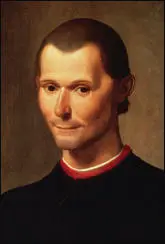
Niccolò di Bernardo dei Machiavelli, the third child and first son of the lawyer Bernardo di Niccolò Machiavelli and his wife, Bartolomea di Stefano Nelli. was born in Florence, Italy, on 3rd May, 1469. At a young age became a pupil of a renowned Latin teacher, Paolo da Ronciglione. (1)
After the execution of Girolamo Savonarola Machiavelli obtained a minor in the Florentine government. (2) Florence had been under a republican government since 1494, when the leading Medici family and its supporters had been driven from power. (3)
Machiavelli's talents were appreciated and he was sent on important diplomatic missions. He was at first the republic's foreign minister before becoming the minister of war. His role involved frequent travel to the courts of kings, emperors, popes and generals and he had the "opportunity to observe different personalities and systems; and because he was charged with the delicate task of negotiating with powers far more formidable than Florence itself, he was able to refine his analytic and diplomatic skills to consummate levels." (4)
According to Erica Benner: "Both as secretary to the republic and through his writings - which include reams of poetry, risqué comedies and a quietly tragic history of Florence - he spent his life fighting to defend his city’s republican government against threats from within and without. It was a hard fight, with battles on many fronts. It took Machiavelli on a long journey across France with King Louis XII, and to the court of Cesare Borgia, where he spent nerve-racking months trying to dissuade the violent youth from attacking Florence. Machiavelli was convinced the real threats to freedom come from within - from gross inequalities on the one hand, and extreme partisanship on the other. He saw first-hand that authoritarian rule can take root and flourish in such conditions with terrifying ease, even in republics like Florence that had proud traditions of popular self-government." (5)
During this period he watched Pope Alexander VI, who took office in 1492, trying to bring a large part of Central Italy under his possession. He dis this by forming several military alliances. To help him do this he appointed his illegitimate son, Cesare Borgia, who was only seventeen, as Archbishop of Valencia. The following year he became a Cardinal. Another son, Giovanni Borgia, was made captain general of the military forces of the papacy. (6)
After the death of Giovanni (possibility murdered by his brother) Cesare Borgia became commander of the papal army: "Brave, daring and determined, he was insatiably power-hungry and entirely ruthless. Murder, bribery and deceit were all in the day's work to him and his pleasures were women, hunting and fashionable clothes. He was considered the handsomest man in Italy, there were inevitably rumours of incest with his sister Lucrezia and he had syphilis from his early twenties." (7)
Pope Alexander VI died in August 1503. The news of his father's death arrived when his son Cesare was planning the conquest of Tuscany. The new pope, Pope Pius III, supported Cesare but after only twenty-six days, he died. Borgia's deadly enemy, Giuliano Della Rovere, now became Pope Julius II. Cesare was arrested but did manage to escape but was killed on 12th March, 1507. "In his last fight, he struggled alone, like a legendary knight, against a small army. But he was thrown from his horse and was stabbed to death multiple times with lances and daggers. His armor and clothes were removed and the body was abandoned. None of the assassins knew who he was." (8)
Pope Julius II now gave his support to Giovanni di Lorenzo de' Medici (the future Pope Leo X). In October 1511 he was appointed papal legate of Bologna and the Romagna, and when the Florentine republic declared in favour of the schismatic Pisans, Julius II sent Giovanni with the papal army and in 1512, he defeated the republic's armed forces and dissolved the government. Machiavelli was initially placed in a form of internal exile and, when he was (wrongly) suspected of conspiring against the Medici in 1513, he was imprisoned and tortured for several weeks. He was eventually released and he retired to a farm outside of Florence where he could concentrate on his literary pursuits. (9)
Primary Sources
(1) Cary Nederman, Niccolò Machiavelli: The Stanford Encyclopedia of Philosophy (28th May, 2019)
For
(1) Cary Nederman, Niccolò Machiavelli: The Stanford Encyclopedia of Philosophy (28th May, 2019)
For
(1) Cary Nederman, Niccolò Machiavelli: The Stanford Encyclopedia of Philosophy (28th May, 2019)
Why Machiavelli? That question might naturally and legitimately occur to anyone encountering an entry about him in an encyclopedia of philosophy. Certainly, Machiavelli contributed to a large number of important discourses in Western thought - political theory most notably, but also history and historiography, Italian literature, the principles of warfare, and diplomacy. But Machiavelli never seems to have considered himself a philosopher - indeed, he often overtly rejected philosophical inquiry as beside the point - nor do his credentials suggest that he fits comfortably into standard models of academic philosophy. His writings are maddeningly and notoriously unsystematic, inconsistent and sometimes self-contradictory. He tends to appeal to experience and example in the place of rigorous logical analysis. Yet there are good reasons to include Machiavelli among the greatest of political philosophers, some of which are internal to his writings. In spite of the temptation to emphasize his political pragmatism, a lively scholarly debate rages about the presence of a coherent and original philosophy, addressed to topics of concern to philosophers, at the core of his thought.
Moreover, succeeding thinkers who more obviously qualify as philosophers of the first rank did (and still do) feel compelled to engage with his ideas, either to dispute them or to incorporate his insights into their own teachings. Even if Machiavelli grazed at the fringes of philosophy, the impact of his extensive musings has been widespread and lasting. The terms “Machiavellian” or “Machiavellism” find regular purchase among philosophers concerned with a range of ethical, political, and psychological phenomena, regardless of whether or not Machiavelli himself invented “Machiavellism” or was in fact a “Machiavellian” in the sense commonly ascribed to him. Machiavelli's critique of utopian philosophical schemes (such as those of Plato) challenges an entire tradition of political philosophy in a manner that that commands attention and demands consideration and response. Finally, a new generation of so-called “neo-Roman” political theorists finds inspiration in Machiavelli’s version of republicanism. Thus, Machiavelli deserves a place at the table in any comprehensive survey of political philosophy.
(1) Bertrand Russell, History of Western Philosophy (1946)
The Renaissance, though it produced no important theoretical philosopher, produced one man of supreme eminence in political philosophy: Niccolò Machiavelli. It is the custom to be shocked by him, and he certainly is sometimes shocking. But many other men would be equally so if they were equally free from humbug. His political philosophy is scientific and empirical, based upon his own experience of affairs, concerned to set forth the means to assigned ends, regardless of the question whether the ends are to be considered good or bad. When,
(1) Erica Benner, The Guardian (3rd March, 2017)
If you’re a political outsider who wants to move fast to the top job in a democracy, how to do it? You could start by dipping into a book written 500 years ago by an out-of-pocket Italian civil servant. The quickest way, it says, is to have fortune on your side from the outset, with plenty of inherited money and a leg up through family connections. If lying and breaking your oaths help you crush the opposition, so be it. Make the people your best friend. Promise to protect their interests against predatory elites and foreigners. Fan partisan hatreds so that you alone seem to rise above them, saviour of the fatherland.
The book is The Prince, its author Niccolò Machiavelli. Minus television and Twitter, it seems the techniques of ambitious “new princes”, as he calls them, haven’t changed a bit. But why did Machiavelli write a whole book about them, peppering it with men who soared to power by greasing palms and exploiting weaknesses: Julius Caesar, Pope Alexander VI, Cesare Borgia?
Most people today assume that Machiavelli didn’t just describe their methods, he recommended them - that he himself is the original Machiavellian, the first honest teacher of dishonest politics. According to the Oxford English Dictionary, the adjective has come to mean “cunning, scheming, and unscrupulous, especially in politics”. Along with our daily news, popular culture has brought legions of Machiavellian figures into our homes and made them both human and entertaining: Tony Soprano, Frank and Claire Underwood in House of Cards, Lord Petyr Baelish from Game of Thrones. These Machiavellians are scoundrels, but subtle ones. In watching their manoeuvres on screen we, like their victims, can’t help being a little seduced by their warped ingenuity. So it no longer shocks us to think that a highly intelligent man who lived five centuries ago, in times we imagine were far crueller than ours, spent night after night at his desk in the Tuscan countryside, his wife and children sleeping nearby, drafting the rulebook for today’s cynical populists and authoritarians.
But what if we’re overlooking Machiavelli’s less obvious messages, his deeper insights into politics? Until about a decade ago, it never occurred to me to ask this question. It was part of my job to teach Plato-to-Nato courses in the history of ideas, and Machiavelli came up early in the year, squeezed between Augustine and Hobbes. Like thousands of overworked lecturers, I had my shortcuts. Picking up The Prince or Discourses, I’d highlight all the attention-grabbing Machiavellian phrases and skim the rest. Academic summaries told me that Machiavelli was devoted to the salvation of his native city, Florence, and his country, Italy, at a time when both were ravaged by wars. Yes, he made sinister excuses for violence and hypocrisy. But his reasons were patriotic, well-meaning, human.
Yet the more I read, the more I questioned this story. I started noticing that Machiavelli’s writings speak in different voices at different times. At one moment he seems to applaud men who break their oaths at will, caring little for just dealings. But he also says - in a passage most scholars pass over - that “victories are never secure without some respect, especially for justice”. For every cynical Machiavellian precept, I found two or three others that clashed with it.
I began to doubt that Machiavelli believed his own advice. These doubts grew as I delved into his life and times, trying to understand what made him say what he did. The usual story is that he wrote The Prince as a job application, when he was seeking work as an adviser to Florence’s first family, the super-wealthy Medici. But as a leading civil servant in charge of foreign affairs and defence, Machiavelli had been one of the republic’s stoutest defenders. Just a year before he finished the first draft of his “little book”, the Medici swept into Florence in a foreign-backed coup after spending years in exile. They were deeply suspicious of his loyalties, dismissed him from his posts, then had him imprisoned and tortured under suspicion of plotting against them.
If Machiavelli did send the Medici The Prince, which seems unlikely, he could not have expected them to take its “advice” – to bribe, swindle, and assassinate one’s way to power – as gifts of friendly wisdom. Nor would it have helped his cause that he addresses the Medici as “princes” in his dedication, and insists on their remoteness from the people. Just like modern dictators, the Medici were keen to keep up the fiction that they were mere “first citizens” in Florence’s republic, not monarchs or tyrants. Calling them princes was an audacious piece of cheek. No wonder readers of The Prince in the early modern era – philosophers such as Francis Bacon, Spinoza and Rousseau – had no doubt the book was a cunning exposé of princely snares, a self-defence manual for citizens. “The book of republicans,” Rousseau dubbed it.
Don’t judge by reputation or appearances. “Take nothing on authority.” These are among Machiavelli’s less-known maxims, and we should apply them to his own words. If we look again at how he lived his life and how that life shaped his thoughts, it looks as if we’ve got Machiavelli all wrong.
And it’s time we got him right, because no contemporary writer is a better guide to understanding and confronting our own political world. Both as secretary to the republic and through his writings - which include reams of poetry, risqué comedies and a quietly tragic history of Florence - he spent his life fighting to defend his city’s republican government against threats from within and without. It was a hard fight, with battles on many fronts. It took Machiavelli on a long journey across France with King Louis XII, and to the court of Cesare Borgia, where he spent nerve-racking months trying to dissuade the violent youth from attacking Florence.
Machiavelli was convinced the real threats to freedom come from within - from gross inequalities on the one hand, and extreme partisanship on the other. He saw first-hand that authoritarian rule can take root and flourish in such conditions with terrifying ease, even in republics like Florence that had proud traditions of popular self-government.
His city’s tempestuous history taught Machiavelli a lesson he tries to convey to future readers: that no one man can overpower a free people unless they let him. “Men are so simple,” he tells us, “so obedient to present necessities, that he who deceives will always find someone who will let himself be deceived.” To each of us, he says: don’t become that someone. Citizens need to realise that by trusting leaders too much and themselves too little, they create their own political nightmares. “I’d like to teach them the way to hell,” he told a friend toward the end of his life, “so they can steer clear of it.”
So what can citizens can do to preserve their freedoms? For one thing, they can train themselves to see through the various ruses in the would-be tyrant’s handbook. Machiavelli’s The Prince describes most of them, in ways that mimic their disorienting ambiguity. On the day Donald Trump signed his executive order on immigration from seven countries, for instance, these comments were painfully apt:
Nothing makes a new prince so esteemed as to carry on great enterprises and give rare examples of himself. In our times we have Ferdinand of Aragon. If you consider his actions, you will find them great and some of them extraordinary. He kept the minds of the barons of Castile preoccupied with war; so they did not perceive that he was acquiring reputation and power over them. Besides this, to undertake greater enterprises, always making use of religion, he turned to an act of pious cruelty, expelling the Marranos [forcibly converted Muslims and Jews] and purging them from his kingdom; nor could there be a more wretched example than this. And so he has always done and ordered great things, which have always kept the minds of his subjects in suspense and admiration and occupied with their outcome. And his actions have followed one upon another so that men never have time to work steadily against him.
When we know that these words are Machiavelli’s, we tend to let his reputation colour how we read them. But if an anonymous poster were to put up this passage online, how would you take it: as lavish praise for a great leader’s statesmanship, or deadpan sendup of his grandiosity and cheap tricks? You might suspect that it’s all a braintease, a test of whether you can smell trouble behind big talk and manic hyperactivity. And you might wonder: can distraction tactics like these ever bring states lasting security? Machiavelli’s answer is, no, they can’t. True political success needs completely different methods: low-key diplomacy, long-range solutions to complicated problems.
Alongside his lessons for citizens, he also has a message for new populist princes. You might, he tells them, rise with ease to the top by using divide-and-rule tactics and other stock manipulations. People might believe your self-serving version of reality – the world of us-versus-a-thousand-predators – for a while. But in the daily grind of governing, harder realities bite. Then you’ll be tempted to show everyone who’s boss, and try to ascend from a civil order to an absolute one. But be warned: citizens who are used to being governed by laws and magistrates are not ready, in these emergencies, to obey a despot. And if you do steal their freedoms, they never forget them. “The memory of their old liberty cannot let them rest.” They’ll fight you down to the scorched and bloody earth. Oh, and don’t bother building walls to keep out foreigners. Poisonous inequalities, citizens who hate each other, government that lacks legitimacy: these are what make states vulnerable. Walls just advertise your failure to deal with them.
Today, yet again, old and new democracies are fighting for their lives. Between his double-edged lines, Machiavelli makes it clear why law-governed popular government is always better than authoritarian rule: “A people who can do whatever it wants is unwise, but a prince who can do whatever he wants is crazy.” His life and words inspire us to become sharper readers of political danger signs, and ruthless warriors for our freedoms.
Student Activities
References
(1) Cary Nederman, Niccolò Machiavelli: The Stanford Encyclopedia of Philosophy (28th May, 2019)
(2) Roberto Ridolfi, The Life of Niccolò Machiavelli (2013) page 28
(3) Cary Nederman, Niccolò Machiavelli: The Stanford Encyclopedia of Philosophy (28th May, 2019)
(4) Anthony Grayling, The History of Philosophy (2019) page 188
(5) Erica Benner, The Guardian (3rd March, 2017)
(6) Peter Maxwell-Stuart, Chronicle of the Popes (1997) pages 158–159
(7) Richard Cavendish, History Today (3rd March 2007)
(8) Dragoș Moldoveanu, The Downfall and the Death of Cesare Borgia (11th March, 2017)
(9) Cary Nederman, Niccolò Machiavelli: The Stanford Encyclopedia of Philosophy (28th May, 2019)
(34) Bertrand Russell, History of Western Philosophy (1946) page 445
(35) Anthony Grayling, The History of Philosophy (2019) page 159