
Women War Workers
When the First World War was declared, large numbers of men joined the services. By 1916 over 3,000,000 men had joined the army. In February 1916, all single men and childless widowers aged 18 to 41 were compulsory conscripted into the armed forces. The country was no desperately short of labour. The Government decided that more women would have to become more involved in producing food and goods to support their war effort. It was suggested that as a reward for their effort, women would be given he right to vote after the war. Over a 250,000 women became farm labourers during the war. However, in some areas, farmers were unwilling to employ women. In 1916 the Board of Trade began sending agricultural organising officers around the country in an effort to persuade farmers to accept women workers.
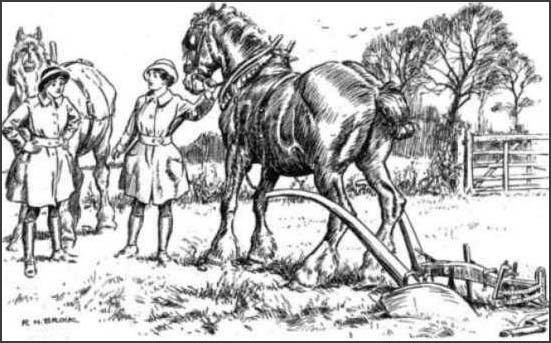
have a smaller horse. This one's too tall for the shafts.
Punch Magazine (April, 1915)
In June 1916, East Grinstead had a visit from Miss Bradley, Agricultural Organising Officer for the Board of Trade. She criticised local farmers for being prejudiced against women workers and warned that there would be food shortages if they did not employ more women.
Primary Sources
(1) The East Grinstead Observer (17th June, 1916)
At St. Michael's Parish Hall, Miss Bradley, agricultural organising officer for the Board of Trade, said that Sussex had been one of the best countries for recruiting for the army and navy, and she hoped that with the co-operation of the farmers it would occupy a similar position with regard to women working on the land and filling the places of the men who had gone to fight for their country. She knew that in Sussex there was a strong feeling against "foreigners", and therefore it was all the more necessary that women of Sussex should help in this movement, so that it would not be necessary to import female labour from other counties. She believed that the home grown food supply would be a quarter below the average that year. Women generally had responded splendidly to this call for service. The same could not hardly be said of the farmers, but she realised that there were difficulties and prejudices were being gradually overcome and that when farmers realised that women could do useful work they would accept their service more and more readily. Women were proving in many directions that they could perform useful work - in offices, in munition works, and she had even seen them assisting in tarring and repairing roads. On farms, too, they could be of great assistance they could do valuable work with weeding. Three pence an hour was the minimum wage for untrained helpers.