
Armenia
Armenia is one of the most ancient countries of the East, situated between the Black, the Caspian and the Mediterranean Sea. It was inhabited in the prehistoric times by the Armenians, an Indo-European originated race. The Armenians were always amongst the most progressive races of the East. Plenty of historic monuments that we can admire even today witness it's glorious past and culture.
The history of Armenia, starting from the enormous empire of Tigranis the Great until the loss of the Armenian's national independence, is written in pages of greatness or fall, victory or defeat, national regeneration or periods of pain and suffering.
After the fall of the Armenian kingdom in 1375 and afterwards with various Russian-Turkish, Russian-Persian and Turkish-Persian wars centuries later Armenia was divided between the Ottoman empire and Russia. So the largest part of the Armenian empire became part of the Ottoman empire.
However while the Armenians of the Russian part led a life rather tolerable, those of the Turkish Armenia met a horrible fate. The Sultan Abdul Hamit the 2nd organized the massacres of 1894-96. More than
300.000 Armenians were lost in these massacres. The Turkish government acted against the Armenians with sheer brutality. Their purpose was to accomplish a plan to eliminate the Armenians.
It was the spring of 1915 when the Turkish government moved on to perform a true genocide. On the 24th of April the Armenian intellectuals were arrested and taken to the center of the East. They were murdered on the way or once they arrived there. They young Armenians were recruited, but once disarmed they joined the amele tambourou (working orders, torture centres, used for building roads and railroad tracks), where they were slaughtered in groups of fifty to a hundred persons.
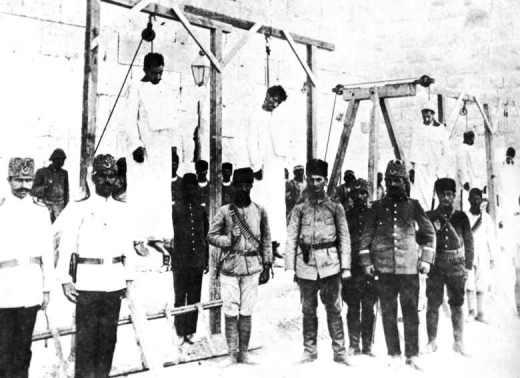
Therefore the Armenians lacking their leadership and support suffered torture and were finally eliminated by organized massacres. Wherever mass evacuation was difficult the Armenians were slaughtered on ground or burned alive and those who tried to escape met their doom in the end. One of the survivors described how the Turks locked him in a cave among 200 more Armenians including women and children and tried to burn them alive. He watched a woman that survived eating parts of the burned corpses and finally died from food poisoning. Furthermore if one of the prisoners survived after being shot he was asked to pay the price of the lost bullet.
Approximately 500,000 Armenians were killed in the last seven months of 1915, and the majority of the remainder were 'deported' to desert areas and there either starved or died of disease. It has been estimated that 1,500,000 people died as a result of this action.
In certain areas once the Armenians heard what had happened to their fellow countrymen they organized an armed resistance (Van, Sassun, Mous, Sabin-Karahisarh, Urfa, Mousa-Dag). They often fought with the most primitive weapons, but fell like heroes. Only a part of the population (Van, Mousa-Dag) managed to survive.
Alexandros Ketetzian
5th Lyceum of New Smyrna, Athens
Primary Sources
(1) Telegraphs sent by Talaat Passas, minister of interior affairs of Turkey, to the Turkish authorities of Chalepi, between September 1915 and December 1916.
September 9th 1915 : For the Armenian people the right to live and work in Turkish area has been abolished. The government, that takes any relative responsibility, ordered the total annihilation of the Armenians. In some regions those orders have already been applied. But, for some reason we don't know, there have been exceptions for certain people who remain in Chalepi instead of being sent to exile. With no discrimination such as being women, children or heavily injured they must be annihilated and you must not give the local populations reasons to protect them. Because of its ignorance and illiteracy, the Turkish people put the profit higher than the love for country, and cannot understand the policy followed by the government. You can proceed to immediate ways of execution. The ministry of war has ordered the military command not to interfere with this plan. Inform the officers in charge that they must not be afraid of the responsibilities and they must do their best to complete the plan. You'll inform me each week about your progress by sending encoded telegrams.
September 15th 1915 : As you already know, the government, with orders of the Komitat (Komitat Union and Progress) has decided the total annihilation of the Armenians living in Turkey. Everyone opposed to this decision and order will not continue serving the government.
Without exceptions for children, women and heavily wounded and without twinges of conscience we must put an end to their existence.
December 29th 1915 : We learn that foreign officers take pictures of the bodies of the people you know, that are found in the streets. I warn you that it's a matter of vital importance to bury the bodies and not leave them exposed in the streets any more.
January 15th 1916: We learn that there are orphanages that accept children of a certain nation. As the government considers their existence harmful, it would be against its will to feed, show mercy or take care of these children. You must be careful not to accept such children at the orphanages and also not to create special ones for them.
(2) In September 1919, just after the consummation of the proceedings of the Nationalistic Turkish Assembly in Sevastia (Siva), during of which Kemal appointed a temporary government, the American Lieutenant-General, James G. Harbord (1866-1947), was commissioned by the government of the United States to look into the possibility of the coalition mandate for Turkey as a whole being accepted by the USA. His report Military Mission in Armenia, was published in June 1920.
Since the day when Abdol Hamid ascend the throne, an official massacre of the Armenians was organised every year. In 1895 more than one hundred thousand Armenians died. In Van in 1908, in Adana and in other places of Kilikia in 1909 more than thirty thousand Armenians were killed. The last and the most horrible tragedy happened in 1915. Massacres and banishments were organised in 1915 with a very strict and specific system, which the solders put into practice from place to place. Firstly, they concentrated all the young men at the headquarters of each village, they led them to the fields and killed them. After some days, they banished the women, the elderly people and the children at that Talaat called "Agrarian Colonies" (the desert of Syria and Arabia, the plains of Efratis which were full of malaria etc.). The victims of this genocide are estimated by different sources between 500,000 and 1,000,000. Most sources state that the victims were approximately 800,000. The soldiers forced the Armenians to walk bare-footed, while the hot sun was shining, took from their clothes everything they had, forced them by using their swords to walk when they couldn't, while many people were dying due to hunger, typhus and dysentery.
(3) George Horton, The Blight of Asia (1926)
The details of the genocide of the Armenians (debauchery, brutalities, harassments etc.) render it the most horrible outrage against humanity and send down its perpetrators from the society and from the fraternity of the civilized nations, until the day when they prove their complete repentance and try to re-erect as much as possible.