PART
3 : THE GROWTH OF PHOTOGRAPHIC STUDIOS IN BRIGHTON ( 1854-1861
)
Photographic
Portrait Studios
In the ten years between November 1841 and November 1851, William
Constable, aided by a few assistants, was the only photographic
artist operating a portrait studio in Brighton.
When W.J.Taylor's Original Directory of Brighton was compiled
for the year 1854, ten photographic studios were listed :
Edward COLLIER 58, King's Road
Charles and John COMBES 62, St James's Street
William CONSTABLE 57, Marine Parade
Lewis DIXEY 21, King's Road
Robert FARMER 59 & 114 North Street
GREY & HALL 13, St James's Street
Jesse HARRIS 213, Western Road
HENNAH & KENT 108, King's Road
William LANE 213, Western Road
Madame Agnes RUGE 180 Western Road
All the photographers listed in Taylor's 1854 directory appeared
under the heading 'ARTISTS - Daguerreotype', yet we know Hennah
& Kent specialised in talbotypes, Lewis Dixey stocked
photographic apparatus for the calotype and collodion processes,
Farmer produced calotypes using a waxed paper process and Grey
& Hall employed "three distinct processes" - talbotype
and collodion as well as daguerreotype.
To the 10 studios listed by Taylor's Directory in 1854 we can
add the names of the artists Edward Fox junior and George
Ruff, both of whom were using a camera to make views of Brighton
in the early 1850s.
William Constable, who for 10 years had enjoyed a monopoly
in the production of photographic portraits, was now faced with
up to a dozen competitors. In the summer of 1854, Constable closed
his original studio at 57 Marine Parade and removed his photographic
business to the Old Custom House at 58 King's Road, where he joined
forces with the daguerreotype artist Edward Collier. The
Partnership of Constable & Collier continued for about
3 years. By 1858, William Constable was listed as the sole proprietor
of the Original Photographic Institution at 58 Kings' Road.
In June 1855, the Brighton and Sussex Photographic Society
was formed. The Photographic Society held monthly meetings and
was open to amateurs and professionals. An amateur, the Reverend
Watson acted as chairman, while the post of Honorary Secretary
was held by Constable's business partner and professional daguerreotype
artist Edward Collier. By September 1855, the Photographic Society
boasted 40 members.
James Henderson, a well known London daguerreotype artist,
arrived in Brighton in the summer of 1855, but by September he
had moved on to Cornwall, to establish a portrait studio in Launceston.
Henderson may have been deterred by the number of photographers
already active in Brighton. Folthorp's Brighton Directory, which
had been corrected to September 1856, adds three more photographic
studios not listed in Taylor's earlier directory. George Ruff,
who had been taking daguerreotype since around 1850, finally presented
himself as a professional photograher in 1856. Also listed in
1856 was the firm of Merrick & Co and James
Waggett, who had previously operated as a manufacturer
and tuner of pianofortes at 193 Western Road. Photographic artists
were listed in the section on Professions and Trades in Brighton
directories, but these listings do not provide a complete picture.
William G Smith is described as a photographic artist in
the 1856 street directory, but his name does not appear as a photographer
in the 'professions and trades' directory. William Lane,
an important name in the early history of photography in Brighton,
is not listed in Folthorp's Directory of 1856, yet newspaper advertisements
from this time show that William Lane was employing two other
operators, Mr Davis and Mr Warner, and in addition to his main
studio at 213 Western Road, Lane had a branch studio in Shoreham.
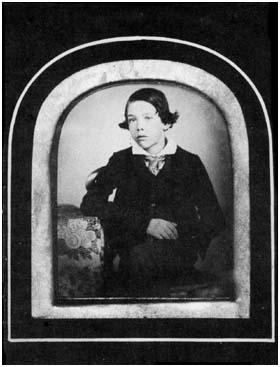
Portrait
of a Boy (c1855). "Verreotype" portrait taken at Lane's
Photographic Gallery, 213 Western Road. William Lane called his
collodion positives "verreotypes". In America they were
known as "ambrotypes".
The
Decline of the Daguerreotype
By the time Folthorp's Directory of 1856 was published, the daguerreotype
was on its way out. All the photographers listed in the Professional
and Trades section of Folthorp's Directory appear under the heading
Photographic and Talbotype Galleries. 'Farmer's Daguerreotype
Rooms' had become 'Farmer's Photographic Institution' and William
Lane had abandoned the daguerreotype for his Verreotype process.
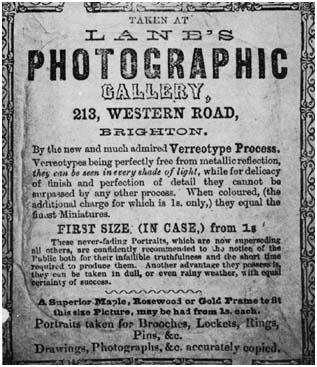
In an advertisement dated 3 January 1856, William Lane
promoted his new and improved Verreotype Process, by detailing
the advantages the new process had over the daguerreotype. Verreotypes,
Lane proclaimed, were perfectly free from metallic reflection
and could be seen "in every shade of light." Verreotype
portraits took only a short time to produce and could be "taken
in dull, or even rainy weather . . . when it would be quite impossible
to operate with the Daguerreotype method." Lane states confidently
in his advertisement that "these never fading Portraits .
. . are now superseding Daguerreotypes."
Stereoscopic
Photographs
In
1838, the English scientist and inventor Sir Charles Wheatstone
(1802-1875) had described the phenomena of binocular vision and
designed apparatus which fused two separate drawings into a single
three dimensional image. To describe this viewing instrument,
Wheatstone coined the term "Stereoscope" (from the Greek
words 'stereos' meaning "solid" and 'skopein' meaning
"to look at") With the advent of photography, Wheatstone's
reflecting stereoscope, which utilised mirrors, could be used
to view a pair of almost identical photographs and give the illusion
of depth.
Sir David Brewster (1781-1868), a Scottish physicist, designed
a stereoscope that employed two lenses which mimicked binocular
vision. Jules Duboscq (1817-1886) a Parisian optician constructed
an improved stereoscope based on Brewster's design, which merged
two photographs of the same subject to form a three-dimensional
picture.
At the Great Exhibition of 1851, Queen Victoria was particularly
impressed by Duboscq's stereoscope and the accompanying stereoscopic
photographs. Queen Victoria's interest in the stereoscope
signalled the start of a popular demand for stereoscope viewers
and stereoscopic photographs. In 1856, Brewster reported over
half a million of his stereoscopes had been sold.
A few stereoscopic talbotypes had been made for Wheatstone soon
after the introduction of photography in 1839. In the early 1850s,
however, most of the early stereoscopic photographs were daguerreotypes.
Duboscq had displayed a set of his own stereoscopic daguerreotypes
at the Great Exhibition of 1851. In 1853, Antoine Claudet
patented a folding stereoscope which could view stereo daguerreotypes.
A couple of years after the Great Exhibition of 1851 stereoscopic
photography arrived in Brighton. In 1853, Thomas Rowley,
Optician to the Sussex and Brighton Eye Infirmary, was advertising
his "superior selection of stereoscopes with Daguerreotype
plates, Collodion and Photographic Pictures" which could
be hired from his premises at 12 St James Street. In November
1853, Robert Farmer of the Daguerreotype Rooms, 59 North
Street was offering to provide a "stereoscopic Portrait,
with Stereoscope, 10s 6d, complete." Lewis Dixey,
Optician and Dealer in Photographic Apparatus, announced in 1854
that he could supply "Stereoscopes & Stereoscopic subjects
in Calotype, Daguerreotype & Collodion or Glass." George
Ruff of 45 Queens Road, Brighton specialised in stereoscopic
portraits in colour.
Stereo Cards
The reflective surface of a silvered copper plate was not ideal
for stereoscopic effects and the process did not lend itself to
the manufacture of large quantities of stereo pictures. With the
advent of the collodion glass negative and photographic prints
on albumenized paper in the mid 1850s, the mass production of
stereo cards became possible.
The London Stereoscopic Company, founded in 1854 by George
Swan Nottage, was a firm that specialized in the mass production
of stereoscopic photographs. Nottage's company responded to the
enormous demand for stereoscopes and stereo cards. By 1856, The
London Stereoscopic Company had sold over 500,000 stereoscopes
and had 10,000 titles in its trade list of stereo cards. Two years
later, in 1858, The London Stereoscopic Company claimed to have
100,000 stereo cards in stock [ George Swan Nottage (1823-1885)
had connections with Brighton. He owned property in the town and
was a regular visitor to Brighton. At the time of the 1861 Census
George Swan Nottage was residing at 15 Marine Parade, Brighton
and when he died in April 1885, he had just returned from an Easter
holiday at the seaside town.]
In 1857, The Brighton Stereoscopic Company based at 121
St James Street, near the Old Steine was selling stereoscopes
from half a crown (2s 6d/121/2 p) and stereoscopic views were
on sale at a shilling (1s/10 p) each.
The fashion for collecting and viewing stereoscopic photographs
reached its peak in the early 1860s. In 1862 alone, The London
Stereoscopic Company had sold a milliion stereoscopic views.
A wide variety of stereoscopic images could be purchased - views
of faraway places, (Japan, The Andes) scenes of everyday life,
anecdotal pictures, humorous tableaux scenes, 'still life' arrangements
and pictures of life in town and country.In 1858, Samuel Fry,
a photographic artist based at 79 Kings Road, Brighton,even produced
a "Stereograph of the Moon"
Some of the stereoscopic views sold in Brighton were of purely
local interest.
In March 1863, William Cornish junior of 109 Kings Road,
Brighton was advertising a set of six stereoscopic photographs
of a decorated railway shed. The 531 ft. long railway shed was
used to house 7,000 school children who had gathered for a meal
to celebrate the marriage of Edward, Prince of Wales and Princess
Alexandra of Denmark. Stereoscopic views of the decorated railway
shed could be purchased singly for one shilling (10 pence) or
the customer could buy a complete set for 6 shillings
William Mason junior, the son of W.H.Mason, printseller
and proprietor of the Repository of Arts in Brighton's Kings Road,
photographed scenes featuring local craftspeople, such as basketmakers,
and issued them as stereographic cards.
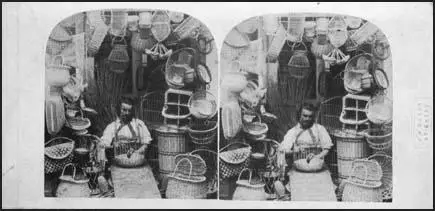
Stereocard
of a Brighton Basketmaker by W H Mason junior (c1862)
More typically, the Brighton artist Edward Fox, who specialised
in landscape photography, advertised "local views as stereoscopic
slides." Familiar landmarks in Brighton, such as the Royal
Chain Pier and the Royal Pavilion became popular subjects for
stereo cards.Some of Edward Fox junior's stereoscopic slides featured
particularly dramatic scenes. Fox's titles included " The
Chain Pier During a Gale " and " Chain Pier by Moonlight".
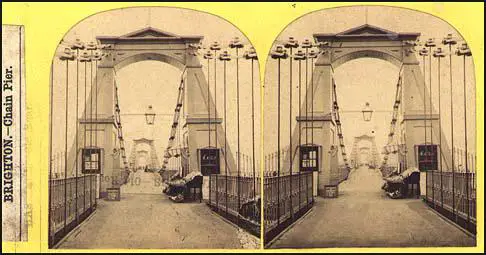
Stereocard of the Chain
Pier, Brighton c1870
Albumen in Photography
Albumen is a clear,organic material found in its purest form in
the white of an egg. Smooth, transparent and sticky, albumen was
seen as a suitable binder in photography. In 1847, the French
army officer and chemist Abel Niepce de Saint-Victor (1805-1870),coated
glass plates with egg-white mixed with potassium iodide and then
sensitized the dried plates in a bath of silver nitrate. The albumen-coated
glass plates made fine, photographic negatives, but exposure times
ranged from five to fifteen minutes and so were only really suitable
for photographing landscapes or buildings. Albumen glass negatives
were soon superseded by Fred Scott Archer's collodion glass negatives.
The Albumen Print
In 1850, L. D. Blanquart-Evrard (1802-1872), a French photographer,
introduced albumenized paper for photographic prints. Albumen
from the white of an egg was mixed with sodium chloride. Sheets
of thin paper were coated with the albumen mixture and then sensitized
with silver nitrate. A collodion glass negative could produce
finely detailed photographs on albumenized paper. By the 1860s,
most photographers were using collodion glass negatives and albumenized
paper in the production of photographic prints.
Blanquart-Evrard exhibited his albumen prints at the Great Exhibition
of 1851, announcing that his new process made it "possible
to produce two or three hundred prints from the same negative
the same day." The albumen print became an essential
component for the mass production of photographic images and played
an important part in meeting the public demand for stereographic
cards and carte de visite portraits in the 1860s.
Outdoor Photography
When Joseph Nicephore Niepce created the earliest surviving
photograph in 1826, the materials he used were so insensitive
it took 8 hours of sunlight for the image to be fixed on the pewter
plate he had prepared. Niepce's heliograph ('sun drawing') was
a view of his courtyard, taken from a top floor window. In 1839,
when photography was first introduced to the world, camera exposure
times ranged from five to fifteen minutes and so the only suitable
subjects were buildings, landscapes and arrangements of still
life. The majority of the pictures made by L.J.M.Daguerre himself
are of buildings and views in Paris.
Artists and amateurs may have been content to use the new invention
to produce a pleasing landscape or record an interesting building,
but astute businessmen knew that financial reward and commercial
success would lie in portrait photography. Every effort had been
made to reduce camera exposure times so that the daguerreotype
process could be used to make portraits. By the early 1840s technical
advances in photography meant that a sitter would only have to
hold a pose for a number of seconds rather than a number of minutes.
When Richard Beard, the patentee of the daguerreotype process
in England and Wales, sold licences authorising the setting up
of 'Photographic Institutions' in provincial towns, the purchasers
were mainly interested in using the invention to "take likenesses."
Outdoor Photography in Brighton Before
1854
The journalist who in November 1841 welcomed the opening of William
Constable's 'Photographic Institution' on Marine Parade in the
pages of the Brighton Guardian, recognised that the main purpose
of photography was to secure "a correct likeness without
the tedium of sitting for hours to an artist."
William Constable made his living from taking "likenesses",
charging his customers one guinea for "a portrait in a plain
morocco case", but it is known that he occasionally took
his camera on to the streets of Brighton. In the 1840s, Constable
took views of fashionable houses in Kemp Town, and two daguerreotypes
of houses in Lewes Crescent ended up in the photograph collection
of Richard Dykes Alexander.
In the early 1850s, local artists Edward Fox junior and
George Ruff senior were taking photographs of buildings
in Brighton. Ruff made a daguerreotype of St Nicholas Church around
1850 and Edward Fox, who declared in later advertisements that
he had "given his whole attention to Out-Door Photography
since 1851", produced pictures of shop fronts, churches and
other public buildings in Brighton and the surrounding area. In
1853, Robert Farmer, proprietor of the 'Daguerreotype Rooms'
in North Street, Brighton was exhibiting his calotype views of
the Royal Pavilion and the Railway Terminus and daguerreotype
views of Brighton's oldest church.
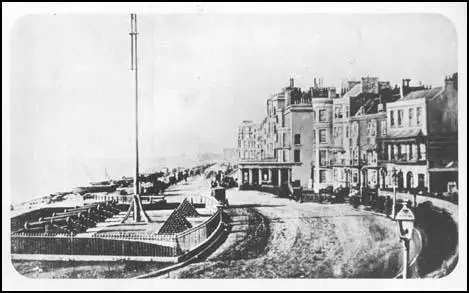
The
West Battery, Kings Road (c1850)
Outdoor Photography in Brighton 1855-1862
With the advent of the collodion process, more and more photographers
in Brighton were taking their cameras out on the street to record
life in the town.
Old buildings and structures scheduled for demolition were a favourite
subject for photographers, who were anxious to record them for
posterity. For example, a battery of eight guns was established
in Brighton's West Cliff in the 1790s to protect the town from
French attacks by sea. In 1857, it was decided to remove the West
Battery so that Brighton's main thoroughfare, the King's Road,
could be widened. Work commenced in January 1858 and from this
date a series of photographs recorded the progress of the dismantling
of the battery and the breaking up of the artillery ground.
In 1862, a row of old houses and shops that ran from 41 to 43
North Street, was scheduled for demolition. A set of oval shaped
photographs recorded the shop fronts and the rear ends of the
buildings that were to be demolished. It is not clear exactly
why these photographs were commissioned, but they allow us to
glimpse not only a vanished parade of Victorian shops, but also
a few bystanders, some of whom would not have been able to afford
the services of a photographer. Another gorup of workers whose
wages probably would not stretch to pay for a sitting at the professional
portrait studio, are captured on a photograph showing the entrance
ot the premises of Palmer and Company, Engineers and Iron Founders.
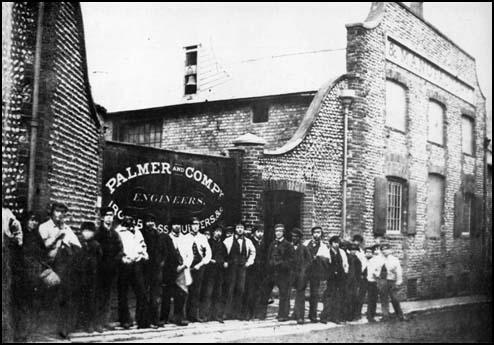
Workers
employed by Palmer & Co.Engineers stand
outside the company's premises in North Road. (c1865)